Samuel L. Jackson & Stephen in Django Unchained (part 2)

Stephen (Samuel L. Jackson)

Stephen (Samuel L. Jackson)

Stephen (Samuel L. Jackson) works in Quentin Tarrantino’s Django Unchained. Then again, he does not. What makes him run? Well, Stephen rests in a most controversial place in the annals of film / slave history, and we know him: Uncle Tom. Uncle Rastus. Ol’ Uncle Ben. Coon. Buffoon. Stepin’ Fetchit. House Negro. Any person of African descent perceived to be a sell-out to his race receives at least one of these labels. During a Meet the Press conference for MovieManiacsDE, Jackson calls Stephen “the most despicable Negro in cinematic history.”

In Django, Jackson plays ‘the House Negro’ with the rancor of a disturbed rattlesnake attended by the cunning of a fox! Indeed, he is the villain who ‘grins and lies’ for Master ‘Monsieur’ Calvin Candie (Leonardo DiCaprio) in the presence of visitors; yet, behind the Paul Dunbarian mask, Stephen governs the Candieland plantation with unmitigated terror. Jackson rightly recognizes Stephen as “the power behind the throne; the Dick Cheney of Candieland!” (BlacktreeTv). Under his piacular eye, those enslaved, such as Broomhilda von Shaft (Kerry Washington) and Cora (Dana Gourrier) live in a virtual domestic hell. The plantation regime itself compounds the situation.

Two cinematic figures coalesce to form “the power behind the throne”: the Tom and the House Negro. Film historian and critic Donald Bogle, author of Toms, Coons, Mulattoes, Mammies & Bucks, defines the Tom as the character who “ne’r turn against their white massas, and remain hearty, [and] submissive”. Malcolm X’s famous speech to the SNCC Workers in Selma, Alabama February 4, 1965, no doubt made firm the characteristics of the House Negro:

the House Negro always looked after his master. When the field Negro got too much out of line, he held them back in check. […] The House Negro could afford to do that because he lived […] up next to the master. […]. He ate the same food as massa [and] [h]e could talk just like his master; he had perfect diction. And he loved his master more than his master loved himself. If the master got sick he’d say “what’s the matter boss? We sick?” He never wanted his master’s property threatened, and he was more defensive of it than the master was. That was the House Negro!

In the Big House, Stephen, accordingly, achieves both power and contempt living up next to his master. More striking, the House Negro wrangles respect for his position from the Candie family planters and from the brutal plantation overseers as well. How does he do it? On one hand, he is ‘charmed’ because a cotton ball never touched his hands; somehow he bypassed labor in the cotton fields and kept on walking for 76 years. On another, slave historian Kenneth Stamp would argue that Monsieur Candie succeeds in one of the missions of plantation owners: “persuade bondsmen to take an interest in the master’s enterprise and to accept his standards of enterprise” (147) (my emphasis).

Boardroom Politics

Boardroom Politics

Stephen accepts the master’s charge; therefore, he works in terms of our common sense notions about him. There is more. Tarrantino goes further. The director showcases Stephen’s ‘boardroom politics’ in Candie’s drawing room. Man-to-man, casually sipping his liquor in leather seats in front of a roaring fire in the big-house, Stephen points out to Candie every facet of Django’s (Jamie Foxx) and Schultz’s (Christoph Waltz) plan. Then, he leans comfortably in his seat, and unveils the real intention of the two ‘interlopers’’ visit to Candieland. “Them motherfuckers ain’t here to buy no mandingos,” he says, “They’s here for that [Broomhilda].” The ‘board meeting’ is notable for several reasons. First, it makes known Stephen’s keen discernment of people, their body language, and nuances in dialogue. Second, it solidifies Stephen’s main concern, and that is the preservation of his position on the Candie plantation. Finally, the meeting exposes “the power behind the throne”; in this case it is the African/American mind at work that protects the fiscal health of the plantation and, more notable, maintains the ‘prop’ of whiteness.

Yes, Calvin Candie has power, but his is a power founded on inheritance and the installation of white privilege. Stephen, the master observer, apprehends Monsieur Candie has a license to kill his chattel at will. Regardless of his position, Stephen is chattel. Thus, his investment in the “master’s enterprise” not only ensures the economic wealth of Candieland; his investment, no doubt, has saved his life. In this context, Stephen works.

Stephen and Broomhilda (Kerry Washington)

Stephen and Broomhilda (Kerry Washington)

What does not work is Tarrantino’s dramatization of Stephen as a pathological enslaved everyman Uncle Tom. That Stephen practices evil without compromise coerces the viewer to wish for his punishment and/or demise, and Tarrantino obliges. Why? I hazard one reason: Tarrantino presupposes an acceptance of Stephen without question because of Uncle Tom’s loathsome history. He does not anticipate an interrogation of the character nor that we would care about him. Well, I care, and there are some things I want to know: What is Stephen’s backstory? His ‘charm’ betrays an observant if not precocious enslaved child who learned the strategies necessary to manipulate the emotions and psyche of the plantation owners. What fertilized the ground for Stephen’s ‘charm’ to take to such an extent that he could ‘enjoy’ and practice his rule without retribution? Stephen is shrewd. Someone taught him to read the signs. Someone gave him instructions in semiotics and trained him to interpret those signs in order to make him indispensable to massa himself! On another note, did he breed any children/chattel? If so, how did his power play out when they met the auction block or were whipped or raped? If not, what were his feelings as he witnessed families being torn apart by the auction block? What made his ‘evil’ take root in the interior? Finally. And. Finally. Did he ever love?

Arna Bontemps, author

Arna Bontemps, author

In his ‘research’ of slavery, Tarrantino could have taken a cue from Arna Bontemps, the Harlem Renaissance author of Black Thunder: Gabriel’s Revolt: 1800 (1936). Set in Virginia in the 1800’s, Bontemps features Ben ‘Old Ben’ Woodfolk, an enslaved ‘House Negro’ on the Sheppard plantation for nearly 50 years. Old Ben is meticulous in his daily rituals for Marse Sheppard. Every morning he winds the clock and carefully arranges the old planter’s washstand. He fluffs and feathers the old planter’s bed that it looks like a sitting hen; he unties his nightcap. (155). Both Marse Sheppard and Old Ben “were […] well satisfied with their present status” as master and enslaved. (94). Bontemps, however, designs a contemplative enslaved man. Old Ben’s thoughts on freedom and the auction block not only add dimensions to the character; in addition, his narration points up the why and how Old Ben has curried a kind of loyalty to the Sheppards. On the idea of freedom, Old Ben feels,

[…] it was hard to love freedom. Of course, it was the self-respecting thing to do. Everything that was equal to a groundhog wanted to be free. But it was so expensive, this love; it was such a disagreeable compulsion, such a bondage. (93).

As the aged enslaved servant questions Gabriel Prosser’s slave revolt and the “eleven hundred folks going to cross the streams going into Richmond”, memory springs up to remind Old Ben of his own losses at the hands of Marse Sheppard:

Licking [Marse Sheppard’s] spit because he done fed you, hunh? Fine nigger you is. Good old Marse Sheppard hunh? Is he ever said anything about setting you free? He wasn’t too good to sell them two gal young-uns down the river soon’s they’s old enough to know the sight of a cotton-chopping hoe. How’d he treat yo’ old woman befo’ she died? And you love it hunh? (94).

Black Thunder

These historical markers in Old Ben’s life that memory compels him to revisit shed some light on why he betrays Prosser’s slave revolt: The selling of his children and the mistreatment of his “old woman befo’ she died” have formed an interior callous; his age, too, inhibits any motivation to whole-heartedly embrace Prosser & Co.’s enterprise since “[h]e was past that reckless age” (135). Old Ben, therefore, turns to the only thing left to love: the ‘Good Boy’ status watchfully nurtured by him in the Big House on Marse Sheppard’s plantation.

Tarrantino refuses the device of narrative history for Stephen; one flashback or a piece of dialogue would have sufficed. His refusal is his prerogative but I still hold him accountable. The detection of the narrative absences in Django Unchained can forestall fixed beliefs about enslaved people or at least frustrate the inclination. A socio-cultural context as well as auto/biography is indispensable in the dramatization of that history. This call requires filmmakers to consult with those who have conducted research in the field in addition to checking out history books from the library. In other words, do your homework; if you fail to do so, American film/history suffers.

Watch for in-depth Film • Television • & More reviews & commentary.

In the meantime, Catch a film … Share the Popcorn … Feed Your Soul!

Before Midnight @ The Ross

Celine (Judith Delpy) and Jesse (Ethan Hawke)

Celine (Judith Delpy) and Jesse (Ethan Hawke)

Richard Linklater is back with his third installment Before Midnight, and if you saw his first two installments, Before Sunrise and Before Sunset, Before Midnight will not disappoint you.

Ethan Hawke as novelist Jesse is back; Julie Delpy as Celine is back, and this unmarried couple with a son and twin girls is still kicking about – this time in Greece — and they are talking – still — and talking and talking and talking about any and everything: love, fidelity, jealousy, work, travel, the future of humanity; children and chicken pox; death in the family; funerals, technology, and Skype—it’s the sex of the next century; and they’re talking in all sorts of places: in the kitchen, at the dinner table, in the car, in a hotel, in a chapel, in between kisses and breasts – yes, Celine and Jesse have a full very involved conversation in-between Celine’s breasts … sigh … you gotta have patience; yet the verbal athleticism of Hawke and Delpy will keep you engaged but … you gotta have patience.

Celine and Jesse in mid-conversation

Celine and Jesse in mid-conversation

There are no long shots of exotic Greece—just a focus on people and conversations. Linklater refrains from giving us visual relief from Celine and Jesse; they dominate every scene. So, polish up your listening skills and be ready for a film about conversations on the everyday ordinary. But you gotta have patience! Jesse and Celine will talk your ears off!

Before Midnight plays through July 4 at The Ross Media Arts Center in Lincoln.

The Ross logo

Listen to the Friday Live! at The Mill review @ 41:53

http://www.netnebraska.org/interactive-multimedia/none/friday-live-nebraska-chamber-institute-complete-program

Watch for in-depth Film • Television • & More reviews & commentary.
In the meantime, Catch a film … Share the Popcorn … Feed Your Soul!


Frances Ha @ The Ross

Frances Ha (Greta Gerwig)

Frances Ha (Greta Gerwig)

Limbo. Yes, Limbo.
That space that’s neither here nor there.
The place you fall into after college or some other graduation into another phase of life.
You’re an adult but not quite there yet.
The career hasn’t happened but you’re working on it;
You hold on to the wisps of sing-song youth.
Then, that dull realization.
No one is coming to kiss us out of our sleep.
Ah, Life. We have to wake up!

Frances and Sophie (Mickey Sumner)

Frances and Sophie (Mickey Sumner)

Such is the world filmed in black and white by Noah Baumbach in his warm-hearted film Frances Ha, starring Greta Gerwig. In the frenzied space of New York, Gerwig perfoms Frances, an aspiring dancer, with an over-the-top but awkward innocence. Frances is clumsy, messy, and graceless. She’s irritating yet tolerable; however, the abandonment for adulthood by her best friend, Sophie, played by Mickey Sumner, throws Frances into crisis mode. This break-up produces the true gem of Frances Ha. Baumbach asks and answers the question that HBO’s Sex and the City dared never to approach: what happens when our best friends outgrow us? With treks through Brooklyn, China Town, Sacramento, Paris, France, and an upstate college, Baumbach, with grace and care, drops Frances into her own backyard, and she is smiling!

Frances Ha plays through June 20 at The Ross Media Arts Center in Lincoln.

The Ross logo

Listen to the review on Friday Live! The Mill @ 36:52
http://www.netnebraska.org/interactive-multimedia/none/friday-live-nebraska-chamber-institute-complete-program

Watch for in-depth Film • Television • & More reviews & commentary.
In the meantime, Catch a film … Share the Popcorn … Feed Your Soul!

The Angels’ Share @ The Ross

The Gang in 'Angels Share'

The Gang in ‘Angels Share’

Let’s first deal with definitions: Two percent of the whiskey that evaporates while it distills is called ‘the angels’ share’. You could liken the angels’ share to an offering to the deities for allowing the creation of the spirited drink.

Tasting The Golden Blend

Set in Glasgow, The Angels’ Share is British film director Ken Loach’s film about second chances and the people who give them. Paul Brannigan stars as Robbie, a “wee thug who doesn’t know any better”, who forms an unlikely partnership with his community service pals. In comes Harry, (played lightheartedly by John Henshaw), the delightful supervisor, who, against the rules, takes the motley crew on a field trip on his day off to his “sacred place”, a whiskey distillery. He makes them solemnly swear not to “fight, drink, or rob” while there. A docent informs them of the “subtle reaction between the wood and the spirit” as well as the angels’ share. What follows is an adventure all in the name of whiskey, its taste, its smell, and the artistry in the culture of making a rare and valuable golden blend. The Angels’ Share is a charm, and will leave you feeling, well, … charmed!

The Angels’ Share plays through May 30 at the Ross Media Arts Center in Lincoln.

The Ross logo

Hear the Friday Live! At the Mill review at 38:59
http://www.netnebraska.org/interactive-multimedia/none/friday-live-lincoln-choral-artists-0

Watch for in-depth Film • Television • & More reviews & commentary.

In the meantime, Catch a film … Share the Popcorn … Feed Your Soul!

Room 237 @ The Ross

Room 237

I don’t get it: Robert Ascher directs a very provocative documentary entitled Room 237. The documentary is a welcomed exercise in close-readings of a film as unseen narrators uncover myriad meanings in Stanley Kubrick’s psychological horror film, The Shining. There are various plausible theories: The Shining is about the slaughter of Native Americans (remember the red & silver ‘Calumet’ baking soda cans in the hotel’s pantry?); The Shining is all about the Holocaust. Well, the number 42 proves it. Remember the year when the Nazi’s initiated the final solution? 1942? Comments by the narrators are in-depth and quite perceptive, and each one carefully investigates the signs and symbols cast about the film, including the number 237. In all, however, Ascher’s project holds tightly to one theory: The Shining is about history and man’s proclivity to create atrocities only to conveniently forget them.

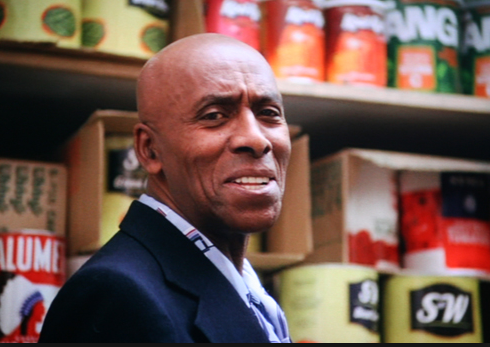
Dick Halloran (Scatman Crothers)

Dick Halloran (Scatman Crothers)

Yet, Room 237 does exactly that: forget, and this oversight is what I don’t get. The glaring omission is an analysis of Dick Halloran, the hotel’s chef in The Shining played by African American entertainer, Scatman Crothers. Why? I have my own ideas but time only permits me to point out that Dick Halloran is the character who is killed by that crazy Jack Torrance when he delivers an ax to his chest. Dick Halloran leaves the wife and son a means to escape from the ‘sins of the father’ after hell has frozen over! No more screaming “Here’s Johnny!” That ending, in and of itself, deserved critique.

Room 237 plays through May 23 at the Ross Media Arts Center in Lincoln.

The Ross logo

Hear the Friday Live! At the Mill review at the following website @ 36:50:
http://www.netnebraska.org/interactive-multimedia/none/friday-live-lincoln-choral-artists-0

Watch for in-depth Film • Television • & More reviews & commentary.

In the meantime, Catch a film … Share the Popcorn … Feed Your Soul!

The Company You Keep @ The Ross

Jim Grant (Robert Redford)

Jim Grant (Robert Redford)

My My My. Robert Redford on the silver screen! The Sundance Kid, Hubbell, Johnny Hooker, Roy Hobbs, and … oh … well … I digress.

Redford tackles a most frenzied yet nostalgic moment in the history of anti-war activism in the United States in his newest film, The Company You Keep. Based on Neil Gordon’s novel, The Company You Keep tells the story of former members of The Weather Underground, a radical leftist anti-war group of white, middle-class students that sometimes used violence as a means for revolutionary change in the 1960s.

Sharon Solarz (Susan Sarandon) gives up

Sharon Solarz (Susan Sarandon) gives up

Several have eluded the FBI for 30 years until Sharon Solarz (played by Susan Sarandon) decides to turn herself in, thus initiating the manhunt for the others. Redford plays with warm-hearted though measured zeal, Jim Grant, a.k.a Nick Sloan, a Weather Underground comrade. Via a series of insightful vignettes, Redford showcases reflections from these rebels-turned-aged adults who are law-abiding citizens, even running good honest marijuana off the coast of California. Each story is relatable; who among us has not turned to the past to reflect? We just hope peace is there when we step back into the present. The cast of old school stars as his former comrades-in-arms, Julie Christie, Sam Elliott, Susan Sarandon, Nick Nolte, and Richard Jenkins, has a sepia effect. As veterans of an entertainment industry salivating over youth, it is simply groovy when the camera closes in on the wrinkles, pot-marks, and crow’s feet, each actor wears with the dignity of an American eagle.

Mimi (Julie Christie) and Jim share a tender moment

Mimi (Julie Christie) and Jim share a tender moment

Redford resists the snap, crackle, and pop; instead, he massages Lem Dobbs’s script into a compact adventure encased in suspense and intrigue. Shia Labeouf, however, is the disappointment. He’s miscast! And his performance as Ben Shepard, the investigative reporter, is a filmic intrusion, at which you want to throw a rotten tomato, and … well …

The Ross logo

The Company You Keep plays through May 16 at The Ross in Lincoln.

Adam Leon’s independent film Gimme the Loot plays through May 9
Dror Moreh’s The Gatekeepers opens May 10 and plays through May 16

Friday Live! audio version @ 28:27 http://bit.ly/1132vFB

Trashed @ The Ross

a line of refuse in the ocean

a line of refuse in the ocean

Land. Sea. Air.

Landfills. Incineration. Sea-dumping.

Oscar winner Jeremy Irons narrates with personal depth the visceral truth of waste, the inefficient methods used to dispose of it, the harmful pollutants, and the health risks that attend those exposed to it. It is a global phenomenon, and British documentary filmmaker Candida Brady does not flinch in her ecological examination of the casual gesture of throwing things away and its repercussions on the environment. The documentary is called Trashed, and even though Brady refrains from an all-out pedantic tirade, she, nevertheless makes clear her intent to educate the public about the devastating effects of trash, be they in Vietnam, Indonesia, Lebanon, France, San Francisco, or North Pacific Gyre.

Jeremy Irons sits amid a pile of trash

Jeremy Irons sits amid a pile of trash

Trashed is loaded with facts, and each factoid is backed-up by experts in the field. The presentation of the harrowing effects of the toxic chemical compounds called dioxin evokes guilt but calls for active responsibility. Through the eyes of Jeremy Irons, Brady takes us inside a Vietnamese hospital, for instance, and the camera scans rows of deformed fetuses in formaldehyde jars, and takes a hard look at living children deformed from Agent Orange sprayed during the war. Trashed makes it point without any visual relief from the waste with which we have strewn across the earth.

The Ross logo

Watch for in-depth Film • Television • & More reviews & commentary.

In the meantime, Catch a film … Share the Popcorn … Feed Your Soul!

White Space ~ A Review

Maya Washington

Maya Washington

Sirens
The clink of penny change on a sidewalk
Applause
The cuddle of coffee cups on a waitress’s tray
Sounds …

Conversation
Altercation
Love notes whispered
Laughter
Sounds we take for granted

Sounds. Spoken Words. Each conducts the melodies of everyday life, but speaking the word is celebrated as the most powerful of social exchanges. In her beautifully imagined film short White Space, however, film director Maya Washington (White Space Poetry Project) gingerly dramatizes silence as the ‘other’ manner of communication in a space that privileges the spoken word: the stage. Washington shrewdly casts subtle clues that lead to an ‘opening night’ so affectionate that the heart stirs to rejoice; it has one other outlet for infinite expression.

The film opens on a street as the echoes of the night accompany a determined young man in a hoodie walking to somewhere. Matt Koskenmaki’s impassioned score forges the film’s serious almost haunting tone with bluesy bass chords dancing with percussion and the brassy buzz of the trumpet. The process of addition by subtraction produced the music’s blend Koskenmaki remembers:

I first saw the film … there was no music; it was very rare for someone to give me a short film like that … most temp in the music. [White Space] was a blank canvas, so what I did was write a lot of music–more music than was needed. When Maya came to hear what I had done, we went for low tones to [evoke] intimacy.

On the way, Koskenmaki’s musical pulses emphasize the intimacy between the young man and the writer of the uplifting phone texts he reads: “I know you can do this; Love you”; and then a plea: “Please don’t mess this up”; “Get here!!!” Cinematographer James Adolphus builds audience curiosity as he alternates between the dots of street sounds and the warm jollity of a small theater called The Alabaster located in the backroom of a laundromat. Slam Poets serve as an entertaining preface to what is to come with their respective rat-a-tat rhythms to socio-cultural critique,

You’re right! I’m overreacting to white folks who liberate they coon selves through the culture of black people replacing stereotypes in hip-hop music with caricatures from Dixie!
–Ant Black

and smooth stylistic musings on the power of inner beauty,

No reflections on glass, shadows or shapes, pictures on the wall, or shimmering lakes can show you what you are: A truly undefinable beauty. – Tanya Alexander

Enter The Poet, the young man in the hoodie, played by deaf performance poet Ryan Lane (Dummy Hoy: A Deaf Hero; Switched at Birth). Koskenmaki stops the music, and the scene transitions from a lively night at the coffee house to an awkward but reverent silence bathed in white light.

Sayna (Washington) and The Poet (Lane)

Sayna (Washington) and The Poet (Lane)

Lane excels in this precarious moment as he laudably conveys The Poet’s self-conscious hesitancy on-stage along with his virtuosity in communication. “When we suck the sound out of the coffee house, the absence of sound becomes more intense,” reveals Washington. For approximately two minutes and nineteen seconds, The Poet transcribes the issues from his heart through his hands. It is silent. “I can’t tell you who I am without telling you where I’ve been,” he signs with such spirit and emotion that patrons nod with understanding. Washington plays Shayna, his girlfriend, whose texts are the love notes of encouragement that drive the poet past his fear.

The Poet (Ryan Lane)

The Poet (Ryan Lane)

It is without question. Lane performs his own frustration as a deaf actor navigating within a business that more often than not recognizes those who hear. The film’s chief virtue, then, is courage—the courage of the deaf artist to perform live and the courage of the audience to hear him. These diegetic collaborations are the fruits of Washington’s own collaborative labors:

Ryan and I collaborated with a hearing poet Herschel McPherson; a poet/interpreter Mona Jean Cedar; and, a deaf poet/actress Zendrea Mitchell (the woman at the train station) to create the poem in the final scene. We had to shape a poem written in spoken English into [American Sign Language] then back into English subtitles. Cinematographer James Adolphus and I thought a lot about how we wanted the audience to experience the ASL visually. [The work of] Brett Bachman (Editor) and Matt Koskenmaki (Composer) […]made the emotion of the scene tangible.

Washington reaches deeply to shift our perspective on live performance and its conventional venue. In the process, she attends to those issues that tug her own heart. “I want hearing people to […] feel a little anxious and uncomfortable, even if they aren’t sure why,” she explains, “a lot of deaf artists walk in both the hearing and deaf world. I feel like it’s time for hearing artists to do the same.” That ‘walk’, no doubt, is fragile, and as the luminous alabaster stone requires care, so does the journey taken together by the hearing and the deaf. White Space makes that happen, and in all of eight minutes and fifty seconds.

White Space is scheduled to screen at the Langston Hughes African American Film Festival in Seattle, Washington, Monday April 15 (www.langstonarts.org); the Indie Boots Film Festival in Chicago (www.indieboots.org) and the Toronto International Deaf Film and Arts Festival in May 2013 (www.tidfaf.ca).

‘Like’ White Space Poetry Project on Facebook
follow @Whitespacepp on Twitter

Watch for in-depth Film • Television • & More reviews & commentary.

In the meantime, Catch a film … Share the Popcorn … Feed Your Soul!

Trance @ The Ross

Dr. Elizabeth Lamb (Rosario Dawson)

Dr. Elizabeth Lamb (Rosario Dawson)

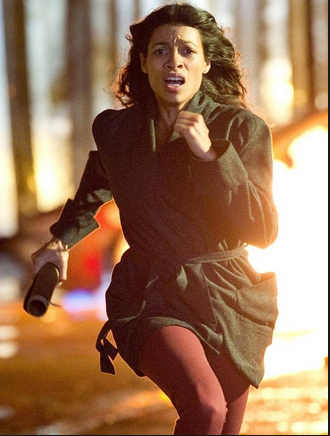
Rosario Dawson shines in Danny Boyle’s new thriller Trance. She plays Elizabeth Lamb, the mysterious hypnotherapist you will want to help you access any hidden memory you have willed to forget. Charged with hypnotizing Simon (James McAvoy) an art thief who cannot remember where he placed his stolen goods, Elizabeth Lamb weaves her magic on the con artists who hire her to tap Simon’s brain. The audience does not escape her charms as we are exposed to the mental and emotional calisthenics that would fell a marine. Lamb carefully guards her secret to produce her own desired results. In the meantime, with expert proficiency, Lamb entrances us to believe whatever she wants us to believe.

Dr. Lamb runs for her life

Dr. Lamb runs for her life

Is she on the take? Did she plan the entire heist of Goya’s painting, “Witches in the Air”? Whatever is the truth, Dawson’s portrayal invites us to ‘bear with her’ on the non-stop twists and double-backs that leave us dizzy with anticipation for the next turn. The ending is a shocker that places front and center what a woman will do to gain her freedom.

The Ross logo

Trance plays through May 2 at The Ross Media Arts Center in Lincoln, NE

Watch for in-depth Film • Television • & More reviews & commentary.

In the meantime, Catch a film … Share the Popcorn … Feed Your Soul!

Stoker @ The Ross

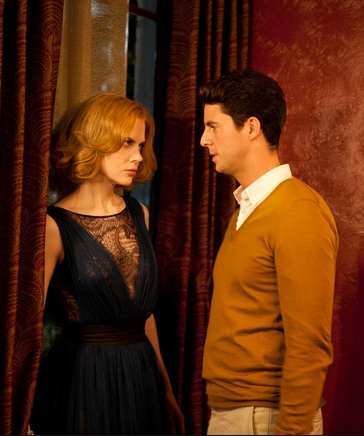
Evelyn Stoker (Nicole Kidman) and Uncle Charlie (Matthew Goode)

Evelyn Stoker (Nicole Kidman) and Uncle Charlie (Matthew Goode)

Pity on Evelyn Stoker, played with controlled anguish and a sigh by Nicole Kidman. Her daughter India Stoker, played by Mia Wasikowska, grew up a daddy’s girl and is intrigued by her uncle Charlie. These facts torment Evelyn. “Weren’t you supposed to love me?” she wails to her daughter at one point.

Uncle Charlie, played with sinister boyish charm by Matthew Goode, is Evelyn’s foil from whom she tries to wrestle her daughter’s devotion.

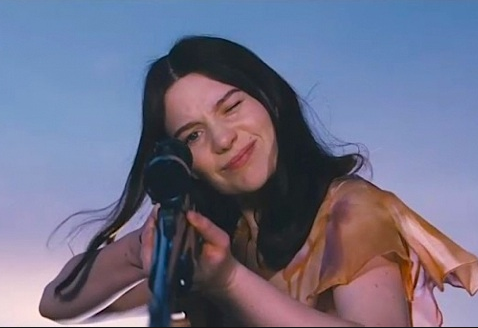
India Stoker comes of age under Uncle Charlie's guidance.

India Stoker comes of age under Uncle Charlie’s guidance.

Stoker, Chan-Wook Park’s U.S. directorial debut, is a cautionary tale. Evelyn should have conducted a background check on Uncle Charlie who suddenly comes a’callin after her husband’s death—a death that swings the door wide open for Uncle Charlie to swoop into the home and to work his … uhm … magic.

Beware of Uncle Charlie. Anyone who protects India simply is … banished!

Chan-Wook Park delivers a strikingly uncanny film; yet, don’t be surprised if you fight the urge to yell at the screen, “get on with the story, will you?”

The Ross logo

Stoker plays through April 11 at the Ross Media Arts Center in Lincoln.

Like Someone in Love, the story of an unlikely attraction directed by Abbas Kiarostami and starring Rin Takanaski and Tadaski Okuno is showing at the Ross through April 4.

Abridged Audio version from Friday Live! at the Mill @ 13:53 http://tinyurl.com/dyum2ul