Koch @ The Ross

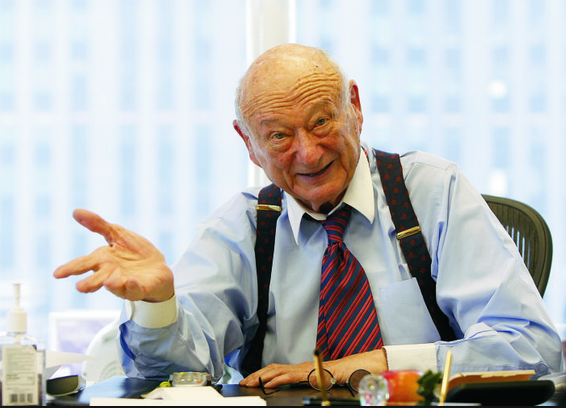
Ed Koch

Ed Koch

“Whenever I would fly home … there was the city of New York … And I thought … this belongs to me. Thank you God.” The incomparable Edward Irving “Ed” Koch loved New York City with abandon. The former Mayor is the subject of Neil Barsky’s documentary simply named Koch. We know his signature taglines, “How’m I doin’?” or “None of your fucking business” to questions on his sexuality or “No! The people threw me out, now they must be punished” on his defeat to Mayor David Dinkins in 1990. Along the way, Barsky sprinkles in ‘Koch’ a study in the yearning to be liked, recognized, and appreciated by a fickle public.

Koch's beloved city, New York

Koch’s beloved city, New York

The pugnacious city of New York is the backdrop, and Barsky plays the story well as he moves through the crags and crevices in the life of this controversial political figure. Bella Abzug, Mario Cuomo and Bess Meyerson, his companion in the 1970s, among others, make appearances, along with high-profile events, most notable, the AIDS crisis in the 1980s and the 1989 murder of Yusef Hawkins in Brooklyn. Barsky decorously illustrates Koch’s formal engagement then marriage to politics forming a sturdy couple that endured for better or worse; yet, one cannot help but to want to strangle Koch’s better half to get to Koch, the man. Koch’s history in politics, however, is overwhelming—even tedious–and the Mayor’s fidelity to his lifelong partner leave Barsky no choice but to cram it all in.

Koch plays through March 21 at the Ross Media Arts Center in Lincoln.

The Ross logo

Audio version from Friday Live! at the Mill @ 39:47 http://tinyurl.com/c88fdlq

The Kitchen @ The Ross

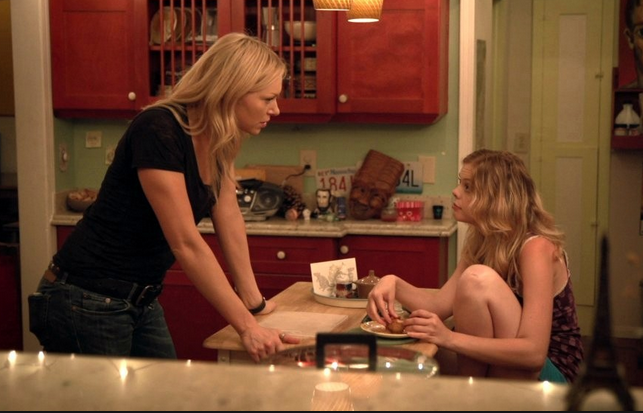
Sisters Jennifer (Laura Prepon) and Penny (Dreama Walker) having a conversation about life.

Sisters Jennifer (Laura Prepon) and Penny (Dreama Walker) having a conversation about life.

Jennifer Parker is distressed, and it is no wonder. Paul, her ex-boyfriend, cheated on her with two of the women who are celebrating her 30th birthday; one of the women gives her earrings as a present out of guilt; her name is misspelled on her birthday cake; she’s unemployed and wants to open an art gallery featuring an artist whom no one appreciates; she feels unattractive; and, among other things, her sister, Penny, may have an abortion.

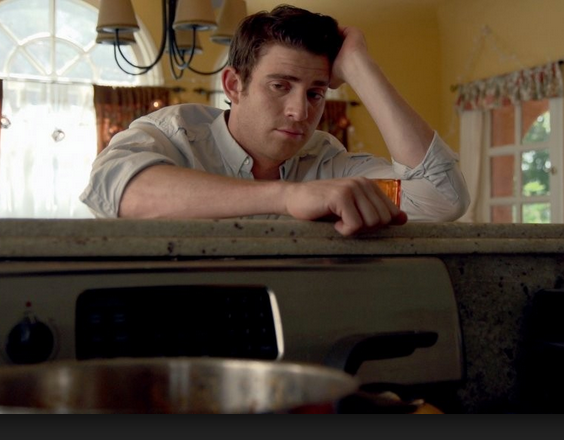
Paul (Bryan Greenberg)

Paul (Bryan Greenberg)

All of these ingredients stir the pot in Ishai Setton’s ensemble feature The Kitchen.

Laura Prepon is endearing as Jennifer, and she sensitively walks the line between pessimism and hopeful expectancy in the awareness of this 30th turning point in her life. Dreama Walker, plays her adorable but mildly sarcastic sister Penny, who, even in her sarcasm, betrays a sliver of embarrassment and vulnerability as a single pregnant young woman. Jennifer’s and Penny’s conversations generate provocative insights into what it means to be at a crossroads not knowing what the future holds.

The audience will thank Jim Beggarly profusely for the script since the film’s score by American Indie rock band, Fun. will gnaw you to the bone!

The Kitchen plays through March 21 at the Ross Media Arts Center in Lincoln.

The Ross logo

Abridged Audio version from Friday Live! at the Mill @ 41:52 http://tinyurl.com/c88fdlq

Amour @ The Ross

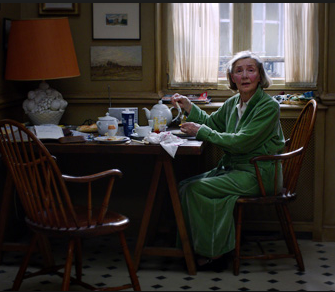
Anne (Emmanuelle Riva) and Georges (Jean-Louis Trintingnant)

Anne (Emmanuelle Riva) and Georges (Jean-Louis Trintingnant)

Austrian director Michael Haneke’s Oscar winning film Amour, is cold and raw, and music director’s Cecile Lenoir’s meager score intensified Haneke cinematic chill. Amour is a film that is so spare that we are strained to feel every nuance and every exasperating waking moment. Anne (Emmanuelle Riva) and Georges (Jean-Louis Trintignant) are old and married and in love.

Theirs is a simple compassionate love story that becomes compromised by Anne’s paralysis which eventually renders her immobile. Both Anne and Georges are retired music teachers who have cultivated a love for the arts. A joyous evening at a piano recital, a blissful ride home on the bus, and easy talk upon their arrival thereafter suggest that this couple has managed well their marriage. It is effortless. It is fluid. It is lovely; but this is just about all of the ‘romance’ the audience gets. The morning after ushers in the beginning of the end, and no matter how much Georges tries to order his and Anne’s life, control of it creeps out.

Georges and Anne are visited rarely by neighbors and occasionally by their daughter Eva (played by Isabelle Huppert). A former student of Anne’s, played with restraint by French classical pianist Alexandre Tharaud, pays the couple a visit but the conversation is quite uniform—even flat. It is obvious Alexandre is nervous to see the paralyzed hand of his former piano teacher, and Anne does nothing to put him at ease.

Anne

Anne

Cinematographer Darius Khondji emphasizes the haunting echo of Anne’s illness that seizes the ambiance of the apartment. Every inch of space in their home has surrendered to the inevitable: Anne will not get well. Yet, Jean-Louis Trintignant’s performance demands our trust that he will deliver Anne back to some semblance of the wife he has known; and we believe in him; and so does Anne.

The Ross logoAmour plays through March 7 at The Ross Media Arts Center in Lincoln.

Abridged audio version @ 33:41 http://www.netnebraska.org/interactive-multimedia/none/friday-live-arts-soul

The Women Make Movies at 40 Festival, runs through March 14.

This weekend’s MetHD Live at Wagner’s Parsifal.

Gregory Crewdson: Brief Encounters opens at The Ross on March 8.

Brooklyn Castle @ The Ross

Master Chess Player Rochelle Ballantyn

Master Chess Player Rochelle Ballantyn

“Playing to win” is the mantra of “The Yankees of Chess”, the chess champions from P.I.S. 318, a junior high school in Brooklyn, New York known for its championships. Yes, in Brooklyn Castle, the geek and the nerd are the athletes in the crowd. In her inspirational documentary, Katie Dellamaggiore charts the day-to-day activities of these students, who work tirelessly to juggle the twists and turns of life. The one constant is the mastery of chess with its intellectual challenges and intricate strategies. The game itself is the anchor, and chess opens the door to a wealth of opportunities and, even more significant, the game paves the way for the building of determination, confidence, and intellectual stamina within the students. The nurture of relationships between parents and teachers is very apparent.

practicing the game

practicing the game

Brooklyn Castle is intoxicating for a number of reasons. Witnessing student eagerness to learn the game and the all-out investment of time, belief in, and engagement with the students by the teachers are amazing. Seeing the chess game taken apart in its pieces by a teacher brings the audience into the classroom. These particular scenes no doubt will inspire you to at least learn more about the game. Each competitor’s commitment to the game of chess above is impressive above all as is the unquestioned faith in the ability to win!

Brooklyn Castle plays through February 21 at the Ross Media Arts Center.

Abridged audio version @ 48:00 http://tinyurl.com/d3gd4es on Friday Live at the Mill!

A Royal Affair @ The Ross

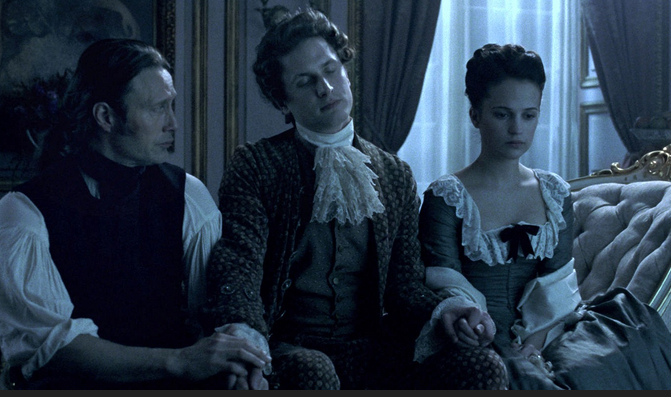
Dr. Struensee (Mads Mikkelsen), the Danish King Christian (Mikkel Boe Følsgaard), and Queen Caroline (Alicia Vikander)

Dr. Struensee (Mads Mikkelsen), the Danish King Christian (Mikkel Boe Følsgaard), and Queen Caroline (Alicia Vikander)

Courtly madness and arrant passion combine for A Royal Affair, Nikolaj Arcel’s lavish historical drama set in 18th century Denmark. It is based on the true story of a love triangle between Dr. Johann Friedrich Struensee (Mads Mikkelsen), the German physician to the mentally ill Danish King Christian IV (Mikkel Boe Følsgaard), and his love affair with the well-versed English Princess turned Queen, Caroline Matilde (Alicia Vikander). It is the Age of Enlightenment, and Dr. Struensee and Queen Matilde contemplate the ideal of personal freedom. Arcel’s production unleashes the usual suspects once the affair is discovered: the lovers’ carelessness, intrigue, and, of course, the set-up. The device Arcel cleverly uses to set-up the attraction between Dr. and his patient, the King, and for the love affair to materialize is the seduction of the written word. Dr. Struensee earns the Royal Physician’s post by trading quotations from Shakespeare with the King like an experienced chess player. When the Dr. examines the Queen for a possible illness in his office, she spies his library and borrows a book on the Enlightenment. Later, the Dr. sends the Queen a gift of Rousseau and Voltaire for her private reading. These literary gestures endear physician, King and Queen to each other as each word conjures up intense friendship and fascination; loyalty and trust.

The Dr. and Queen in a stolen moment

The Dr. and Queen in a stolen moment

Worth noting in A Royal Affair are the sumptuous eye-pleasing costumes overrun with rich brocades, lace and silk. Nikolaj Arcel has produced an astonishing smartly executed period piece drawn with a very modern feel.

A Royal Affair plays through February 21 at The Ross Media Arts Center in Lincoln.

This weekend’s Met HD Live opera is Rigoletto February 16 and Sunday, February 17.
The Coffee and Conversation film on Sunday is Soul Food Junkies.

Abridged audio version @ 49:36 http://tinyurl.com/d3gd4es on Friday Live at the Mill!

Barbara @ The Ross

Barbara (Nina Hoss)

Barbara (Nina Hoss)

“What’s Barbara’s secret?” is the question we ask throughout Christian Petzold’s Barbara, a sharply pensive but remarkable film. Petzold holds out the answer like a rabbit to a racing greyhound even until the end. It is 1980. Cold War Germany. The superbly talented Nina Hoss, plays Barbara, an East German Doctor from Berlin who smartly negotiates between the evil of the Stasi and the life-affirming healing arts she practices in a rural hospital. There she meets the sympathetic Andre (Ronald Zehrfeld), a doctor who cultivates her love for the arts (and eventually for him) but also watches Nina along with the East German secret police.

Barbara is a good story; thin on the dialogue, but thick with potent character interactions which betray every passion and emotion; every fear and desperation. All combine to step away from the common place notions of East Germany: cold and repressive; grey and ominous. Instead, Petzold films flourishing countrysides and forests; colorful apartments, and people, like Barbara and Andre, who invest in those who have come to them for care.

Andre (Ronald Zehrfeld) and Barbara

Andre (Ronald Zehrfeld) and Barbara

Yes, Barbara is a good story but Petzold takes far too long to unveil the mystery, and we almost cast aside our investment in the characters. Nina Hoss and Ronald Zehrfeld inhabit their characters to such an extent, however, that we are brought back into the fold. Barbara’s end will strike a hopeful chord with everyone, and that is: No matter the trial, in the end, we are blessed to return home and to be welcomed back.

Barbara plays through February 7 at The Ross Media Arts Center in Lincoln.

The Ross logo

Movie Talk at The Ross on Sunday, February 3, at 2:15 pm with Marco Abel and H. Peter Reinkordt after the 12:30 pm screening of Barbara.

The Oscar Nominated Shorts 2013 and The House I Live In both open at The Ross on February 8th

Abridged Audio Version @ 40:06 http://tinyurl.com/bhwqhu6

‘Hansel & Gretel: Witch Hunters’ ~ the skinny

Muriel, the Bad Witch after Gretel's pure heart (Famke Janssen)

Muriel, the Bad Witch after Gretel’s pure heart (Famke Janssen)

There is only one word for Hansel & Gretel: Witches! They are fierce! They are fearless! They ride the cadillac of brooms and are masters of hand-to-hand combat. They are as beautiful as they are ugly, but each witch is a force to be reckoned with! The fight scenes between them and the Hunters alone are worth a run to theater.

Tommy Wirkola directs a pretty good fantasy as he imagines a back story on the classic fairy tale. In addition to his exploration of the socio-cultural dynamic of the rumor mill once it is unleashed within a small town, Wirkola, too, imagines why mom (Kathrin Kuhnel)  & pop (Thomas Scharff) decided to take their children to the forest and what became of Hansel (Jeremy Renner) and Gretel (Gemma Aterton) after they save themselves and burn the witch (Monique Ganderton) in her own oven in the gingerbread/candy house. All grown up now, H&G have mined a celebrated reputation as witch hunters. Wirkola might have worked in a collage of flashbacks to give some idea as to how they made it from 10 or 12 year-old children to very skillful adult hunters.

Quite revealing, however, is that the witch hunt is the hunt for mature and/or single powerful women who have magic; they live by themselves on the outskirts of town deep deep into the verdant forest apparently minding their own business! What makes them prey is their magic (if not, H&G’s revenge for their childhood trauma), and, even more dangerous, they appear human but will turn into something-or-other and hiss and grunt at you.  When the evil Muriel kidnaps children, every witch is in danger–you will pinpoint the historical tie-ins.

See the movie and enjoy. There’s even an adorable Troll named Edward (Derek Mears) lumbering about the forest.

Witch 4

In the meantime, watch for film television & more to come!
“I insist,” says the witch!

Rust and Bone @ The Ross

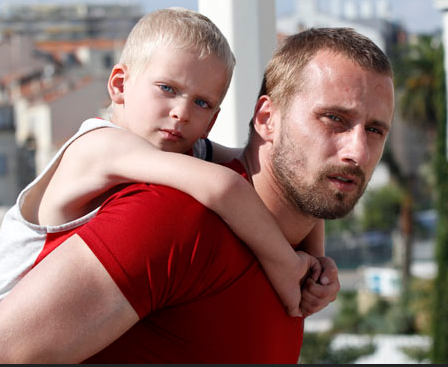
Stephanie (Marion Colliard) and Ali (Matthias Schoenaerts)

Stephanie (Marion Colliard) and Ali (Matthias Schoenaerts)

French director Jacques Audiard entices us to remember that life will compel us to fight for what we desire when we least expect it. His newest film Rust and Bone features two likeable but brooding characters forced to wade through life-altering catastrophes. The film centers on Stephanie, a trainer of Orcas played by Oscar winning actress Marion Cotillard, and Ali, played by Belgian actor Matthias Schoenaerts—two strangers who ‘bump’ into each other on an ordinary night at a disco, in an ordinary town called Antibes on the Cote A’Zur, France. Ali, a bouncer and a former prize-fighter, rescues Stephanie from a boisterous male patron, escorts her home, and leaves his phone number in the presence of her live-in boyfriend.

The film then moves between the disparate worlds of Stephanie and Ali, leaving the audience to ponder the connection between this handsome puissant boxer and very confident athletic trainer of Orcas.

Ali and Sam (Armand Verdure)

Ali and Sam (Armand Verdure)

Audiard enfolds Rust and Bone into day-to-day ordinariness, but releases a virtuoso of trials brought on by life’s obnoxious interruptions to bring Stephanie and Ali together. In one instance, Stephanie is an accomplished trainer of Orcas but none of her skills protects her when the killer whale ‘breaks character’ from a trained creature for human amusement at the marineland while she conducts a show. While she is recovering from her injuries, on impulse, Stephanie calls Ali. In another instance, Ali deeply loves his five-year-old son Sam, but Ali’s carelessness almost costs Sam his life. As Ali awaits word of Sam’s recuperation in the hospital, Ali asks Stephanie not to leave him.

The beauty of this film rests in exactly how these characters will wrestle for what is meaningful to them and if, in the end, they will find respite from and reward for enduring each trial.

Rust and Bone plays at The Ross through February 7.

Abridged Audio Version @ 42:12 http://tinyurl.com/bhwqhu6

‘Django Unchained’ – A Review (in parts)

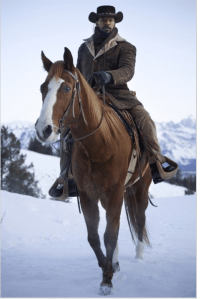
Django (Jamie Foxx) rides with confidence

Django (Jamie Foxx) rides with confidence

I could whip Quentin Tarrantino’s %#! up and down Main Street for making a multi-faceted piece of work that a 700-800 word review cannot contain. Readers, this film review is long … well … so is the film for that matter. To accommodate the cornucopia of ‘stuff and things’ this eclectic director packs into all 165 minutes on celluloid, ‘Django Unchained’ has to be written in parts. Here is Part One. Be forewarned: you will need some tea and an afternoon to read through it. Bear with me.

‘Django Unchained’ is a rich filmic kaleidoscope paying homage to film and literary genres, art forms, political currents, and moments in the history of the United States. To begin, the director reflects on the Spaghetti Western of the 1960s (The Good, The Bad, and the Ugly, and Django, 1966; Find a Place to Die, 1968); and the Blaxploitation western (Buck and the Preacher, 1972 and Take a Hard Ride, 1976) and plantation drama of the 1970s (The Legend of Nigger Charley, 1972 and Drum, 1976). Second, Django’s blue velvet suit (with knee pants), and fancy buckled shoes, imagined by costume designer, Sharon Davis, bring to mind The Blue Boy, painted in 1770 by English portrait and landscape painter Thomas Gainsborough, and Richard Birch’s illustrations of Little Lord Fauntleroy’s costume in the children’s book of the same name (1885-1886). Third, ‘Mandingo Fighting’ decidedly refers to not only the film Mandingo (1975); the brutal sports event is a strong allusion to “Battle Royal”, a chapter in Invisible Man written in 1952 by African American novelist Ralph Ellison. Finally, but not complete, the ex-slave narratives of the 18th and 19th centuries; the abolitionist movement; the North Star (Frederick Douglass’s newspaper of the same name and the icon of the Underground Railroad); even Opera (Richard Wagner’s Gotterdamerung of 1876) cohere to build a charming love story infused with German folklore (Siegfried and Brunhilde) within the framework of slavery in the United States.

‘Django Unchained’ nestles easily within the genre of romance, and this element forms the rare pearl within the film. The context that frames the love story warrants a brief commentary before I continue. As Nathanial Hawthorne examines Puritan culture in The Scarlet Letter (1850), and Arna Bontemps assesses the slave revolt in Black Thunder (1936), Tarantino reaches into the past to consider present-day socio-cultural moeurs.

Scene from Sankofa by Haile Gerima (1993)

Scene from Sankofa by Haile Gerima (1993)

Despite the nimiety of posts and articles swirling about Tarantino; Spike Lee’s rant; and questions over whether or not white people can tell our stories; when all is said, read, and done … slavery happened. Period. Yet, the historical distance compromises our national memory as attempts are made to chain this ragged but alert specter to the past. We have heard, if not entertained, every excuse and plea to disremember its legacy: I didn’t do it; I was not there! Why can’t we just forget? What is the big deal? Every so often, however, that specter will agitate for a production of a story to activate yet another discussion in its honor. We can depend on our popular culture to oblige its request. John Korty’s televised production The Autobiography of Miss Jane Pittman (1974) and Marvin J. Chomsky’s dramatization of Alex Haley’s Roots (1977) compelled my generation to remember as we feasted on the fruits of integration; and for those who were allowed to see them in the movie theater, the plantation dramas of the 1970s as well. As a young woman in search of a purpose in the 1990s, Haile Gerima’s poignant Sankofa (1993) encouraged me to continue learning my own history.

The popularity of ‘Django Unchained’ attended by a whirlpool of discourses, then, not only is important; it is necessary. The election of President Barack Hussein Obama ushered into the White House three generations of African Americans: the First Lady’s mother, Mrs. Marian Lois Shields Robinson; the President and the First Lady; and Natasha “Sasha” and Malia Ann. Some people are tempted to declare that race no longer matters and, now, well we can … exhale. Tarantino’s ‘Django Unchained’ antagonizes this temptation. Thanks to his reputation, the present-day generation has taken notice. ‘Django Unchained’ transports this generation into its own sankofa, Akan meaning “to go back and get it”. They are “to get” that the plantation regime released capillaries infected with a psychology that took a firm hold on the American psyche, culture, and society for some 300 plus years. Kerry Washington even concedes in an interview with The Daily Beast,

It’s so unthinkable that my ancestors endured all the torture and pain. I saw things in the script and thought this never happened. But then I talked to Quentin and he showed us the history books that illustrated the masks and other items used to inflict torture and violence on the slaves. It really blew my mind and made me appreciate even more what my ancestors made it through.

That Tarantino informs Washington of her ancestral history solicits critique, but let us reserve that for another review and move on to the love and the passion.

The consideration of the Django (Jamie Foxx) and Broomhilda (Kerry Washington) love story brings to relief an interview ABC’s Good Morning America host Robin Roberts conducted with the Obamas while on the presidential campaign trail in 2008. In that interview, Roberts turned to the GOP backlash over a remark Mrs. Obama made on being an American. Mrs. Obama leaned in to answer but Mr. Obama interjected on her behalf with the following statement:

If [the GOP] think that they’re going to try to make Michelle an issue in this campaign. […] I find unacceptable, the notion that you start attacking my wife or my family. […] lay off my wife. She loves this country. For them to try to distort or to play snippets of her remarks in ways that are unflattering to her is, I think, just low class. I think that most of the American people would think that as well.

In essence, Mr. Obama drew the proverbial line in the sand and dared anyone to disparage Mrs. Obama in any way, form, or fashion. Any move to the contrary, and he was coming back to collect some dues.
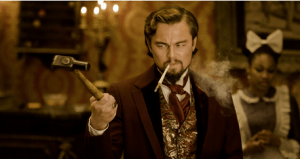
Calvin Candie (Leonardo DiCaprio), the ruthless plantation owner

Calvin Candie (Leonardo DiCaprio), the ruthless plantation owner

Django (the ‘D’ is silent) is a slave-turned-bounty hunter in desperate search to find his wife, Broomhilda. She was sold down the river to the notorious Calvin Candie (Leonardo DiCaprio), owner of Candieland plantation in Mississippi. He locates Broomhilda with the help of Dr. King Schultz (Christoph Waltz). Django stands ready to defend her at all costs but he has to court discipline before he (re)acts. Django’s poise corresponds not only with Mr. Obama’s warning to the GOP; also, his composure calls up moments in African American history when Black men supported families in an oppressive culture that generally denied the recognition of the institution for the enslaved. The film opens in 1858 somewhere in Texas–eight years after a more restrictive Fugitive Slave Law of 1850 took effect. James Buchanan is president of the United States. The year before, the Supreme Court ruled in Dred Scott v. Sanford that an enslaved Scott could not obtain his freedom because he was not a U. S. citizen. Until that final decision, Scott petitioned not only for his freedom, he sued for the freedom of his wife and children. In another but similar vein, research shows that African Americans searched for family members before and after the Emancipation Proclamation. Help Me Find My People: The African American Search for Family Lost in Slavery (U of North Carolina P, 2012) by Heather Andreas Williams is worth the read. Django’s pursuit of Broomhilda after obtaining freedom undeniably complements these histories and contemporary politics.

Thomas Jefferson by Mather Brownn (1786)

Thomas Jefferson by Mather Brownn (1786)

In Django’s quest, Tarantino crafts an African American Hero who slays the ‘dragon’, gets the girl, and lives to tell his own story with witnesses to spread his legend. Foxx plays Django with the confidence of a panther stalking its prey. Even though enslaved, he is not a slave in mind. He speaks with a purpose, walks with the familiar cowboy swagger, and commands a horse to ride and to dance. More significant, his unwavering focus on the rescue of Broomhilda dispels several stereotypes and myths. First, he is not the subservient “yes’m massa” enslaved who, if freed, would not know what to do with his freedom. Second, Django overturns the myth of the enslaved and his inability to manage emotions President Thomas Jefferson so brazenly posits in his ‘Notes on Slavery’ written in 1785. Jefferson believes,

[t]hey are at least as brave, and more adventuresome. But this may perhaps proceed from want of forethought, which prevents their seeing a danger till it be present. When present they do not go through it with more coolness or steadiness than the whites. They are more ardent after their female: but love seems with them to be more an eager desire, than a tender delicate mixture of sentiment and sensation.

Broomhilda (Kerry Washington)

Broomhilda (Kerry Washington)

Eager desire? Want of forethought? Who cannot feel the sheer urgency of Django’s yearning to liberate the black woman from torture and to facilitate the restoration of her honor? Who cannot appreciate Django’s steady nerve in his methodical assessment of every situation? Django not only will die for Broomhilda; also, for his woman, he will live! More significant, who cannot apprehend Broomhilda from Django’s point of view? In his eyes, she is his true love rising up through the mist in the lake. Through the lens of the plantocracy, however, Broomhilda is but property to be raped and branded. Is it not striking to see Django plead to stand in for Broomhilda as the overseer strips her back in preparation for the lash from the whip? That Broomhilda harbors her own belief in Django–not in massa or anyone else—is even more meaningful.

‘Django Unchained’ is a well-made film. We must remember, however, Tarrantino has not done anything new, but viewing ‘Django Unchained’ is crucial for today’s generation. Others came before him and offered up their own powerful stories of captivity and oppression. Let me suggest again Sankofa, a fervid narrative of bondage by Haile Gerima, and add Quilombo (1986) by Carlos Diegues (both on DVD). Each deserves your interest and dollars just as much as Tarrantino. On the whole, these are stories we all have to summon the courage to witness.

(A special ‘Thank You’ to Sandra Denise Clifton and historian Herbert Jefferson for their valuable insights and stimulating discussions on this film; to Dr. Robert Haller for editor’s notes.)

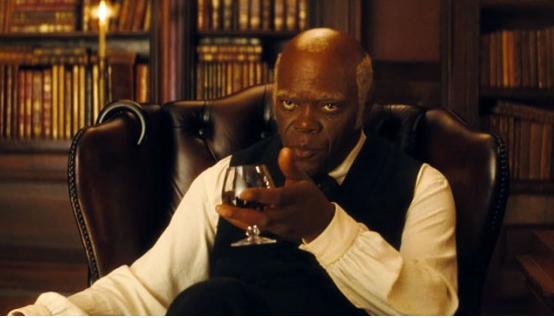
Stephens (Samuel L. Jackson)

Stephens (Samuel L. Jackson)

Watch for in-depth Film • Television • & More reviews & commentary.

Next Part Two: ‘Samuel L. Jackson & Stephens’

In the meantime, Catch a film … Share the Popcorn … Feed Your Soul!
‘Barbasol’ – A Review

Barbasol Poster 1

Trickster that it is, ‘coming-of-age’ will not be ignored. I remember when the trickster tapped my dad, and he answered by teaching me how to drive a 1972 Volkswagen Beetle. “Equal distribution … Equal distribution,” he chanted as I, in herky-jerky frustration, tried to shift the gears and push in the clutch. To this day, I only will drive a manual transmission in honor of my dad and, even more notable, his courage.

In his heart-rending film short ‘Barbasol’, independent film director Ralph K. Scott uses the tradition of shaving to pay homage to his own memory of his father. Scott knows all too well that it takes a brave soul to ‘talk about’ a parent in a public venue and, more onerous, to choose what to portray of him onscreen. He says,

I wasn’t sure how deep I should go into my own life experience with telling the story about my father. He would yell at the drop of a hat, and that existence kept me and my sisters on edge. I did not, however, want to portray him as an ogre; there were gentle times.

Ralph K. Scott, Director

Ralph K. Scott, Director

Scott finds his mettle in ‘Barbasol’, a wonderfully passionate film that is mindful of its autobiographical element. “My father never really treated my mother with any harshness,” he remembers, “it was like she had a grip on his anger.” This is the memory he weaves into the story. For 19 minutes, Scott explores two African American parents, Harper (Stephen Hill) and Grace (Ebbe Bassey) Collins, who are cast into a domestic crisis when ‘coming-of-age’ calls on them. This ritual usually is a child’s transition into young adulthood, and the parent and/or guardian guides the initiate into the next phase. Scott, however, is to be applauded for a savvy filmic twist: the director focuses on Harper and takes him on a journey from father to daddy – the latter signifying the compassionate teacher. Harper has difficulty talking to his son, Grant (Elijah Williams) yet rests comfortably in the verbal synergy enjoyed by him and Grace. More laudable, Scott appoints Grace, (played with sharp patience by Bassey) to guide Harper and Grant during this crucial turning point. Their quiet scuffle points up the respect husband and wife have for their turn at coming-of-age. Barbasol, the soft moisturizing beard buster of shaving creams, serves as the tool to move things along.

Practically every scene in ‘Barbasol’ is a pressure cooker of change, and writer/producer Kiara Jones meticulously charts the strains running through the Collins household. She remarks,

there is no ticking time bomb in this film but I wanted to parlay the sense of urgency for this family. It is now or never, and I have them ask the unspoken question: Are we going to repeat the same things or are we going to work on this urgent call?

A game of contrasts comes to relief as each character wrestles to find answers. Harper barks orders to his son (“Boy! Get Up! Didn’t you hear me??”), but listens affectionately to Grace’s subtle warm plea (“Harper, honey, [Grant] just wants you to like him. It’s not too late.”); the latter sealed with a kiss. Harper’s father is Ed ‘Super Chief’ Collins (played with unfettered zeal by William Jay Marshall). Once a decorated police chief of 25 years, Super Chief now is a snarly curmudgeon throwing insults to Harper and Grant from a wheelchair (“what the hell you standing there with your thumb up your ass for!?”). Father and son scramble to please the Super Chief.

Grace (Ebbe Bassey) and Harper (Stephen Hill) enjoy an intimate momentGrace (Ebbe Bassey) and Harper (Stephen Hill) enjoy an intimate moment.

Grace (Ebbe Bassey) and Harper (Stephen Hill) enjoy an intimate moment.

Cinematographer Eric Branco masterfully envisions the tenuity of marital protocol Grace and Harper must handle at this juncture in their marriage. His establishing shot captures the delicacy of early morning awakenings. “Because some of the dialogue is so sharp,” Branco says, “there is a danger that the film would become too violent, so Ralph and I specifically went for a very smooth and a very pleasant morning scene.” In one instance, Grant enters his parent’s bedroom with caution, and when ‘Grace’ invites him in, Branco treats audiences to a relaxed moment between mother and son. In another, Branco’s medium close-up sharply defines Grant’s alarming vulnerability in the enclosed space of the bathroom. With straight razor in hand, Harper begins his awkward attempt to teach his son how to shave. Grant winces. Harper growls, “Don’t be a little baby! Real men shave!” It is scary but “we know that Grant is safe with Harper because of his gentle interaction with Grace,” Jones reveals, “so we continue with Harper on his journey.”

Harper (Stephen Hill) and Grant (Elijah Williams) and Barbasol

Harper (Stephen Hill) and Grant (Elijah Williams) and shaving creme Barbasol

In conjunction with rights-of-passage, Scott’s direction is a flawless dramatization of health issues most families grapple with as they witness their elders pass from vibrant self-sufficient caretakers to patients suffering with dementia. “When my father started coming down with dementia,” he recalls, “it was scary and tragic. He kept himself together; when I would visit him, his fingernails would be disgustingly long and dirty. I would clip and file his nails. He would sit there just as calm as if I was the prettiest beautician. It is those moments that drew me to write in the story about Harper’s and Grant’s visit to shave the Super Chief.” Ever aware of his father’s legacy, Scott ministers a heartwarming and uplifting denouement to Super Chief’s verbal madness.

Stephen Hill is dexterous in his smooth transition from gruff father to the huggable-lovable teddy bear with Grace to the humble son during his visits with the Super Chief; and, Elijah Williams carries Grant’s vulnerability with honest reserve.

‘Barbasol’ made its New York debut at the Urbanworld Film Festival in September 2012. For more information visit http://www.socialcinemaproject.com

Watch for in-depth Film • Television • & More reviews & commentary.

In the meantime, Catch a film … Share the Popcorn … Feed Your Soul!