Samuel L. Jackson & Stephen in Django Unchained (part 2)

Stephen (Samuel L. Jackson)

Stephen (Samuel L. Jackson)

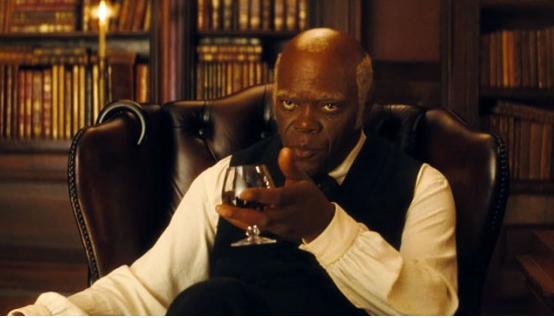
Stephen (Samuel L. Jackson) works in Quentin Tarrantino’s Django Unchained. Then again, he does not. What makes him run? Well, Stephen rests in a most controversial place in the annals of film / slave history, and we know him: Uncle Tom. Uncle Rastus. Ol’ Uncle Ben. Coon. Buffoon. Stepin’ Fetchit. House Negro. Any person of African descent perceived to be a sell-out to his race receives at least one of these labels. During a Meet the Press conference for MovieManiacsDE, Jackson calls Stephen “the most despicable Negro in cinematic history.”

In Django, Jackson plays ‘the House Negro’ with the rancor of a disturbed rattlesnake attended by the cunning of a fox! Indeed, he is the villain who ‘grins and lies’ for Master ‘Monsieur’ Calvin Candie (Leonardo DiCaprio) in the presence of visitors; yet, behind the Paul Dunbarian mask, Stephen governs the Candieland plantation with unmitigated terror. Jackson rightly recognizes Stephen as “the power behind the throne; the Dick Cheney of Candieland!” (BlacktreeTv). Under his piacular eye, those enslaved, such as Broomhilda von Shaft (Kerry Washington) and Cora (Dana Gourrier) live in a virtual domestic hell. The plantation regime itself compounds the situation.

Two cinematic figures coalesce to form “the power behind the throne”: the Tom and the House Negro. Film historian and critic Donald Bogle, author of Toms, Coons, Mulattoes, Mammies & Bucks, defines the Tom as the character who “ne’r turn against their white massas, and remain hearty, [and] submissive”. Malcolm X’s famous speech to the SNCC Workers in Selma, Alabama February 4, 1965, no doubt made firm the characteristics of the House Negro:

the House Negro always looked after his master. When the field Negro got too much out of line, he held them back in check. […] The House Negro could afford to do that because he lived […] up next to the master. […]. He ate the same food as massa [and] [h]e could talk just like his master; he had perfect diction. And he loved his master more than his master loved himself. If the master got sick he’d say “what’s the matter boss? We sick?” He never wanted his master’s property threatened, and he was more defensive of it than the master was. That was the House Negro!

In the Big House, Stephen, accordingly, achieves both power and contempt living up next to his master. More striking, the House Negro wrangles respect for his position from the Candie family planters and from the brutal plantation overseers as well. How does he do it? On one hand, he is ‘charmed’ because a cotton ball never touched his hands; somehow he bypassed labor in the cotton fields and kept on walking for 76 years. On another, slave historian Kenneth Stamp would argue that Monsieur Candie succeeds in one of the missions of plantation owners: “persuade bondsmen to take an interest in the master’s enterprise and to accept his standards of enterprise” (147) (my emphasis).

Boardroom Politics

Boardroom Politics

Stephen accepts the master’s charge; therefore, he works in terms of our common sense notions about him. There is more. Tarrantino goes further. The director showcases Stephen’s ‘boardroom politics’ in Candie’s drawing room. Man-to-man, casually sipping his liquor in leather seats in front of a roaring fire in the big-house, Stephen points out to Candie every facet of Django’s (Jamie Foxx) and Schultz’s (Christoph Waltz) plan. Then, he leans comfortably in his seat, and unveils the real intention of the two ‘interlopers’’ visit to Candieland. “Them motherfuckers ain’t here to buy no mandingos,” he says, “They’s here for that [Broomhilda].” The ‘board meeting’ is notable for several reasons. First, it makes known Stephen’s keen discernment of people, their body language, and nuances in dialogue. Second, it solidifies Stephen’s main concern, and that is the preservation of his position on the Candie plantation. Finally, the meeting exposes “the power behind the throne”; in this case it is the African/American mind at work that protects the fiscal health of the plantation and, more notable, maintains the ‘prop’ of whiteness.

Yes, Calvin Candie has power, but his is a power founded on inheritance and the installation of white privilege. Stephen, the master observer, apprehends Monsieur Candie has a license to kill his chattel at will. Regardless of his position, Stephen is chattel. Thus, his investment in the “master’s enterprise” not only ensures the economic wealth of Candieland; his investment, no doubt, has saved his life. In this context, Stephen works.

Stephen and Broomhilda (Kerry Washington)

Stephen and Broomhilda (Kerry Washington)

What does not work is Tarrantino’s dramatization of Stephen as a pathological enslaved everyman Uncle Tom. That Stephen practices evil without compromise coerces the viewer to wish for his punishment and/or demise, and Tarrantino obliges. Why? I hazard one reason: Tarrantino presupposes an acceptance of Stephen without question because of Uncle Tom’s loathsome history. He does not anticipate an interrogation of the character nor that we would care about him. Well, I care, and there are some things I want to know: What is Stephen’s backstory? His ‘charm’ betrays an observant if not precocious enslaved child who learned the strategies necessary to manipulate the emotions and psyche of the plantation owners. What fertilized the ground for Stephen’s ‘charm’ to take to such an extent that he could ‘enjoy’ and practice his rule without retribution? Stephen is shrewd. Someone taught him to read the signs. Someone gave him instructions in semiotics and trained him to interpret those signs in order to make him indispensable to massa himself! On another note, did he breed any children/chattel? If so, how did his power play out when they met the auction block or were whipped or raped? If not, what were his feelings as he witnessed families being torn apart by the auction block? What made his ‘evil’ take root in the interior? Finally. And. Finally. Did he ever love?

Arna Bontemps, author

Arna Bontemps, author

In his ‘research’ of slavery, Tarrantino could have taken a cue from Arna Bontemps, the Harlem Renaissance author of Black Thunder: Gabriel’s Revolt: 1800 (1936). Set in Virginia in the 1800’s, Bontemps features Ben ‘Old Ben’ Woodfolk, an enslaved ‘House Negro’ on the Sheppard plantation for nearly 50 years. Old Ben is meticulous in his daily rituals for Marse Sheppard. Every morning he winds the clock and carefully arranges the old planter’s washstand. He fluffs and feathers the old planter’s bed that it looks like a sitting hen; he unties his nightcap. (155). Both Marse Sheppard and Old Ben “were […] well satisfied with their present status” as master and enslaved. (94). Bontemps, however, designs a contemplative enslaved man. Old Ben’s thoughts on freedom and the auction block not only add dimensions to the character; in addition, his narration points up the why and how Old Ben has curried a kind of loyalty to the Sheppards. On the idea of freedom, Old Ben feels,

[…] it was hard to love freedom. Of course, it was the self-respecting thing to do. Everything that was equal to a groundhog wanted to be free. But it was so expensive, this love; it was such a disagreeable compulsion, such a bondage. (93).

As the aged enslaved servant questions Gabriel Prosser’s slave revolt and the “eleven hundred folks going to cross the streams going into Richmond”, memory springs up to remind Old Ben of his own losses at the hands of Marse Sheppard:

Licking [Marse Sheppard’s] spit because he done fed you, hunh? Fine nigger you is. Good old Marse Sheppard hunh? Is he ever said anything about setting you free? He wasn’t too good to sell them two gal young-uns down the river soon’s they’s old enough to know the sight of a cotton-chopping hoe. How’d he treat yo’ old woman befo’ she died? And you love it hunh? (94).

Black Thunder

These historical markers in Old Ben’s life that memory compels him to revisit shed some light on why he betrays Prosser’s slave revolt: The selling of his children and the mistreatment of his “old woman befo’ she died” have formed an interior callous; his age, too, inhibits any motivation to whole-heartedly embrace Prosser & Co.’s enterprise since “[h]e was past that reckless age” (135). Old Ben, therefore, turns to the only thing left to love: the ‘Good Boy’ status watchfully nurtured by him in the Big House on Marse Sheppard’s plantation.

Tarrantino refuses the device of narrative history for Stephen; one flashback or a piece of dialogue would have sufficed. His refusal is his prerogative but I still hold him accountable. The detection of the narrative absences in Django Unchained can forestall fixed beliefs about enslaved people or at least frustrate the inclination. A socio-cultural context as well as auto/biography is indispensable in the dramatization of that history. This call requires filmmakers to consult with those who have conducted research in the field in addition to checking out history books from the library. In other words, do your homework; if you fail to do so, American film/history suffers.

Watch for in-depth Film • Television • & More reviews & commentary.

In the meantime, Catch a film … Share the Popcorn … Feed Your Soul!

White Space ~ A Review

Maya Washington

Maya Washington

Sirens
The clink of penny change on a sidewalk
Applause
The cuddle of coffee cups on a waitress’s tray
Sounds …

Conversation
Altercation
Love notes whispered
Laughter
Sounds we take for granted

Sounds. Spoken Words. Each conducts the melodies of everyday life, but speaking the word is celebrated as the most powerful of social exchanges. In her beautifully imagined film short White Space, however, film director Maya Washington (White Space Poetry Project) gingerly dramatizes silence as the ‘other’ manner of communication in a space that privileges the spoken word: the stage. Washington shrewdly casts subtle clues that lead to an ‘opening night’ so affectionate that the heart stirs to rejoice; it has one other outlet for infinite expression.

The film opens on a street as the echoes of the night accompany a determined young man in a hoodie walking to somewhere. Matt Koskenmaki’s impassioned score forges the film’s serious almost haunting tone with bluesy bass chords dancing with percussion and the brassy buzz of the trumpet. The process of addition by subtraction produced the music’s blend Koskenmaki remembers:

I first saw the film … there was no music; it was very rare for someone to give me a short film like that … most temp in the music. [White Space] was a blank canvas, so what I did was write a lot of music–more music than was needed. When Maya came to hear what I had done, we went for low tones to [evoke] intimacy.

On the way, Koskenmaki’s musical pulses emphasize the intimacy between the young man and the writer of the uplifting phone texts he reads: “I know you can do this; Love you”; and then a plea: “Please don’t mess this up”; “Get here!!!” Cinematographer James Adolphus builds audience curiosity as he alternates between the dots of street sounds and the warm jollity of a small theater called The Alabaster located in the backroom of a laundromat. Slam Poets serve as an entertaining preface to what is to come with their respective rat-a-tat rhythms to socio-cultural critique,

You’re right! I’m overreacting to white folks who liberate they coon selves through the culture of black people replacing stereotypes in hip-hop music with caricatures from Dixie!
–Ant Black

and smooth stylistic musings on the power of inner beauty,

No reflections on glass, shadows or shapes, pictures on the wall, or shimmering lakes can show you what you are: A truly undefinable beauty. – Tanya Alexander

Enter The Poet, the young man in the hoodie, played by deaf performance poet Ryan Lane (Dummy Hoy: A Deaf Hero; Switched at Birth). Koskenmaki stops the music, and the scene transitions from a lively night at the coffee house to an awkward but reverent silence bathed in white light.

Sayna (Washington) and The Poet (Lane)

Sayna (Washington) and The Poet (Lane)

Lane excels in this precarious moment as he laudably conveys The Poet’s self-conscious hesitancy on-stage along with his virtuosity in communication. “When we suck the sound out of the coffee house, the absence of sound becomes more intense,” reveals Washington. For approximately two minutes and nineteen seconds, The Poet transcribes the issues from his heart through his hands. It is silent. “I can’t tell you who I am without telling you where I’ve been,” he signs with such spirit and emotion that patrons nod with understanding. Washington plays Shayna, his girlfriend, whose texts are the love notes of encouragement that drive the poet past his fear.

The Poet (Ryan Lane)

The Poet (Ryan Lane)

It is without question. Lane performs his own frustration as a deaf actor navigating within a business that more often than not recognizes those who hear. The film’s chief virtue, then, is courage—the courage of the deaf artist to perform live and the courage of the audience to hear him. These diegetic collaborations are the fruits of Washington’s own collaborative labors:

Ryan and I collaborated with a hearing poet Herschel McPherson; a poet/interpreter Mona Jean Cedar; and, a deaf poet/actress Zendrea Mitchell (the woman at the train station) to create the poem in the final scene. We had to shape a poem written in spoken English into [American Sign Language] then back into English subtitles. Cinematographer James Adolphus and I thought a lot about how we wanted the audience to experience the ASL visually. [The work of] Brett Bachman (Editor) and Matt Koskenmaki (Composer) […]made the emotion of the scene tangible.

Washington reaches deeply to shift our perspective on live performance and its conventional venue. In the process, she attends to those issues that tug her own heart. “I want hearing people to […] feel a little anxious and uncomfortable, even if they aren’t sure why,” she explains, “a lot of deaf artists walk in both the hearing and deaf world. I feel like it’s time for hearing artists to do the same.” That ‘walk’, no doubt, is fragile, and as the luminous alabaster stone requires care, so does the journey taken together by the hearing and the deaf. White Space makes that happen, and in all of eight minutes and fifty seconds.

White Space is scheduled to screen at the Langston Hughes African American Film Festival in Seattle, Washington, Monday April 15 (www.langstonarts.org); the Indie Boots Film Festival in Chicago (www.indieboots.org) and the Toronto International Deaf Film and Arts Festival in May 2013 (www.tidfaf.ca).

‘Like’ White Space Poetry Project on Facebook
follow @Whitespacepp on Twitter

Watch for in-depth Film • Television • & More reviews & commentary.

In the meantime, Catch a film … Share the Popcorn … Feed Your Soul!

‘Django Unchained’ – A Review (in parts)

Django (Jamie Foxx) rides with confidence

Django (Jamie Foxx) rides with confidence

I could whip Quentin Tarrantino’s %#! up and down Main Street for making a multi-faceted piece of work that a 700-800 word review cannot contain. Readers, this film review is long … well … so is the film for that matter. To accommodate the cornucopia of ‘stuff and things’ this eclectic director packs into all 165 minutes on celluloid, ‘Django Unchained’ has to be written in parts. Here is Part One. Be forewarned: you will need some tea and an afternoon to read through it. Bear with me.

‘Django Unchained’ is a rich filmic kaleidoscope paying homage to film and literary genres, art forms, political currents, and moments in the history of the United States. To begin, the director reflects on the Spaghetti Western of the 1960s (The Good, The Bad, and the Ugly, and Django, 1966; Find a Place to Die, 1968); and the Blaxploitation western (Buck and the Preacher, 1972 and Take a Hard Ride, 1976) and plantation drama of the 1970s (The Legend of Nigger Charley, 1972 and Drum, 1976). Second, Django’s blue velvet suit (with knee pants), and fancy buckled shoes, imagined by costume designer, Sharon Davis, bring to mind The Blue Boy, painted in 1770 by English portrait and landscape painter Thomas Gainsborough, and Richard Birch’s illustrations of Little Lord Fauntleroy’s costume in the children’s book of the same name (1885-1886). Third, ‘Mandingo Fighting’ decidedly refers to not only the film Mandingo (1975); the brutal sports event is a strong allusion to “Battle Royal”, a chapter in Invisible Man written in 1952 by African American novelist Ralph Ellison. Finally, but not complete, the ex-slave narratives of the 18th and 19th centuries; the abolitionist movement; the North Star (Frederick Douglass’s newspaper of the same name and the icon of the Underground Railroad); even Opera (Richard Wagner’s Gotterdamerung of 1876) cohere to build a charming love story infused with German folklore (Siegfried and Brunhilde) within the framework of slavery in the United States.

‘Django Unchained’ nestles easily within the genre of romance, and this element forms the rare pearl within the film. The context that frames the love story warrants a brief commentary before I continue. As Nathanial Hawthorne examines Puritan culture in The Scarlet Letter (1850), and Arna Bontemps assesses the slave revolt in Black Thunder (1936), Tarantino reaches into the past to consider present-day socio-cultural moeurs.

Scene from Sankofa by Haile Gerima (1993)

Scene from Sankofa by Haile Gerima (1993)

Despite the nimiety of posts and articles swirling about Tarantino; Spike Lee’s rant; and questions over whether or not white people can tell our stories; when all is said, read, and done … slavery happened. Period. Yet, the historical distance compromises our national memory as attempts are made to chain this ragged but alert specter to the past. We have heard, if not entertained, every excuse and plea to disremember its legacy: I didn’t do it; I was not there! Why can’t we just forget? What is the big deal? Every so often, however, that specter will agitate for a production of a story to activate yet another discussion in its honor. We can depend on our popular culture to oblige its request. John Korty’s televised production The Autobiography of Miss Jane Pittman (1974) and Marvin J. Chomsky’s dramatization of Alex Haley’s Roots (1977) compelled my generation to remember as we feasted on the fruits of integration; and for those who were allowed to see them in the movie theater, the plantation dramas of the 1970s as well. As a young woman in search of a purpose in the 1990s, Haile Gerima’s poignant Sankofa (1993) encouraged me to continue learning my own history.

The popularity of ‘Django Unchained’ attended by a whirlpool of discourses, then, not only is important; it is necessary. The election of President Barack Hussein Obama ushered into the White House three generations of African Americans: the First Lady’s mother, Mrs. Marian Lois Shields Robinson; the President and the First Lady; and Natasha “Sasha” and Malia Ann. Some people are tempted to declare that race no longer matters and, now, well we can … exhale. Tarantino’s ‘Django Unchained’ antagonizes this temptation. Thanks to his reputation, the present-day generation has taken notice. ‘Django Unchained’ transports this generation into its own sankofa, Akan meaning “to go back and get it”. They are “to get” that the plantation regime released capillaries infected with a psychology that took a firm hold on the American psyche, culture, and society for some 300 plus years. Kerry Washington even concedes in an interview with The Daily Beast,

It’s so unthinkable that my ancestors endured all the torture and pain. I saw things in the script and thought this never happened. But then I talked to Quentin and he showed us the history books that illustrated the masks and other items used to inflict torture and violence on the slaves. It really blew my mind and made me appreciate even more what my ancestors made it through.

That Tarantino informs Washington of her ancestral history solicits critique, but let us reserve that for another review and move on to the love and the passion.

The consideration of the Django (Jamie Foxx) and Broomhilda (Kerry Washington) love story brings to relief an interview ABC’s Good Morning America host Robin Roberts conducted with the Obamas while on the presidential campaign trail in 2008. In that interview, Roberts turned to the GOP backlash over a remark Mrs. Obama made on being an American. Mrs. Obama leaned in to answer but Mr. Obama interjected on her behalf with the following statement:

If [the GOP] think that they’re going to try to make Michelle an issue in this campaign. […] I find unacceptable, the notion that you start attacking my wife or my family. […] lay off my wife. She loves this country. For them to try to distort or to play snippets of her remarks in ways that are unflattering to her is, I think, just low class. I think that most of the American people would think that as well.

In essence, Mr. Obama drew the proverbial line in the sand and dared anyone to disparage Mrs. Obama in any way, form, or fashion. Any move to the contrary, and he was coming back to collect some dues.

Calvin Candie (Leonardo DiCaprio), the ruthless plantation owner

Calvin Candie (Leonardo DiCaprio), the ruthless plantation owner

Django (the ‘D’ is silent) is a slave-turned-bounty hunter in desperate search to find his wife, Broomhilda. She was sold down the river to the notorious Calvin Candie (Leonardo DiCaprio), owner of Candieland plantation in Mississippi. He locates Broomhilda with the help of Dr. King Schultz (Christoph Waltz). Django stands ready to defend her at all costs but he has to court discipline before he (re)acts. Django’s poise corresponds not only with Mr. Obama’s warning to the GOP; also, his composure calls up moments in African American history when Black men supported families in an oppressive culture that generally denied the recognition of the institution for the enslaved. The film opens in 1858 somewhere in Texas–eight years after a more restrictive Fugitive Slave Law of 1850 took effect. James Buchanan is president of the United States. The year before, the Supreme Court ruled in Dred Scott v. Sanford that an enslaved Scott could not obtain his freedom because he was not a U. S. citizen. Until that final decision, Scott petitioned not only for his freedom, he sued for the freedom of his wife and children. In another but similar vein, research shows that African Americans searched for family members before and after the Emancipation Proclamation. Help Me Find My People: The African American Search for Family Lost in Slavery (U of North Carolina P, 2012) by Heather Andreas Williams is worth the read. Django’s pursuit of Broomhilda after obtaining freedom undeniably complements these histories and contemporary politics.

Thomas Jefferson by Mather Brownn (1786)

Thomas Jefferson by Mather Brownn (1786)

In Django’s quest, Tarantino crafts an African American Hero who slays the ‘dragon’, gets the girl, and lives to tell his own story with witnesses to spread his legend. Foxx plays Django with the confidence of a panther stalking its prey. Even though enslaved, he is not a slave in mind. He speaks with a purpose, walks with the familiar cowboy swagger, and commands a horse to ride and to dance. More significant, his unwavering focus on the rescue of Broomhilda dispels several stereotypes and myths. First, he is not the subservient “yes’m massa” enslaved who, if freed, would not know what to do with his freedom. Second, Django overturns the myth of the enslaved and his inability to manage emotions President Thomas Jefferson so brazenly posits in his ‘Notes on Slavery’ written in 1785. Jefferson believes,

[t]hey are at least as brave, and more adventuresome. But this may perhaps proceed from want of forethought, which prevents their seeing a danger till it be present. When present they do not go through it with more coolness or steadiness than the whites. They are more ardent after their female: but love seems with them to be more an eager desire, than a tender delicate mixture of sentiment and sensation.

Broomhilda (Kerry Washington)

Broomhilda (Kerry Washington)

Eager desire? Want of forethought? Who cannot feel the sheer urgency of Django’s yearning to liberate the black woman from torture and to facilitate the restoration of her honor? Who cannot appreciate Django’s steady nerve in his methodical assessment of every situation? Django not only will die for Broomhilda; also, for his woman, he will live! More significant, who cannot apprehend Broomhilda from Django’s point of view? In his eyes, she is his true love rising up through the mist in the lake. Through the lens of the plantocracy, however, Broomhilda is but property to be raped and branded. Is it not striking to see Django plead to stand in for Broomhilda as the overseer strips her back in preparation for the lash from the whip? That Broomhilda harbors her own belief in Django–not in massa or anyone else—is even more meaningful.

‘Django Unchained’ is a well-made film. We must remember, however, Tarrantino has not done anything new, but viewing ‘Django Unchained’ is crucial for today’s generation. Others came before him and offered up their own powerful stories of captivity and oppression. Let me suggest again Sankofa, a fervid narrative of bondage by Haile Gerima, and add Quilombo (1986) by Carlos Diegues (both on DVD). Each deserves your interest and dollars just as much as Tarrantino. On the whole, these are stories we all have to summon the courage to witness.

(A special ‘Thank You’ to Sandra Denise Clifton and historian Herbert Jefferson for their valuable insights and stimulating discussions on this film; to Dr. Robert Haller for editor’s notes.)

Stephens (Samuel L. Jackson)

Stephens (Samuel L. Jackson)

Watch for in-depth Film • Television • & More reviews & commentary.

Next Part Two: ‘Samuel L. Jackson & Stephens’

In the meantime, Catch a film … Share the Popcorn … Feed Your Soul!

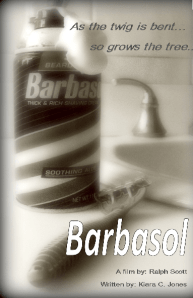
‘Barbasol’ – A Review

Barbasol Poster 1

Trickster that it is, ‘coming-of-age’ will not be ignored. I remember when the trickster tapped my dad, and he answered by teaching me how to drive a 1972 Volkswagen Beetle. “Equal distribution … Equal distribution,” he chanted as I, in herky-jerky frustration, tried to shift the gears and push in the clutch. To this day, I only will drive a manual transmission in honor of my dad and, even more notable, his courage.

In his heart-rending film short ‘Barbasol’, independent film director Ralph K. Scott uses the tradition of shaving to pay homage to his own memory of his father. Scott knows all too well that it takes a brave soul to ‘talk about’ a parent in a public venue and, more onerous, to choose what to portray of him onscreen. He says,

I wasn’t sure how deep I should go into my own life experience with telling the story about my father. He would yell at the drop of a hat, and that existence kept me and my sisters on edge. I did not, however, want to portray him as an ogre; there were gentle times.

Ralph K. Scott, Director

Ralph K. Scott, Director

Scott finds his mettle in ‘Barbasol’, a wonderfully passionate film that is mindful of its autobiographical element. “My father never really treated my mother with any harshness,” he remembers, “it was like she had a grip on his anger.” This is the memory he weaves into the story. For 19 minutes, Scott explores two African American parents, Harper (Stephen Hill) and Grace (Ebbe Bassey) Collins, who are cast into a domestic crisis when ‘coming-of-age’ calls on them. This ritual usually is a child’s transition into young adulthood, and the parent and/or guardian guides the initiate into the next phase. Scott, however, is to be applauded for a savvy filmic twist: the director focuses on Harper and takes him on a journey from father to daddy – the latter signifying the compassionate teacher. Harper has difficulty talking to his son, Grant (Elijah Williams) yet rests comfortably in the verbal synergy enjoyed by him and Grace. More laudable, Scott appoints Grace, (played with sharp patience by Bassey) to guide Harper and Grant during this crucial turning point. Their quiet scuffle points up the respect husband and wife have for their turn at coming-of-age. Barbasol, the soft moisturizing beard buster of shaving creams, serves as the tool to move things along.

Practically every scene in ‘Barbasol’ is a pressure cooker of change, and writer/producer Kiara Jones meticulously charts the strains running through the Collins household. She remarks,

there is no ticking time bomb in this film but I wanted to parlay the sense of urgency for this family. It is now or never, and I have them ask the unspoken question: Are we going to repeat the same things or are we going to work on this urgent call?

A game of contrasts comes to relief as each character wrestles to find answers. Harper barks orders to his son (“Boy! Get Up! Didn’t you hear me??”), but listens affectionately to Grace’s subtle warm plea (“Harper, honey, [Grant] just wants you to like him. It’s not too late.”); the latter sealed with a kiss. Harper’s father is Ed ‘Super Chief’ Collins (played with unfettered zeal by William Jay Marshall). Once a decorated police chief of 25 years, Super Chief now is a snarly curmudgeon throwing insults to Harper and Grant from a wheelchair (“what the hell you standing there with your thumb up your ass for!?”). Father and son scramble to please the Super Chief.

Grace (Ebbe Bassey) and Harper (Stephen Hill) enjoy an intimate momentGrace (Ebbe Bassey) and Harper (Stephen Hill) enjoy an intimate moment.

Grace (Ebbe Bassey) and Harper (Stephen Hill) enjoy an intimate moment.

Cinematographer Eric Branco masterfully envisions the tenuity of marital protocol Grace and Harper must handle at this juncture in their marriage. His establishing shot captures the delicacy of early morning awakenings. “Because some of the dialogue is so sharp,” Branco says, “there is a danger that the film would become too violent, so Ralph and I specifically went for a very smooth and a very pleasant morning scene.” In one instance, Grant enters his parent’s bedroom with caution, and when ‘Grace’ invites him in, Branco treats audiences to a relaxed moment between mother and son. In another, Branco’s medium close-up sharply defines Grant’s alarming vulnerability in the enclosed space of the bathroom. With straight razor in hand, Harper begins his awkward attempt to teach his son how to shave. Grant winces. Harper growls, “Don’t be a little baby! Real men shave!” It is scary but “we know that Grant is safe with Harper because of his gentle interaction with Grace,” Jones reveals, “so we continue with Harper on his journey.”

Harper (Stephen Hill) and Grant (Elijah Williams) and Barbasol

Harper (Stephen Hill) and Grant (Elijah Williams) and shaving creme Barbasol

In conjunction with rights-of-passage, Scott’s direction is a flawless dramatization of health issues most families grapple with as they witness their elders pass from vibrant self-sufficient caretakers to patients suffering with dementia. “When my father started coming down with dementia,” he recalls, “it was scary and tragic. He kept himself together; when I would visit him, his fingernails would be disgustingly long and dirty. I would clip and file his nails. He would sit there just as calm as if I was the prettiest beautician. It is those moments that drew me to write in the story about Harper’s and Grant’s visit to shave the Super Chief.” Ever aware of his father’s legacy, Scott ministers a heartwarming and uplifting denouement to Super Chief’s verbal madness.

Stephen Hill is dexterous in his smooth transition from gruff father to the huggable-lovable teddy bear with Grace to the humble son during his visits with the Super Chief; and, Elijah Williams carries Grant’s vulnerability with honest reserve.

‘Barbasol’ made its New York debut at the Urbanworld Film Festival in September 2012. For more information visit http://www.socialcinemaproject.com

Watch for in-depth Film • Television • & More reviews & commentary.

In the meantime, Catch a film … Share the Popcorn … Feed Your Soul!

‘Alex Cross’ – A Review

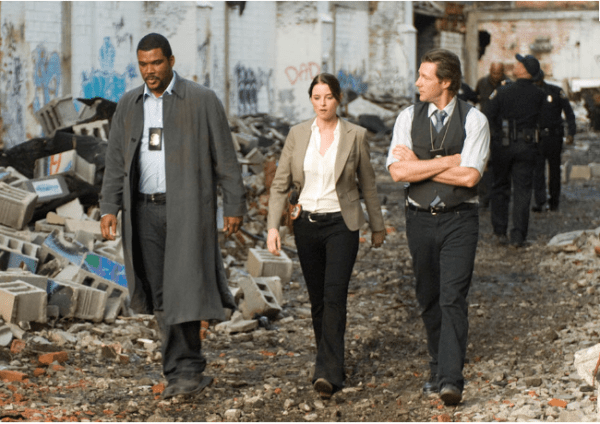
Alex Cross (Tyler Perry), Monica Ashe (Rachel Nichols), and Tommy Kane (Edward Burns)

Alex Cross (Tyler Perry), Monica Ashe (Rachel Nichols), and Tommy Kane (Edward Burns)

Tyler Perry takes a chance in the middle of a career that he has established carefully as a writer, producer, director, and actor. Refreshing is this cinematic move. Refreshing, too, is Perry’s faith in his followers that they will support his decision to perform outside of the Madea box. Perry’s calculated risk affords him top billing, and a project advanced by a well-oiled advertising campaign; however, the movie rewarded him with a dismal box office disappointment. Not surprising because this newest venture directed by Rob Cohen (The Fast and The Furious; Dragon: The Bruce Lee Story) has too many individual parts that fail to coalesce into a unified filmic ensemble.

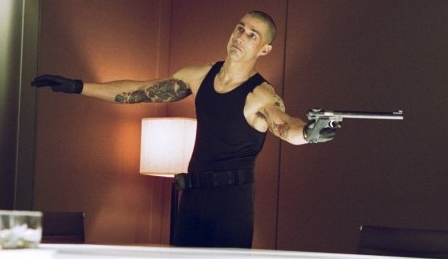
Alex Cross is the creation of author, James Patterson, whose entourage of murder mysteries and crime thrillers features an African American homicide detective who is a psychologist with the skill of deduction that mimics Sir Author Conan Doyle’s Sherlock Holmes. Film goers were introduced to Cross in Kiss the Girls (1997) and Along Came a Spider (2001) starring Morgan Freeman. In this installment set in Detroit, Michigan, Cross finds himself tackling a sadistic assassin and serial killer named Picasso (Matthew Fox), so-called because of the cubist drawings he leaves with his victims. Cross believes he can draw Picasso out by psycho-analyzing him; but his sole reliance on textbook psychology leads him to underestimate the extreme lengths Picasso will go to divert the detective from his deadly mission. Picasso snags Tommy Kane (Edward Burns), Cross’s longtime partner, in his lethal coil. Motivated by intense grief and loss, Kane and Cross launch a no-holds-barred man-hunt for Picasso.

Fox delivers Picasso with such an exaggerated passion that it pushes him into caricature; The Joker and The Riddler could be his big brothers. Burns works hard to establish his character’s loyalty to Cross and to make believable to the audience his commitment to his girlfriend Monica (Rachel Nichols).

Picasso (Matthew Fox)

Unfortunately, no one really cares. The most awkward performance, however, is by John C. McGinley who plays the forgettable Captain Richard Brookwell. Who is he again? As for costumes, someone should have advised costume designer Abigail Murray against her design of Cross’s long coat; it looks like two sleeping bags sewn together; and, who made the decision on those dreadful shotguns?

Puzzling, too, is the undeveloped character and confusing storyline of the likeable Pop Pop Jones (Simenona Martinez), a young African American female teenager in jail for murdering two people whom Cross visits. As they sit down to play chess, she says to him, “you can’t save everybody Dr. Cross,” and he replies, “I’m not trying to save everybody, just you.” The film does not fully explain Pop Pop’s function in the story.

Alex Cross is a good enough story, but painful to watch are talented actors working with a script that compromises their efforts. Marc Moss and Kerry Williamson wrote the screenplay that gives generous back story to Cross. During an October 12 interview with Huffington Post Entertainment, Williamson remarks, “What I really wanted to do was an origin story, and introduce [Cross] to a new audience. I knew that it would invite comparisons to Morgan Freeman, and I kind of wanted to pull away from that.” Williamson does more than ‘pull away’; the screenwriter creates a vehicle that firewalls a smidgen of thought of Freeman thereby generating a push/pull viewing experience. Perry portrays very well the homicide detective Williamson draws in the screenplay: the “caring, principled [and] loving family man” whose strong belief in himself and his skill are bolstered by the love of a resilient extended family. Herein resides the strength of Alex Cross and a demonstration of Perry’s promising talent as an actor outside of Madea‘s workshop.

Nana Mama (Cicely Tyson)

Perry’s impressive display of grief when blindsided by tragedy clearly marks not only the gravity of the moment; also, his display sets up the question, “how will the detective present his anger to his family?” Respectfully, the movie pauses to give the audience a private moment with the Cross family and, in this moment, we are party to Cross’s parenting skills as well as to his deference for his mother, Nana Mama (Cicely Tyson). The close-up brings to light the gentle acknowledgment of his daughter Janelle’s (Yara Shahidi) sorrow; Janelle’s acceptance of his tender gestures to console her reveals a daughter’s trust in her father. Cross’s tenderness, though, is transmuted to firm resolve as Nana Mama cautions him against taking revenge. She says with a piercing seriousness that is all Tyson, “Don’t you try placating me! […] Look at cha, self-appointed judge, jury and executioner!” Cross replies with sincere respect wrapped in a blanket of restraint, “Mama, either you step aside or you go back up those stairs, but you’re in my way.” We even are treated to the rituals of the Black church.

Maria (Carmen Ejogo) and Alex (Tyler Perry) enjoy an intimate moment over dinner.

Cinematographer Ricardo Della Rosa contrasts these intense moments with lighthearted interaction between family members. Cross grabs Nana Mama and hugs her as she prepares a meal. Under a smile she feigns annoyance that Cross has interrupted her in the kitchen. Another scene highlights a comfortable banter between Cross and his wife Maria, commendably played by Carmen Ejogo. Cohen’s direction of these playful relationships easily showcases a likeable Black family in everyday situations and thereby builds audience investment in the Cross household.

The domestic levity in the Cross family, however, is insufficient to bind the movie into a unified whole. Even the crimes themselves—as heinous as they are–fall short of holding the pieces together. Hopefully, Tyler Perry will find another action thriller in which to star; he’s good. Perhaps he should write his own.

Watch for in-depth Film • Television • & More reviews & commentary.

In the meantime, Catch a film … Share the Popcorn … Feed Your Soul!

Duvernay Arrives at a Poignant Place in ‘Middle of Nowhere’

Ava DuVernay has emerged as the darling of the Black independent film movement. Her finely crafted second feature, Middle of Nowhere, earned the filmmaker the distinction of the first African American female to win Best Director at the Sundance Film Festival 2012. The film made its New York debut at the Urbanworld Film Festival in September, and during the Q&A, the moderator praised DuVernay for organizing film festivals and lobbying for the release of Black independent films via the African-American Film Releasing Movement or AaFFRM. That Middle of Nowhere opened this weekend to the biggest per screen average adds to her laurel wreath.

In Middle of Nowhere, DuVernay stages a moving drama that investigates the consequences of isolation. DuVernay tells a story specifically about women of color and their management of incarceration that entails long bus rides to prison compounds in the middle of nowhere. No doubt, the film critiques the well-known fact that the prison system undermines the family structure. “I know women who actually do have men who are incarcerated,” says DuVernay, “[imprisonment] is epidemic in black and brown communities.” This epidemic has a strong correlation to the auction block, a horrific practice throughout the plantation regime that separated enslaved families of African descent for profit.

With proficient style, DuVernay centers the story on Ruby (Emayatzy Corinealdi) and Derek (Omari Hardwick), a young married African American couple whose choices have thrust them out of their marital bliss into the prison system. Derek is sentenced to eight-years for running guns; Ruby’s strong faith in the possibility for Derek’s early release for good behavior holds the marriage together. She convinces Derek to invest in her blueprint for handling their predicament. He will follow every rule; she will quit medical school and work at night. Her schedule will allow her to take his daily phone calls. They will write frequently; and, she will visit him every week. Derek protests, “keep going with life! I don’t want you to stop for me, baby!” Ruby reminds him, “you are me.” All goes well until Ruby learns disheartening news during his parole hearing.

The visual acuity of cinematographer Bradford Young brings to life the brilliance of DuVernay’s story. A lone bus carrying family members pierces a road leading to the prison compound that is shaded in a muted tan and hazy ice blue setting. Young’s bird’s eye shot of the bus and the barbed wire establishes the desolate environment. Outside, silence permeates as visitors lean against a chain-link fence waiting for entry. Inside, buzzers grate on the nerves, and the clang-clank of iron cell doors echo throughout the prison structure, compliments

Cinematographer Bradford Young

of sound editors Rickley Dumm (Twilight; Sparkle) and Craig Polding (2012: Ice Age). As the film progresses, Young’s use of the ‘close-up’ is considerable yet admirably efficient. Hues of midnight and dusky blues along with deep browns and golden amber compliment Young’s capture of the expressions of joy, anxiety, tenderness, and seduction. A sprinkle of flashbacks provide glimpses into Ruby’s and Derek’s history; and, selective focus combined with the close-up draw attention to the difficult choices Ruby has to make when Brian (David Oyelowo) enters her life. In addition to using the ‘close-up’ to emphasize intense emotions, Young exploits the film form to expand the terrain of intimacy. His expansion includes visuals of Ruby and her mother (Lorraine Toussaint); and Ruby and her sister, Rosie (Edwina Findley) in conversation. “The human body is like a landscape,” says Young, “and I wanted to stretch this idea of intimacy; I start with the ‘close-up’ and then move away.” An example of Young’s cinematic stretch comprehends Ruby’s and Derek’s vulnerable state that you want to touch the screen and hug the couple.

Corinealdi and Hardwick embody the confinement that has intruded upon their characters’ lives. Hardwick, especially, carries the weight of confinement with interior depth and strength. In the course of Ruby’s visits, he carefully monitors each physical and verbal gesture that we feel the emotional tightrope

Derek and Ruby discuss strategies for serving time.

on which he walks. Corinealdi plays a vivacious Ruby against Hardwick’s restraint with splendid charm, and her performance sustains the zest for the possibilities.

The filmmaker’s small but noteworthy acknowledgement of one of the culprits behind the tear in the seam of this marriage accompanies DuVernay’s story. One evening, the sisters contemplate Derek’s decision to run guns—an operation which enhanced the couple’s economic status. In one line of dialogue, Ruby accedes to her sister Rosie, “I made him think I’d really be happy with all of that stuff.” What is this “stuff”? One moment in pop culture history could offer some insight. The advent of music videos and television programs such as Sex in the City, The Game, Cashmere Mafia and Lipstick Jungle, cultivated consumer desire for material goods, chiefly, all things designer, if not, haute couture. Designers such as Coach, Manolo Blahnik, Christian “Loubou” Louboutin, Gucci, and Louis Vuitton gained widespread currency in households. Ruby and Derek drop down into this culture, and conceivably “got caught up” in the acquisition of things.

Middle of Nowhere truly is a cinematic accomplishment, and with the talent attached, the film has matured into a very lovely creation. The opening weekend attests to that! Casting Agent, Aisha Cooley, deserves applause for a finely cast film.

Watch for in-depth Film • Television • & More reviews & commentary.

In the meantime, Catch a film … Share the Popcorn … Feed Your Soul!

‘Madea’s Witness Protection’ – A Review

Each installment of the Madea franchise guarantees the restoration of order in the landmine of the domestic sphere. Be it the punishment of an impertinent young adult or the reprimand of distracted parents who allow her to act out, we count on Madea’s courage to speak the truth. When she accepts the challenge, she is pardoned for every inane comedic antic. For instance, in Madea’s Family Reunion, we flinch when she reaches in the back seat of the car (butt to camera) to slap the disrespectful runaway Nikki (Keke Palmer). All is forgiven, however, when she inspires Nikki to believe in herself. We excuse the two punches in the face to the rude black male teenager at 3:00 who yells out “shut-up old lady” on the school bus in that same film. In Madea’s One Big Happy Family, she drives her Cadillac through a fast food restaurant but we absolve her of that when she delivers a back-handed slap to H.J. (Stevie Wash, Jr.) for his ill-manners towards her and when she demands that the parents take back their authority within their own household. We forgive her because Perry made her our own mediator in chaos, and we know that she loves us.

Madea’s Witness Protection, however, showcases a Madea with a different approach to chastising white young adults. In addition, the casting of Denise Richards recalls a certain moment in Black film history. These choices bring to relief a film-viewing uneasiness. In summary, Cindy Needleman (Danielle Campbell), daughter of George Needleman (Eugene Levy) and step-daughter to Kate (Denise Richards), is a white teenager who is abruptly thrown into the witness protection program. Her father was set-up to take the fall for a mob-backed Ponzi scheme. The prosecutor (Tyler Perry) hides them in Madea’s house under witness protection, and it is there that Cindy acts out.

Cindy, (Danielle Campbell) throws a pillow at Madea in anger that the matriarch has awakened her..

As aforementioned, in all other Madea films, Madea rightly broaches no patience for insolent Black young adults. In Witness Protection, however, Madea searches for reasons why Cindy is so mad and angry. Cindy tells her stepmother to “go to hell” and, without reserve hollers “you suck” and “I hate you” to her father. In one scene Cindy frustrates Madea’s attempts to awaken her. She yells “Go Away”, and throws a pillow at Madea. A furious Madea pours a bucket of water on the bad-mannered teen. Suddenly the physical violence dispatched to Nikki, H.J., and the student on the school bus isn’t so forgivable. For sure Cindy is not Madea’s child nor a relative, but neither are the other young adults. Nikki, for instance, is a runaway placed in foster care with Madea. In the end, impertinent white young adults need understanding and a “cooling off”; impertinent black young adults deserve a slap, a punch, and/or a battle royal with Madea.

The casting choice of the lithe Denise Richards for Kate Needleman also changes the Madea dynamic. Kate and Madea side-by-side reflect a popular pair in Black film history: Scarlett O’Hara (Vivian Leigh) and Mammy (Hattie McDaniel).

Kate (Denise Richards) looks extremely waif thin in the presence of Madea (Tyler Perry).

The über-thin white delicate body compared to that of the rotund black body ensures two things: the delicate sexy Kate (desirable) and the desexualized and harsh maturity of Madea (undesirable). Consider the Yoga scene. Joe signifies on Madea’s elephantine buttocks during his lecherous eyeballing of Kate’s slim rear-end. Kate stands long and lean in her warrior and tree poses in the living room while Madea prepares breakfast. The camera follows Joe’s focus through Kate and lands on Madea’s behind. In Joe’s eyes, Madea is a “wildebeest in its natural habitat” and her butt must be hungry because it is “chewing through [her] dress.” We laugh.

Wait a minute: Laughing doesn’t feel so good.

Tyler Perry treats us with an array of Black women body types, and Madea fits comfortably within that community. Joe’s taunts generally are dismissed possibly because we all have a Joe/Josephine in the family. “Pay ‘im no mind,” we shrug. Madea’s Witness Protection, though, casts an ominous shadow on Joe’s treatment of Madea in the presence of this white family. An assault on Madea on the silver screen amongst an all-black cast is one thing; but Joe’s insult to Madea to privilege Kate’s white threadlike build at her expense is unforgivable. Madea, when placed against the backdrop of white womanhood, stands as our Matriarch. She is our Elder. She is our Mediator. We intuitively are aware of her stature/status throughout every cinematic portrayal of her. Inside and outside our community she deserves our respect. It is a disappointment that Madea is not afforded this courtesy in Madea’s Witness Protection.

(Note: This review was published in the July 30, 2012 edition of The Washington Informer at http://washingtoninformer.com/index.php/lifestyle/entertainment/item/11509-madeas-witness-protection.)

Sparkle delivers Beauty, Charm, and Elegance in the Quest for the Dream

Sparkle is a lush cinematic cultural artifact sustained by a sumptuous set, a dynamic soundtrack, and the rigorous artistry of its cast. Akil Production Company, along with two-time Emmy nominee Debra Martin Chase (The Princess Diaries; Just Wright), pay a respectful homage to its 1976 predecessor. No cameos needed.

The film opens in 1968 to a cacophony of voices broadcasting newsworthy events: The Vietnam War, The Beatles, civil rights and Martin Luther King, Jr. The camera swoops into Discovery, a juke-joint whose ambience of smoky rhythm, saucy blues, and salty sweat, is thickened by R&B crooner, Black (Cee-Lo Green). As his soulful “I am a Man” opens the action, placards held by Memphis Sanitation workers in 1968 captured by African American photographer Ernest C. Withers flash in my mind.

This socio-cultural context signals that Akil Production Company and Chase have crafted a film that expands the 1976 story but stands on its own. The operative word? Story. Rather than inundate the audience with a multitude of song and dance routines, the film focuses on the story of a single African American mother, Emma (Whitney Houston) who successfully has raised three attractive, well-adjusted, and talented daughters, Tamy/Sister (Carmen Ejogo), Dolores “Dee”, (Tika Sumpter), and Sparkle (Jordin Sparks) in the bustling city of Detroit, Michigan. Emma’s story is that of 1960s upward mobility despite setbacks she endured in her youth–the harshest being her teen-age pregnancy. Her rule is “respect, education and loving the Lord”. The cinematic presence of the Black church denotes her anchor, and this institution no doubt facilitated the upbringing of her daughters and made possible the acquisition and preservation of her middle class existence.

Emma’s home, beautifully shot by cinematographer Anastas N. Michos, highlights the trappings of her success: a two-story with a staircase; the Queen Anne and Bergère chairs; the small library with piano; crystal chandeliers; and the sugar and spice bedrooms replete with iron beds, vanities, and full length mirrors emphasized by pink and white flowered wallpaper. Craig Anthony’s spectacular costumes showcase each lady in her sartorial splendor. For church, gloves, hats, and coat dresses trimmed in fur; and for daytime, suits and sheaths. Even the bedtime wardrobes are luxuriant: sheer nylon peignoirs accentuated with ruffles and bows, and quilted satin bathrobes in colors of aqua, champagne and pink.
The wall art of encased butterflies and birds, however, betray this charm. These set props give nod to Paul Laurence Dunbar’s poem “Sympathy”, whose first lines inspired the title of Maya Angelou’s book, I Know Why the Caged Bird Sings. On the whole, Sparkle is a graceful exploration of generational anxiety aggravated by socio-cultural changes. Emma’s daughters are coming of age, and the painful transition causes domestic seismic shifts that disquiet Emma but feed her daughters’ yearnings. Like the butterflies and the birds, the women in this household are trapped; yet, as does Dunbar’s caged bird, each dares to break free from pasts that have held them and Emma hostage.

On another note, the Akils skillfully dramatize the forgotten art of courtship, and the duo’s brilliant virtuosity of storytelling glistens here. Stix (Derek Luke) and Levi (Omari Hardwick) shines as wordsmiths coaxing the young women to consider them worthy suitors/partners. Hardwick, especially, translates with splendid bravura Levi’s torment when he discovers that his words cannot compete with the conspicuous bling of the wealthy, but mean-spirited Satin (Mike Epps). Epps, in turn, gives a marvelous performance as the successful stand-up comedian whose jokes are contemptuous of African Americans. He brazenly flaunts his material success in front of Levi as Levi expresses his desire for Sister; later, however, he reveals his insecurity over his new material.

Expectedly, references to Motown and its talent line-up abound, yet do not overwhelm the story. The Akils, however, gently manipulate Motown’s reputation to fuel the mother/daughter conflict and the quest for the dream. “I want to be bigger than Diana Ross,” reveals Sparkle to Stix under the stars.

The sparkle, nonetheless, shines on Whitney Houston, Carmen Ejogo, and Tika Sumpter. Houston embodies Emma, and plays her with a cool, yet fierce sophisticated determination. Her life trials dance in her voice in His Eye is on the Sparrow. Ejogo, with artful efficiency, deftly manages the heart of Tamy/Sister, a restless 30-year-old young woman caught between her past failures and that of working as a domestic while living in her mother’s house. Finally, Sumpter, with intelligent wit, steadies the sister-trio, as she moves between the tempestuous Tamy/Sister and the gentle-minded Sparkle.
Honorable mention to Michael Beach (Rev. Bryce) and Tamela Mann (Ms. Sara Waters).

If you have not seen Sparkle, you should. If you already have, see it again. This film is worth the price of the ticket. Twice.

(This Review was first appeared in the August 30, 2012 Edition of The Washington Informer at http://washingtoninformer.com/index.php/lifestyle/entertainment/item/11734-sparkle-delivers-beauty-charm-and-elegance-in-the-quest-for-the-dream.)