God’s Pocket @ The Ross

Mickey (Philip Seymour Hoffman) and Bird (John Turturro) in contemplation

Mickey (Philip Seymour Hoffman) and Bird (John Turturro) in contemplation

We rejoice in small towns! We love the ease in getting around places and living in neighborhoods where everybody knows your name; those neighborhoods where locking your doors is an insult to those in the community. The safety. The familiarity. All of these features of the small town will relax and calm you.

Unless there is a murder around the corner or was it an accident? John Slattery makes his directorial debut in this well-rehearsed deep dark dramedy God’s Pocket.
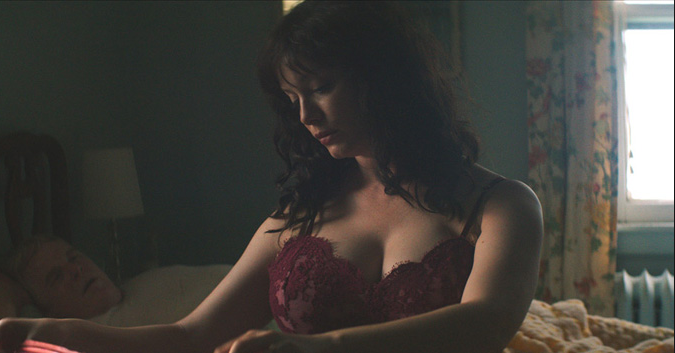
Jeanie (Christina Hendricks) and Mickey

Jeanie (Christina Hendricks) and Mickey

Set in south Philadelphia, Slattery works hard to tease out the subtleties of living in a working class town called God’s Pocket that is inhabited by … well … let’s just say you would not want to be caught on the street after dark–alone.

The late Philip Seymour Hoffman stars as Mickey Scarpato, a luckless outsider who topples over into the life in the Pocket by marriage to his wife Jeannie (played by Christina Hendricks of Mad Men fame). Jeannie’s son Leon, the town’s crime element, has been taken out by one of his co-workers, and everyone swears it was an accident. Mom refuses to accept the verdict, so Mickey has to scrounge around town to find the real story! You will appreciate Slattery’s skill in playing with our common sense notions about the working class town; and, when he disrupts them, you will want to lock your doors.

The Ross logo

God’s Pocket plays through May 22 at The Ross.

Watch for film television & more. In the meantime,
Catch a Movie …
Share the popcorn …
Feed your soul!

Finding Vivian Maier @ The Ross

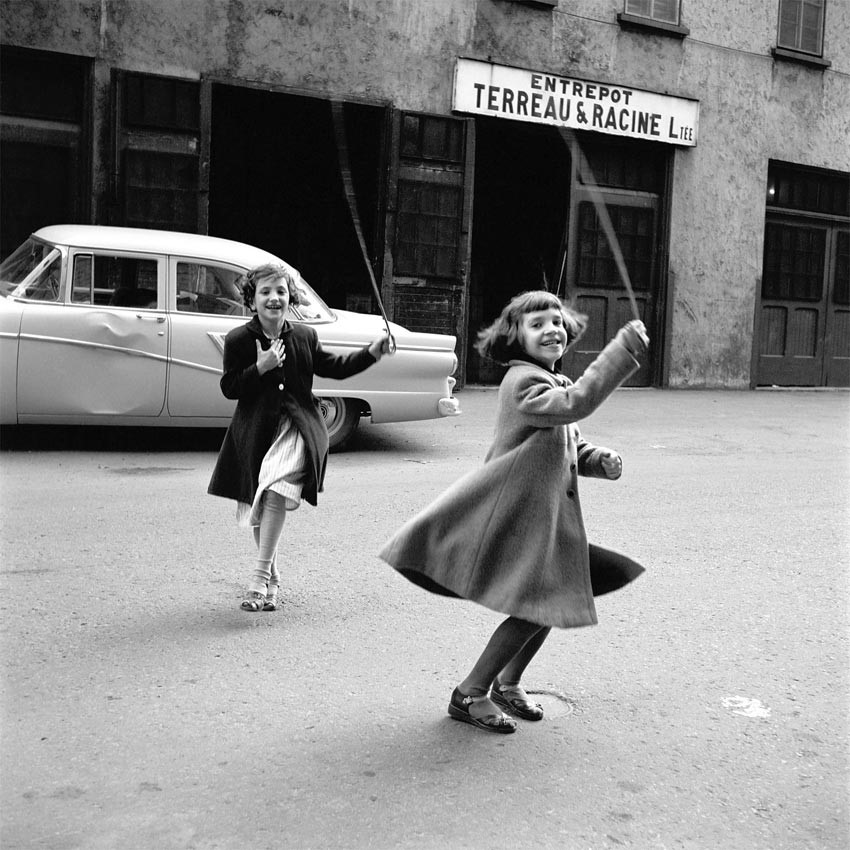
Vivian Maier

Vivian Maier

What’s in your attic? What’s in your basement? Things you no longer care about? Or things you don’t want people to see? Well, let me ask you this: what would you do with those intimate artifacts? Chicago historian and photographer John Maloof explores the world of American street photographer and Nanny Vivian Maier in his documentary Finding Vivian Maier.

pix2

Vivian Maier was born in 1926 in New York city and died in a nursing home in Chicago in 2009 at the age of 83 after a slip and fall on the ice. She hid things in her bathroom—a space she turned into a dark room wherein she developed many of her photographs; she dared any of her charges or employers to step foot therein. In another home, she told her employers “I come with my life, and my life is in boxes,” and those boxes filled up their garage. Those are the boxes Maloof bought for $400.00 at an auction in 2007, and what he found were 30,000 negatives he began to scan onto his computer. During this process, Maloof realizes that he has come across pictures of artistic value that document street life from the 1950s-1970s. He went back bought the remaining boxes, which totaled some 100,000 negatives.

pix of two boys

For all of the sensationalism about the new discovery of a natural talent, the exhibitions in London, Chicago, Los Angeles, or Maier’s spectacular photographs she took with her Rolleiflex twin-lens reflex camera—Maloof has that too—or opinions that she was eccentric, Finding Vivian Maier is a story about privacy and the extreme lengths a woman will go to keep it.

Maier photographed the world around her, but declined to let anyone see the product from her efforts, except for one family with whom she was employed. She refused to satisfy the curiosity of her employers by declining to answer any questions about her life nor did she offer any information about same. Those interviewed, then, could only offer to the public their observations of her.

pix4

The documentary, however, goes a step further. What seeps out is a tale about a woman who felt her business—her life–belonged only to her, and she kept that business in boxes and boxes of things in the attic or in the basement. Perhaps, in such a rapidly changing world, the rolls of film and negatives in her boxes let her know she existed, and she did not seek the world out to affirm that for her.

The Ross logo

Watch for in-depth Film • Television • & More reviews & commentary.

In the meantime, catch a film, and share the popcorn. Watch television, and feed your soul!

Ernest and Celestine @ The Ross

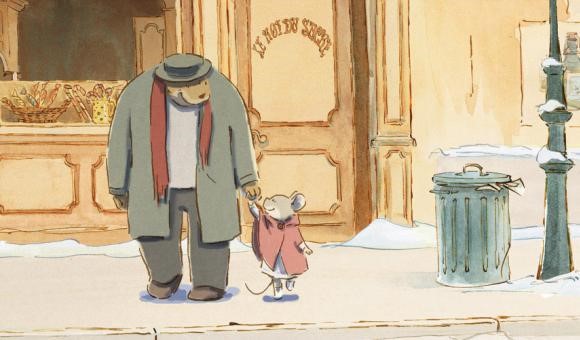
Ernest (Forest Whitaker) and Celestine (Pauline Brunner)

Ernest (Forest Whitaker) and Celestine (Pauline Brunner)

It is no wonder that Ernest & Celestine received standing ovations at Cannes and Toronto in 2012! This animated feature is a delightfully warm and fuzzy story directed by Stéphane AubierVincent Patar, and Benjamin Renner. Ernest, the bear, is brought to life by the vocal talents of English dub cast Forest Whitaker, and Celestine, the mouse by MacKenzie Foy. Other vocal talents are Paul Giammatti as the Rat King, William H. Macy, as the Head Dentist, Lauren Bacall as The Grey One, and Jeffrey Wright as the Grizzly Judge.

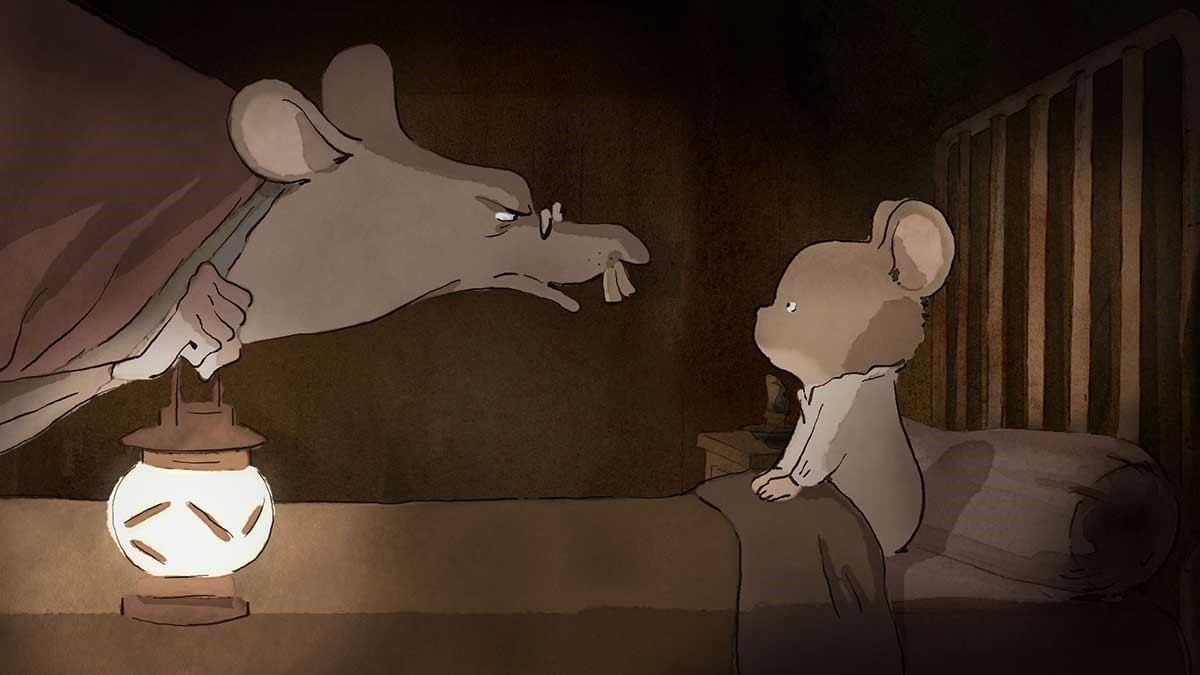
Watch out for the big bad bear! (bedtime story)

Watch out for the big bad bear! (bedtime story)

Celestine is growing up in an orphanage listening to stories told by a very intimidating elder mouse about a big bad bear who lives above ground and has a strong appetite for young and innocent mice.

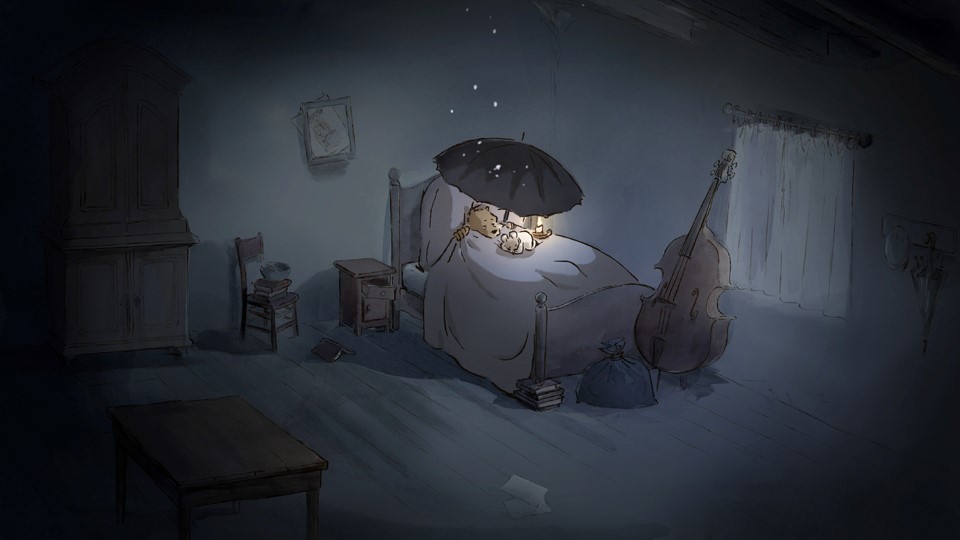
nighttime for the fugitives, Ernest & Celestine

nighttime for the fugitives, Ernest & Celestine

The theme of friendship is front and center. Aubier & Co. prompt us to ask the questions: Do we decide to believe the stories we are told about people who are different, and, if not, can we still have a place among relatives and friends or even a place called home? These questions bring enjoyment to the story. Along the way, Ernest and Celestine challenge societal prescriptions they are expected to fulfill. Celestine is more interested in the arts rather than becoming a dentist, and Ernest has desires to become an actor and musician. When Celestine saves herself from the jaws of a hungry Ernest and leads him to a cellar full of food, bear and mouse come to know each other, and their companionship overcomes the tales each one has heard. The magic and charm intertwined with devotion through friendship are refreshing. You come away from this movie feeling alright about taking a chance on someone you were told was different.

Ernest and Celestine plays through March 8 at the Mary Riepma Ross Media Arts Center in Lincoln.

The Ross logo

Watch for in-depth Film • Television • & More reviews & commentary.

In the meantime, Catch a film … Share the Popcorn … Feed Your Soul!

Particle Fever @ The Ross

The Large Hadron Collider

The Large Hadron Collider

Mark Levinson’s new documentary Particle Fever is about relationships … relationships between scientists who practice theory and those who put theory into practice. It is about particle physics, or those parts that are observed, examined, and scrutinized in an effort to come to some understanding of a whole. Pieces of things. Particles of things.

In the plunge ahead, Particle Fever highlights the search for the Higgs Boson, or “the God particle”. Scientist Peter Higgs talked about its existence, but there was no proof that this particle had or does exist. How do we prove it? We build a machine to find it!

Levinson’s documentary highlights the Large Hadron Collider, man’s latest scientific feat in building machines. It is gargantuan, and seeing it onscreen, I very well can imagine Henry Adams’s wonder at the 40 ft Dynamos he observed at the World Columbian Exposition in 1893. The Large Hadron Collider is the world’s largest and most powerful particle accelerator built by the European Organization for Nuclear Research in Lucerne Switzerland. It will be used to prove Peter Higgs’s theory of the existence of “the God particle”.

The careers are riding on this discovery, and if one jot or tittle of a particle is left out, it could mean failure! It could mean disaster! It could mean humiliation! Oh, the catastrophe! But, Levinson so ably orchestrates a cadre of belief—no—faith among colleagues that is so compelling, you will want to put on your hard hat and overalls and see that project through!

The Ross logo

Particle Fever plays through May 8 at The Ross Media Arts Center in Lincoln.

Watch for film, television, & more!
In the meantime,
Catch a movie!
Share the popcorn!
Feed your soul!

The Lunchbox @ The Ross

Ila (Nimrat Kaur) prepares the lunchbox

Ila (Nimrat Kaur) prepares the lunchbox

This winter was bitter if not brutal, and the wind conspired to make our lives miserable from October to March. It was ice-madness in the streets, on the land,… in the air … First-time director Ritesh Batra has made a film called The Lunchbox. Set in Mumbai, the capital city of the Indian state of Maharashtraa, The Lunchbox is a story that feels like a golden cup of hearty soup on a blustery winter’s night. It is a gentle narrative about a lunchbox, whose contents contain a hot lunch painstakingly prepared by a housewife named Ila (played by Nimrat Kaur) for her businessman husband Rajeev (played by Nakul Vaid). The camera focuses on Ila’s hands as she sprinkles spices on rice, vegetables, and meat. You can smell the curry, the cardemon, the fennel, the coriander, the masala, the cumin [smell] … What’s more, Ila places a little handwritten ‘love note’ encased in the folds of her handmade naan bread. All of this prepared for Rajeev who has refused to pay attention to his very attentive wife; her artistry in cuisine she uses to conjure him back to her.

Dabbawallahs prepare lunchboxes for delivery

Dabbawallahs prepare lunchboxes for delivery

She gives over her homemade victuals to an employee who works within the Mumbai institution called dabbawallahs, a complex delivery system that involves deliverymen on bicycles who collect from households prepared meals and then carefully load them onto a transit system to businessmen and women who have signed up for this service. Ila’s meal not only is delivered to the wrong address; her food potion lands on the desk of Saajan ( played by Irrfan Khan), a widowed accountant who is not her husband.

Saajan (Kirrfan Khan) reads 'love note'

Saajan (Kirrfan Khan) reads ‘love note’

Ritesh Batra uses such simple notions of everyday art to visually anoint his film. When was the last time you opened a letter? When was the last time you sent one? When was the last time you released the message from the envelope, unfolded it with your fingers, held it in your hands, and found the right spot to sit and read it? Nostalgic isn’t it? Batra will have you longing for those days of yore when people took the time to think about you on paper, and not in the cyperspace of e-mail and text messaging.

Ila and Saajan innocently connect by way of the written word read in the privacy of one’s own room over a sumptuous meal prepared especially … especially …. These are the things that will keep you warm on a winter’s night, just by seeing the script written by the hand who salutes you as “Dear …”

The Ross logo

The Lunchbox plays through May 8 at the Ross Media Arts Center.

Watch for in-depth Film • Television • & More reviews & commentary.
In the meantime, Catch a film … Share the Popcorn … Feed Your Soul!

The Unknown Known @ The Ross

Donald Rumsfeld

Donald Rumsfeld

Reports that say there’s — that something hasn’t happened are always interesting to me, because as we know, there are known knowns; there are things that we know that we know. We also know there are known unknowns; that is to say we know there are some things we do not know. But there are also unknown unknowns, the ones we don’t know we don’t know.

Clever huh? That is former Secretary of Defense Donald Rumsfeld fielding questions about Iraq and weapons of mass destruction at a US Department of Defense News Briefing in February 2002. There are some things you just cannot curry any interest in, and that statement is one of those things. I want to go so far as to say Rumsfeld makes no sense but I won’t. Well, you have to take it apart, examine its pieces, and by the time you unravel the thing, you’re just as befuddled as when you attempted to understand it in the first place. Well, my dear listeners, there is another chance at Rumsfeld’s linguistic jumble thanks to Oscar-winning documentary filmmaker Errol Morris in his interview (or is it a conversation?) with Donald Rumsfeld in his newest documentary The Unknown Known. This documentary is to stand as a companion to The Fog of War: Eleven Lessons from the Life of Robert McNamara, for which Morris won the Academy Award for Best Documentary in 2003. McNamara is Rumsfeld’s predecessor.

Rumsfeld 2

You know, Rumsfeld has a sense of humor. He’s a likable guy. His former staff may disagree, however. He inundated them when in office with millions of snowflakes or memorandums as he calls them. He kind of reminds you of a distant uncle who promises quarters if you can answer his questions; except, he never pays up.

His personality puts you at ease; he’s even charming in some instances. No matter the questions thrown to him off camera by Morris, Rumsfeld smiles and tosses answers that he believes will suffice; and, he expects you to take him at his word. After all, the subjects are delicate; they cut to the psychological quick of the nation: Pearl Harbor, Vietnam, waterboarding used to torture prisoners, Guantanomo Bay, Iraq, Osama Bin Laden, are just a few. Rumsfeld talks about them as matter of fact consequences of war. Before you know it, the impulse to question or critique Rumsfeld’s views on war and politics and his ruthless approach to same, is crushed and quickly.

The Infamous Rumsfeld Snowflake

The Infamous Rumsfeld Snowflake

But the documentary is not that seamless. Some things slip, and Morris does nothing to catch them in the fall. Instead, he lets Rumsfeld talk … and … talk … and … talk, and if you listen … just listen … what spills onto the screen like marbles onto a hardwood floor is a man skilled in evasion and manipulation with no depth or groove; he’s like alcohol rubbed on skin but the nurse never returns to give you the needle to cure the problem. It’s just there; it evaporates.

The Ross logo

At the end of the day, however, Morris tells a satisfying story AND gives a history lesson about Donald Rumsfeld and his rise to power; but they’re “just the facts ma’am” because Rumsfeld never lets you into his head. Clever, huh? Donald Rumsfeld is the unknown known.

The Unknown Known plays through April 24 at the Ross Media Arts Center in Lincoln.

Also playing at The Ross through April 24 is The Grand Budapest Hotel.

Watch for more film television & more.
In the meantime, catch a film!
Share the popcorn! Feed your soul!

The Grand Budapest Hotel @ The Ross

Grand Budapest1

Who knew that Wes Anderson had it in him? The ‘it’ being the ability to charm with an exotic, mysterious, strange, outlandish adventure encased in an embroidered, beaded silk cinematic purse named The Grand Budapest Hotel. The set is like a miniature city, and it’s as if Anderson shrunk the audience so we can experience the baubles and trinkets of grand old Europe, especially, the expanse of the countryside and all of its majesty. Frame-by-frame, Anderson delights the senses with visually

Deputy Kovacs (Jeff Goldblum)

Deputy Kovacs (Jeff Goldblum)

stunning settings. The film ricochets through time and place to tell the story of M. Gustave, played by Ralph Fiennes, the exact, fun-loving, sensational proprietor of The Grand Budapest Hotel. Gustave is a man ahead of his time, whom the narrator informs us is “a glimmer of civilization in the barbaric slaughterhouse we know as humanity.” That “glimmer” avails himself of rich and wealthy female patrons, who are smitten with his joie de vivre. An elderly Madame D, played by an unrecognizable Tilda Swinton (kudos to makeup designers) bequeaths to Gustave a valuable painting, and thus begins family squabbles, murder, mayhem, intrigue, and love. Andersen even treats us to a daring prison escape led by Ludwig, played by a bald Harvey Keitel.

Ludwig (Harvey Keitel)

Ludwig (Harvey Keitel)

Madam D (Tilda Swinton)

Madam D (Tilda Swinton)

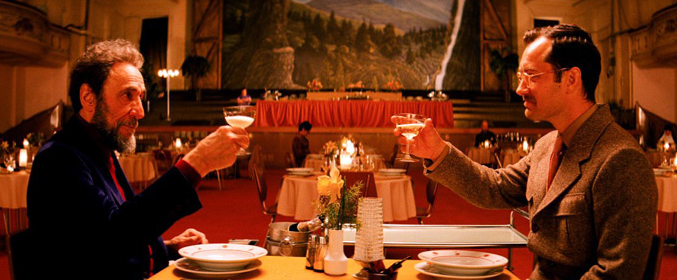
The story begins in 1985 in Lutz, a fictional town in Eastern Europe. An aging author, played by Tom Wilkerson, writes of his journey to the hotel, and through flashbacks we bounce to 1968, and the author recalls his younger self, played by Jude Law, on a stay at the hotel. Over dinner, the author learns of M. Gustave by listening to the story of the hotel’s history and its proprietor from Mr. Mustafa, played by F. Murray Abraham. From that dinner table, Anderson ricochets to 1930, to a cold, dark, and damp Central Europe in between two world wars. Anderson portrays this time and space well as he captures via Gustave, a national tension and disquietude, a kind of controlled panic or a hunger to gorge on life because the joie de vivre could be decimated at a moment’s notice.

Let the story begin! M. Mustafa (F. Murray Abraham) and Young Author (Jude Law)

Let the story begin! M. Mustafa (F. Murray Abraham) and Young Author (Jude Law)

We expect … how shall I say this … we expect divine performances by Swinton, Fiennes, Keitel, Abraham, and Law — that’s a given, really. But Tony Revolori pushes through with a fine performance as Zero, the young M. Mustafa as the Lobby Boy. In the end, it is he who inherits the painting as well as the Grand Budapest Hotel and all of its grand history.

The Grand Budapest Hotel is a must see; you will enjoy every fantastical moment!

The Ross logo

The Grand Budapest Hotel plays through April 24 at the Ross Media Arts Center in Lincoln.

Also at The Ross Elaine Stritch, Shoot Me, a documentary homage to the Broadway legend, who is still going at 80 years old, plays through April 3.

Listen to the review on NET Nebraska @ 20:55 min
http://netnebraska.org/interactive-multimedia/none/friday-live-nebraska-chamber-players-2

Watch for film television & more. In the meantime,
catch a film!
share the popcorn!
feed your soul!

Omar @ The Ross

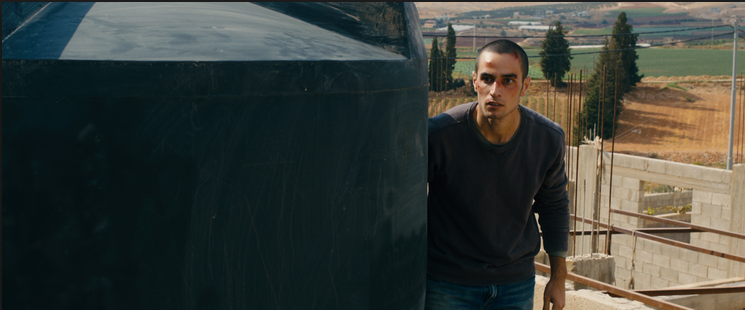
Omar (Adam Bakri)

Omar (Adam Bakri)

Palestine. Israel. Two cultures separated by conflict and war. We know the popular names: the Gaza Strip … the West Bank. Some say strife between these lands is deeply rooted in biblical history but here is what we all know: this socio-geo-political conflict seems endless.

Palestinian director Hany Abu-Assad moves into the vein of everyday life within this discord in his riveting film Omar. Set in the West Bank, Abu-Assad tells the story of Omar (Adam Bakri), a young baker, who, along with his comrades Tarek (Eyad Hourani) and Amjad (Samer Bisharat) form a group of Palestinian rebels who, in acts of defiance, scale the wall that divide the occupied territories. In Omar’s case, the wall cannot keep him from his love Nadia (Leem Lubany).

Omar jumps the wall to see his love, Nadia

Omar jumps the wall to see his love, Nadia

The film is lovely in its dramatization of camaraderie between friends Omar, Tarek, and Amjad, and the delicacy of love separated by clashes and disputes. Abu-Assad is careful to portray a generation of innocence caught in the legacy of war with no way out. Here is where the story turns brutal. After the rebels kill an Israeli soldier, Omar is the only one who is caught. In the hands of officials, he is tortured, and Abu-Assad holds nothing back in his portrayal of these scenes as well as Omar’s angst when presented with a deal. The director does not stop there. Days and nights are blanketed with distrust, deception, and betrayal. The story literally descends into a hellish nightmare, and Palestinian life, already compromised by circumstances that run an historical deep, proves more than stressful. Sadness aside, Abu-Assad patiently films the everyday of Palestinian life, breathing into every home, street, alleyway, countryside, and dialogue the ordinariness of people who manage to live and to be just like everyone else.

Omar and Nadia (Leem Lubany)

Omar and Nadia (Leem Lubany)

There are politics, yes, but the director refuses to strangle Omar with the usual suspects of bureaucracy, interrogation, and red tape. Instead, his major focus is on the characters who are brought to life so wonderfully by the actors, and their character interpretations are worth the price of the ticket!

Adam Bakri, especially, is to be applauded for his rich performance of Omar, a character whose hopes are torn asunder by battles fought over land that have yet to be resolved, and consequences of these battles inherited by his generation.

The Ross logo

Omar plays through March 20 at the Ross Arts Center in Lincoln.

Watch for film, television, & more!

In the meantime,
catch a film!
share the popcorn!
feed your soul!

Broken Circle Breakdown @ The Ross

Elise (Veerle Baetens) and Didier (Johan Heldenbergh) share a tender moment.

Elise (Veerle Baetens) and Didier (Johan Heldenbergh) share a tender moment.

Melodrama with Blue Grass music and Tattoos to boot! In Belgium! The Broken Circle Breakdown, directed by Felix Van Groeningen, will call for every tear you can shed. Groeningen mixes a pish-posh of narrative elements to tell the story of the beautiful free-spirited tattoo artist Elise (Veerle Baetens) and Didier, a banjo player (Johan Heldenbergh). Elise joins Didier’s band, and what follows is a life of joy and fun blanketed by the American twang of Bluegrass music. It is the music that binds these two likeable characters together. They are a sensual couple who are in love—really in love–with not only each other but with life, and Elise and Didier partake of it with abandon.

Heldenbergh carefully portrays Didier as a talented troubadour who, once in love, tries to do everything necessary to make Elise happy. Baetens’s Elise is settled and confident in her new found love because in this bluegrass world with Didier, she has a safe place to land. In that place, she engages all of her sensuality and rolls it up on the music.

The family & Maybelle (Nell Cattrysse)

The family & Maybelle (Nell Cattrysse)

But not one coordinated fret on the banjo can prevent life from intervening on their happiness and, like everyone who lives to tell it, Elise and Didier must search for ways to shelter their marriage from disaster, and are hard-pressed to do so. It is a passionate journey that moves the emotions to the edge. Van Groeningen showcases how this couple manages the severe differences between them. Elise is a believer; Didier is an atheist. When tragedy strikes their 6-year-old daughter Maybelle (played by Nell Cattrysse), Didier grows angry with the world and his inability to control this illness that has been thrown at him with no notice. Elise takes a different approach: she calls on her faith to lift her out of her quagmire of emotions. In all, Elise and Didier experience a marital identity crisis, and we hope and pray they see their way through it. Why? Because we like Elise and Didier; we really do.

The Ross logo

The Broken Circle Breakdown, however, is over-the-top melodrama, and the flashbacks border on annoyance. The strong acting and the story itself, nevertheless, will have you reaching for the Kleenex.

Watch for film, television, & more …
In the meantime, catch a film!
share the popcorn!
feed your soul!

The Week’s End

As we settle into the week’s end, think on this:

Stay away from what and who does not belong to you. That commandment, “thou shalt not covet they neighbor’s goods” is no joke! Why? Because what is not yours never will be happy with you–ever! It will harangue you. It will taunt you. At worse, it will cause destruction in your your world. Bottom line? It wants its own master, and YOU are not it. Remember this: What you are searching for is searching for you and for you only! Be patient while waiting for it to find you. The Psalmist tells us to “fret not thyself” and to “be still […]” and to “wait patiently […]” (Psalm 37). If you are preoccupied with what is not your own, what IS yours will pass on because it has no place to rest in your household. That which is your own is waiting for the right time and for the right place to come to you. Be prepared to receive and embrace it.

Happy Week’s End ~ to all of you!