What if January 6 occurred yet again? How would the nation handle it? War Game explores strategies.
On January 6, 2023, VET VOICE, a non-partisan Veterans organization, staged a secret national security exercise steps from the U.S. Capital. The filmmakers were granted access to document the unscripted exercise.
This statement opens War Game, a 2024 documentary film by Tony Gerber and Jesse Moss, and the exercise is an exploration of the U. S. government’s preparation for what could be a major national conflict. Gerber and Moss deftly combine real world possibilities and strategies within the tense atmosphere of real-world stakes.
Is our Government Ready? is the main question vibrating throughout the documentary. As with any game, there are Teams and Rules. Here, the film organizes a bipartisan team strategizing how to defend U.S. interests against an internal enemy.
The cast of characters range from the government, the military, and the intelligence community. It is a surreal behind the scenes as make-up artists ready the cast for their portrayals. Who’s sitting in the chair? Former Governor of Montana Steve Bullock playing President John Hotham; retired United States Army Officer Wesley Clark playing Chairman of the Joint Chiefs of Staff; former United States Senator from North Dakota Heidi Heitkamp as Senior Advisor to the President; former United States Senator from Alabama Doug Jones as Attorney General, among other personalities.
Gerber and Moss skillfully capture a range of personal perspectives, from the high-level decision-making to the raw emotions of soldiers on the ground.
The documentary is rich in detail, an engrossing, if occasionally clinical, exploration as it portrays real-life national anxieties, tensions, and fear—visceral fear–of the possibility of a coup and another civil war. Where is our hope?
Visually, War Game brings an authentic, almost intimate feel to what is an overwhelming subject. The realism is enhanced by the lack of heavy-handed narration, allowing the events and participants to speak for themselves.
Overall, War Game provides a compelling and thought-provoking look into national possibilities that could harm our nation. The film remains relevant to ongoing discussions about necessary strategies to preserve our democracy.
Man’s inhumanity to man/makes countless thousands mourn are the two stanzas from Man was Made to Mourn: A Dirge composed by the Scottish poet Robert Burns in 1784 It is a fitting introduction to Green Border, Agnieszka Holland’s newest film on the European refugee crisis.
Green Border is a gritty, stone cold film dramatizing the unexpected terror experienced by a busload of refugees who have paid for their trek to freedom with their savings. Several times I wanted to stop watching the film; several times I distracted myself from the film by scrolling TikTok videos as I paused it. It did not help my viewing experience that Green Border runs for 2 hours and 30 minutes. Yes. Green Border is intense in its dramatization of brutality and desperation for asylum, which can be both compelling and difficult to watch. Holland refuses to let up!
The story begins with a high angle of a lush forest, and Tomasz Naumiuk’s camera quickly devolves into a cold black and white canvas of passengers aboard Turkish airlines. It’s October 2021. A hungry baby’s cry lacerates the quiet humm of the airplane, and a whispered conversation between two women—a mother and a middle-aged woman alerts the audience of the border crossing. The mother says to the woman:
“This route through Belarus is a gift from God. It’s a thousand times better otherwise I wouldn’t have come here. With children. Never in my life. In Harasta, Syria we lost everything, the home, the store. We escaped the siege for five years.”
As the Captain announces, “the temperature is -2. … It was my pleasure to have you all on board and we wish you a very good day”, we are lulled into a sense of safety upon the landing at Minsk airport in Belarus, a country in the center of eastern Europe. Panic ensues when the refugees realize the gift, or the route through Belarus, was but a ruse. One of the activists informs the group,
“The Polish Government does not want you here. It’s telling the Polish people that you are evil. The dictator of Belarus cheated you. He invited you on purpose to use you as weapon against the European Union, and now nobody wants to take responsibility for you here neither Belarus nor the Union.”
They are forced over a border separated by barbed wire and are left to fend for themselves in the forest. The forest is a poignant feature of Green Borders. It is unforgiving and provide no shelter from the elements. We are sutured into every discomfort you can imagine under these circumstances, to include lack of food and water and exposure to freezing temperatures. It’s mean-spirited in every way.
In Green Border, Holland deftly explores man’s inhumanity to man in the dramatization of human suffering, political tension, and the ethics of immigration policies, the latter a pressing global issue.
Green Border is a significant film because it is a major intervention into the conversation about immigration and human rights.
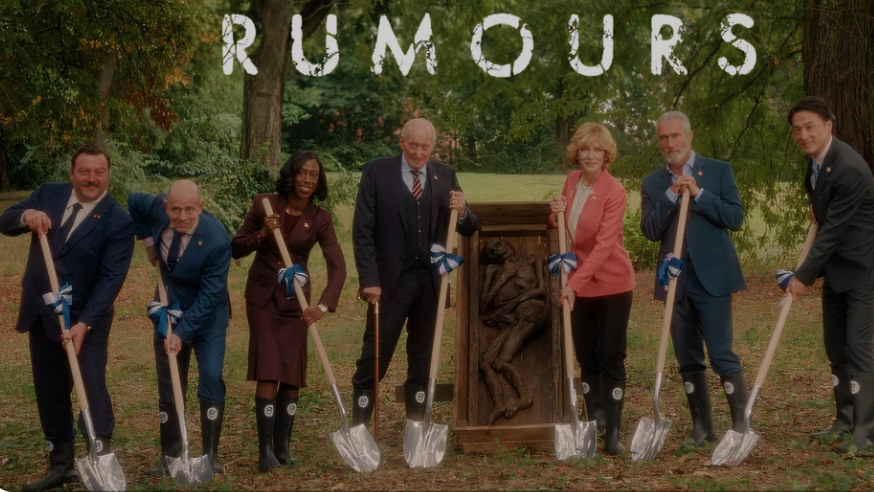
Maybe we could use a bit of political satire right now. You know, enjoy a laugh here and there given this new changing of the guard on the horizon for 1600 Pennsylvania Avenue. Canadian directors Guy Maddin, Evan Johnson, and Galen Johnson have produced a spoof of sorts called Rumours, a collaboration that delivers an immersive cinematic experience that pushes the boundaries of conventional storytelling.
Rumours weaves a kaleidoscopic narrative, blending surrealist imagery, fragmented storytelling, and a dense, dreamlike atmosphere around a fictional G7 summit, a gathering of 7 leaders of the world who have assembled in a chateau in the small town of Dankerode, Germany to discuss well, world leadership. Maddin and Crew blend absurd political comedy with elements of horror, science fiction, and surrealism.
Leaders from the United States, Canada, France, the United Kingdom, Italy, Japan, attend the summit as well as the European Commission’s Secretary-General.
The film’s premise is as elusive as its execution, built around the concept of hearsay and half-truths. The narrative unfolds in a fragmented manner as characters drift in and out of the story like ghosts. Their dialogue isn’t for us; they’re preoccupied with their own insular circle. Whispers and distorted audio fragments bring to relief animated yet hollow people who just happened upon luck and were anointed their country’s leader. They lack substance and direction, and mumble about inconsequential things. What is worse, they aren’t planning anything—no strategy. No missives. No future plans. To the point: What’s the crisis?
All leaders are stranded in the woods somewhere out there in Dankerode, Germany, and, as usual, when night comes no telling what kind of things arrive to greet you. The sound design plays a crucial role in immersing the viewer then catapulting the senses into a realm of darkness, uncertainty, and fear, creating a disorienting atmosphere wrapped in a feeling that the sounds are reaching out from a distance heightening the film’s ghostly mood. There’s even a bit of the absurd! Just imagine discovering a something or other the size of an asteroid plunked down in the forest.
It doesn’t stop there. Shadow or bog people lurk about the fog-laden forest in the night. These ancient mummified figures that represent a preserved though buried history juxtaposed modern political ineptitude. More broadly, The Bog People are part of the film’s critique of leadership and communication failures.
The Film stars Cate Blanchett, Nikki Anuka Bird, Charles Dance, and Takehiro Hira.
Rumours plays through Thursday, November 28 at The Ross Media Arts Center in Lincoln
Also playing at The Ross through December 5 is Anora, Sean Baker’s audacious, thrilling, and comedic variation on a modern day Cinderella story.
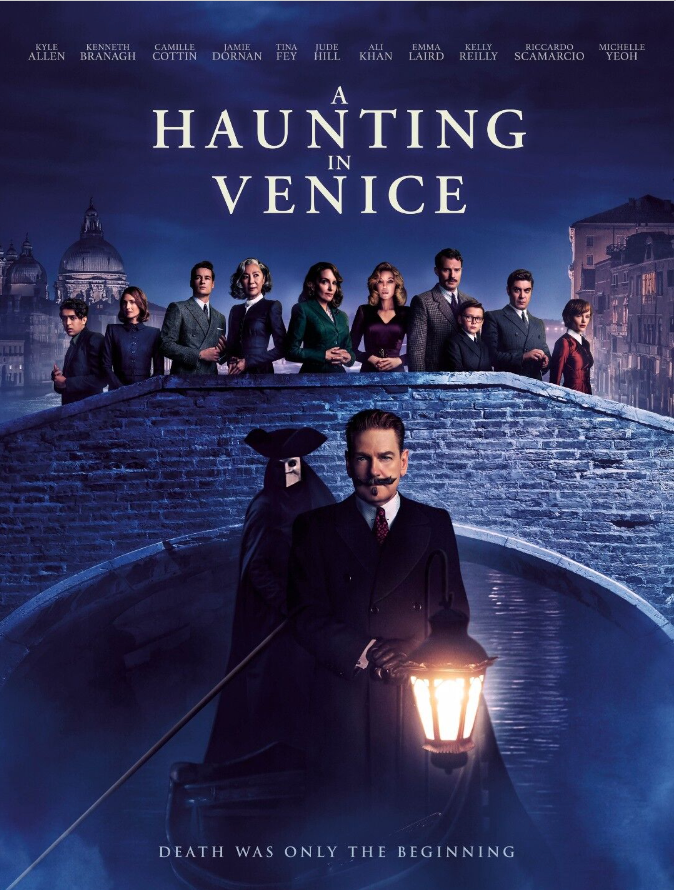
Kenneth Branagh has made a successful turn in the film universe as Agatha Christie’s eccentric but luvable Hercule Poirot in A Haunting in Venice, Agatha Christie’s murder mystery set in Venice, Italy. I absolutely enjoy his interpretation of the egghead detective but he is no match–and I mean NO MATCH–for David Suchet’s masterful portrayal.
You might appreciate Tina Fey’s turn as Poirot’s longtime friend, Ariadne Oliver, mystery writer, though Ariadne’s twist is hurtful, and Poirot feels it in his core. Michelle Yeoh marvels as the enigmatic Mrs. Reynolds.
As it is the cinematography in Murder on the Orient Express and Murder on the Nile, the visuals of Venice are stunning, thanks to cinematographer Haris Zambarloukos, and John Paul Kelly’s interiors are shrouded in delightful shadows and mystery.
Add A Haunting in Venice to your Halloween watchlist. You will not be disappointed.
A word to the wise is sufficient: If you get all twisted and contorted and begin to hiss and spit at a spoiler, read no further:
Parents, be careful: Your children watch you and those around you. They watch your treatment by others, even your friends. Most important, be careful what notes and such you leave around the house. Children are curious, and they will read them. Reading is one thing but to COMPREHEND what is written by you is another. It could get you killed.
And that’s The Skinny!
Watch for in-depth Film • Television • & More reviews & commentary right here on The Dreher Report.
In the meantime, Catch a film. Share the Popcorn. Feed Your Soul!
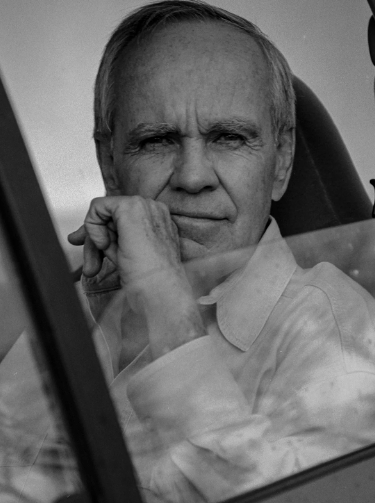
Thoughts on the passing of Cormac McCarthy, Author
by Amanda Gailey
(special to The Dreher Report)
Cormac McCarthy died. About ten years ago, I went on a bender reading his beautiful and horrific novels until I hit a point when I realized the horror and nihilism were too much for me, that they were feeding a part of my mind that didn’t need the help. At the time, I lied to myself that the horrible things that haunted my imagination were false, that they would never come to pass. But many of them have. And that’s why, I guess, when I look at my son sometimes, one particular passage in The Road written by McCarthy comes to my mind:
“He’d stop and lean on the cart and the boy would go on and then stop and look back and he would raise his weeping eyes and see him standing there in the road looking back at him from some unimaginable future, glowing in that waste like a tabernacle.”
I associate his books with a period when I was preoccupied with worry about something happening to my children. It was bad. I talked myself down eventually by trying not to indulge the worries and by rationally persuading myself of the statistics. And then guess what? It happened, some of the worst things you can imagine. Even if you have all the love, all the protective instincts, all the statistics on your side, it doesn’t fucking matter at all. That’s what The Road is really about—you can’t do a damned thing but stand there weeping while fate or chance or genetics or the sins of humanity do what they will with the only things that matter to you. So here’s to Cormac McCarthy who died June 13, 2023, and to all standing in the road looking back.
Amanda Gailey is Associate Professor, English at the University of Nebraska, Lincoln. She specializes in digital text editing and nineteenth-century American literature, and regularly teaches classes in both of these areas. She has published Proofs of Genius: Collected Editions from the American Revolution to the Digital Age (U of Michigan P).
Ryan Grovey is coming to Lincoln. Ryan Grovey is coming to Omaha. Some of you already know him. Perhaps you learned choreography from him when he was a Zumba® Jammer. Or, maybe he trained you to become a MixxedFit® instructor. How about U-Jam Fitness®? If you have not had the opportunity to meet, dance, and/or train with Ryan Grovey, now is your chance.
His first stop is The Clyde Malone Center, in partnership with Danielle Garcia, for its 2nd Annual Health and Fitness Event, 2032 U Street, 3-5 pm, Saturday, April 15. There, Ryan Grovey will be in full effect on the floor bringing his high intensity dance fitness and strength movements. The event is Free and Open to the Public. (Scroll down for poster).
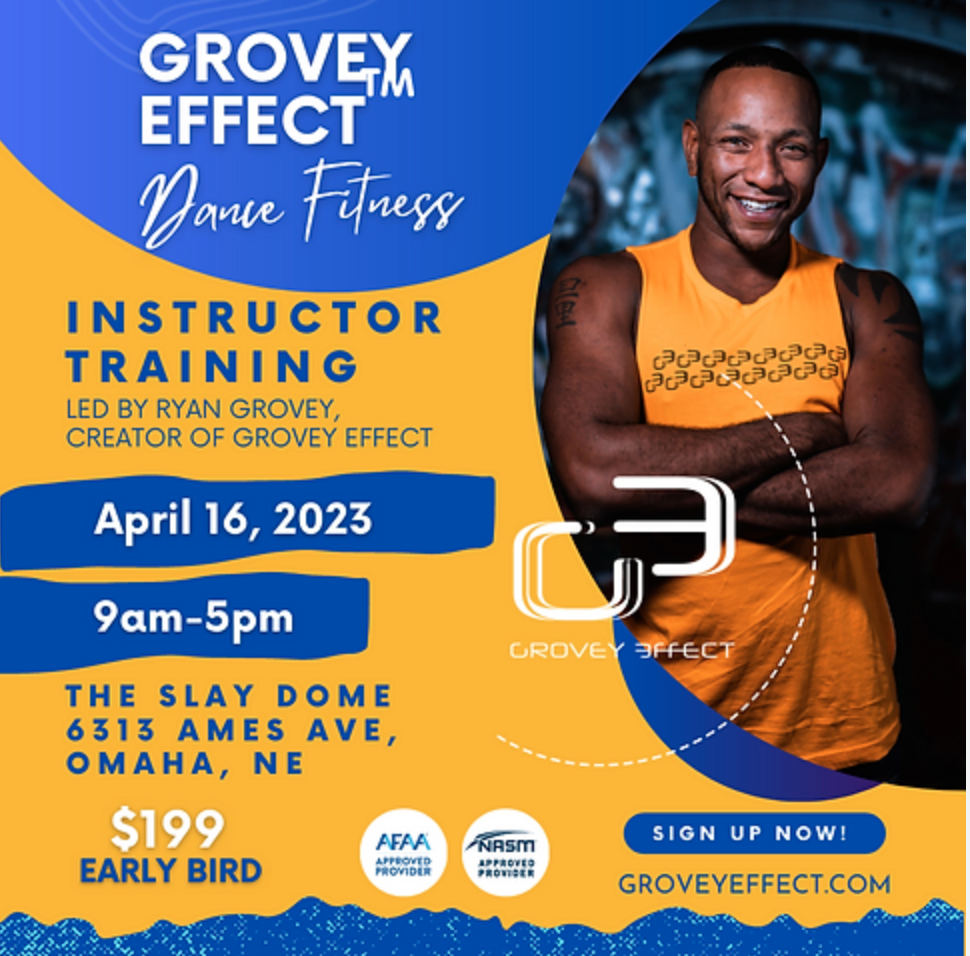
Interested in becoming a The Grovey Effect dance fitness instructor? Join him at The Slay Dome, 6313 Ames Avenue in Omaha, 9am-5pm Sunday, April 16. Sign up at groveyeffect.com. (Scroll down for poster).
Want to know more about Ryan Grovey? Read The Interview below.
What inspired you to form The Grovey Effect dance fitness program?
A lot of things; the main one being COVID. The pandemic really gave me the push I needed to think about creating my own dance fitness program. I am an accomplished dance fitness instructor, having earned my place in dance fitness by way of Hip Hop, Zumba®, MixxedFit®, and World of Dance U-Jam Fitness®. All along, however, I wanted to start my own platform. I talked with my mother who had encouraged me to go on my own for I don’t know how long. My friends had been telling me to step out on my own as well. I just didn’t know how and when to do it. Then COVID hit. My entire income shot to zero after 10 years of the grind and hustle.
How did the pandemic propel you into The Grovey Effect?
I decided to jump online and offer my first free class. I didn’t know what to call it, but I knew I wanted to do my own thing. I put together all choreography I had created over the years. Once I went virtual, I immediately received hundreds of comments! People were asking where to sign up, even how to become an instructor. Let me tell you I had no idea what the heck I was dealing with, but I knew I had created what was the beginning something new and exciting.
Did you create this all on your own?
No. Not at all. I started out very small and created a tight knit committed community! I organized a team of people—some dancers and instructors–to help bring the vision to life. Everyone flew out to Arizona, including my best friend, Diana. The magic of The Grovey Effect was created in my house. We covered my entire upstairs/downstairs wall with post-its and big notepads outlining choreographies and developing our mission.
We filmed about 30 choreographies; later, I conducted a mock training with our corporate team; we had about 60 instructors our first training!
Our mission is to give individuals an incredibly fun, high-energy and effective workout experience that inspires them to develop and grow in all areas of their lives.
What does The Grovey Effect dance fitness program offer that other programs do not?
The Grovey Effect is dance fitness with dynamic cardio, but we incorporate HIIT and strength-style movements. It’s a challenging engagement with dance. We have customized mixes created and arranged by our Grovey Effect DJ. Our classes move dancers to the mountain with a strong push for them to give it all they have. Get that heart rate up!
How has The Grovey Effect developed?
From that first meeting in my house in Arizona, we’ve expanded to a host of states across the country and internationally. I’m talking Mexico, the Philippines, Malaysia, even Japan. We were in Asia for three weeks!
As leaders in the dance fitness industry, GE instructors are valued contributors to positively change the world and instill GE Culture into the lives of our students and community.
Mark out The Grovey Effect team.
Oh wow, yes, our team is spread out all over the country–the world. Our formatting developer, Renee, is in Seattle, Washington; Angela, our Instructor Care Specialist is in Arkansas; Lori, our IT specialist, is here in Arizona; my mom, Patricia Grovey Evans, of course, is the Vice President, and lives in New Mexico; my executive assistant, Pearly, lives in the Philippines.
What do you want to accomplish with The Grovey Effect?
The Grovey Effect is THE next dance fitness program—the largest–on the same level as Zumba! You can print that! We’re just in our second year and we’re already operating in the international arena.
Walk me through your process for developing new choreography? How long does it take you?
I am actually really blessed because my best friend Diana is my choreographer who does the majority of my choreography. I’ll send her the songs that I like and tell her what I envision—a change here, a step there—and we come together to figure out what we can do to maximize and change.
What keeps you motivated?
I’m just a grinder—always have been. I see my vision and I know my vision. I want to be able to take care of my family and have kids; take care of my mother, so I do what I have to do to ensure that I can contribute to a happy healthy lifestyle in the lives of everyone I care about.
Is The Grovey Effect your sole means of exercise?
My dance fitness program is hot cardio, so I have to really integrate the weight training and be sure to eat well. I eat about five times a day. Lots of turkey and fish, and lots of vegetables.
What is the value of dance to you?
Different rhythms speak to the heart … speak to the soul. Dance is movement, and it can take you to different places even in the middle of class. Not to mention that dance allows you to release all the toxins. When I teach, I am motivated by the people who dance with me and find that my platform inspires them to keep on dancing. Someone told me the other day they cannot live without The Grovey Effect! Another wanted to know about online classes because she was leaving for the summer. All contribute to the value of dance in general. I am glad that The Grovey Effect adds tremendous value to dance!
To learn more about Ryan and The Grovey Effect, click link here.
Guillermo del Toro’s Pinocchio is a masterpiece. (Spoiler alert if you have not seen it yet). Geppetto and his son Carlo are developed in heartfelt detail within the opening 15 minutes. As a consequence, Carlo’s death (which you know is coming) leaves you feeling empty.
Geppetto goes down a dark road of drinking and self-loathing. He quits working and, in a drunken stupor, cuts down Carlo’s memorial tree to make a puppet. It all happens deep in the night while he’s completely shit-faced. A life-long mastery of woodcraft is blurred by alcohol yet it is obvious he can handle a chisel and block plane. It is not until morning, after Pinocchio is brought to life, that you see how freakishly assembled he is. It is shocking at first.
Voiced by a wonderful actor (Gregory Mann), Pinocchio quickly overcomes awkward social queues, falls in with a loathsome puppeteer named Count Volpe (Christoph Waltz), and becomes a beloved performer. You fall in love with him too.
Then he dies.
Throughout the film, Pinocchio ventures back and forth between the afterlife. Each time he encounters four black rabbits who look like the bunny in Donnie Darko. He learns the rules of eternal life from Death (Tilda Swinton) who is scary at first. She embodies Greco Roman, Egyptian, and Mesopotamian Gods all mixed together.
The narrative becomes a proto-Grecian myth as Death explains things patiently to Pinocchio. Each time he dies (whether by vehicle, bullet, or sea-mine) he learns that he has agency in life and he can learn from his mistakes. He learns of deeper more troubling problems too, privy only to those who live forever.
Pinocchio cost $35 million to produce. Once you see the quality of stop-motion animation you might guess why. This is by far one of the best stop-motion films.
Michael Burton is a digital artist, film director, and animation producer. Burton combines art, film, and animation to create historically based stories. He has produced several hybrid-animation shorts including Gold Slipper by Willa Cather (2020), Anna (2018), and Freedom Stories (2022). Burton produced and animated the feature film The Bell Affair (2022). Burton’s digital artwork has been featured across the country and in solo exhibitions at the National Willa Cather Center in Red Cloud, Nebraska, the Denver Art Museum, RISD Art Museum, Joslyn Art Museum, Digital Graffiti in Alys Beach, Florida, and the Sheldon Art Museum.
He is currently the director of the Robert Hillestad Textiles Gallery and an Assistant Professor of Foundation Art and Design at the University of Nebraska-Lincoln.
Jameel Rashad Patterson comments on the decision Deion Sanders made to accept the offer of Head Coach at the University of Colorado. Sanders’s decision has drawn controversy given he left Jackson State University, a beloved HBCU in Mississippi.
Special to The Dreher Report
I see both sides of it. It would have been cool if he could have ushered in a new era where the Black community had stake in the talent base of Black athletes. Ultimately, we do not know what Deion Sanders went through as coach of Jackson State, how much support he received, and how the HBCU community welcomed him.
I guarantee you this: Somebody at Jackson State and in the HBCU world is happy he is gone.
From my experience, some members of the Black community would rather keep things the way they are because they benefit some kind of way. Even when Nick Saban [head coach at the University of Alabama] came at Prime, there were probably people in the HBCU world who agreed with him. People usually side with power. Even the people bashing Prime for doing what he deems to be best for him and his family probably do the same thing in their own communities and families.
We really stand on the shoulders of our ancestors, our people who stuck together and created networks. We are not the same as our ancestors, however, even though we stand on common historical ground. They owned sports teams, built communities together. Our ancestors started these colleges, and supported the civil rights movement. In some ways, that’s not our culture today. We bend toward individualism.
In essence, Coach Prime talked a good game so that is why he is getting criticism. Oftentimes when we embark on agendas for the Black community we are not prepared for Black people to be adversarial with us. That’s disheartening, and if Prime went through that, I do not blame him for leaving.
Ultimately we want Prime to lead a grassroots effort of building from the ground up. It is not that we do not have the parts, it is a kind of culture we have embraced for the past four decades in which those parts do not operate in unison. It is an individualistic type culture. Some of us still have the communal ways of our ancestors but those ways are not the dominant culture in Black America .
One of those parts is the HBCU. Why don’t we see rich Black athletes putting their money together to create conglomerates? We say we need to start our own league well Ice Cube did it but you do not see Jay Z, Dre, Puff or whoever helping him for purpose creating our own institutions. It’s obvious: the incentives are not here but can be found in the 40s and 30s, those times. I am not mad at Prime moving with the current of the culture. We have to embrace change and embrace new ideas or a culture of individualism will take shape. I say let’s change the culture.
Rome. Sparta. The Vikings. Ancient China. Great Britain. Movies have been made about these and numerous other aggressive polities in world history. Each one has conquered, slaughtered, and enslaved their way to dominance, and they conquered, slaughtered and enslaved to maintain their dominance.
We enjoyed Gladiator (2000) and 300 (2006), as well as their predecessors The Robe (1953), Ben Hur (1959), and Spartacus (1960) (among others), even though the Romans, throughout the course of their existence as part of a republic and later empire, routinely committed mass murder and enslaved countless Europeans. Yet, they’ve been consistently valorized in cinema. The movie 300, for instance, made it seem as though Sparta was a bright beacon of the Greek idea of freedom in opposition to Persia’s despotism and slavery. Sparta, though, repressed its subservient Helot population with terrible ruthlessness.
I’m aware of Dahomey’s history, and have never had any illusion about the brutality of its armies and the role the kingdom played in feeding the slave trade. However, we shouldn’t shy away from seeing an African kingdom and empire portrayed on screen because of objectionable aspects of its history.
I want to see every African empire and historical African figure either featured in film or in a mini-series format, warts and all, because every precolonial African state has caused massive bloodshed and suffering from the wars they have waged. On the flipside, these very African states produced some of the finest art, literature and architecture the world has ever seen. Their highly developed statecraft, as well, belied traditional European/American notions of Africans being primitive savages. For example, Scottish philosopher David Hume wrote in his essay “Of National Characters”, that there were “no ingenious manufactures amongst [the African], no arts, no sciences.” Emmanuel Kant, the German philosopher, believed as well, that among “…the Negros of Africa … not a single one was ever found who presented anything great in art or science or any other praise-worthy quality…”
We should bring to light these African kingdoms and empires just as the Might of Rome and the semi-mythical King Arthur and his famed knights of the roundtable have been repeatedly highlighted in popular culture.
The creators of The Woman King, I am sure, are seeking to capitalize on what they hope will be a successful Black Panther sequel. Keep in mind, though, that the Dahomean warrior women were unique in the world at that time and in history as being the only organized group of women soldiers. When we speak of great women in African history, it’s usually as individuals. Nzinga or Amina for example, who, besides being strong leaders, demonstrated individual combat abilities. The Dahomean women were regiments of skilled fighters, the elite of the Dahomean military. Their achievements almost demanded a movie.
Ronald Jones is a writer of science fiction. He has written three novels Warriors of the Four Worlds, Blood, Sweat, and Blaster Bolts: Adrenaline Charged Tales of Speculative Fiction, and Interrupted Journey.
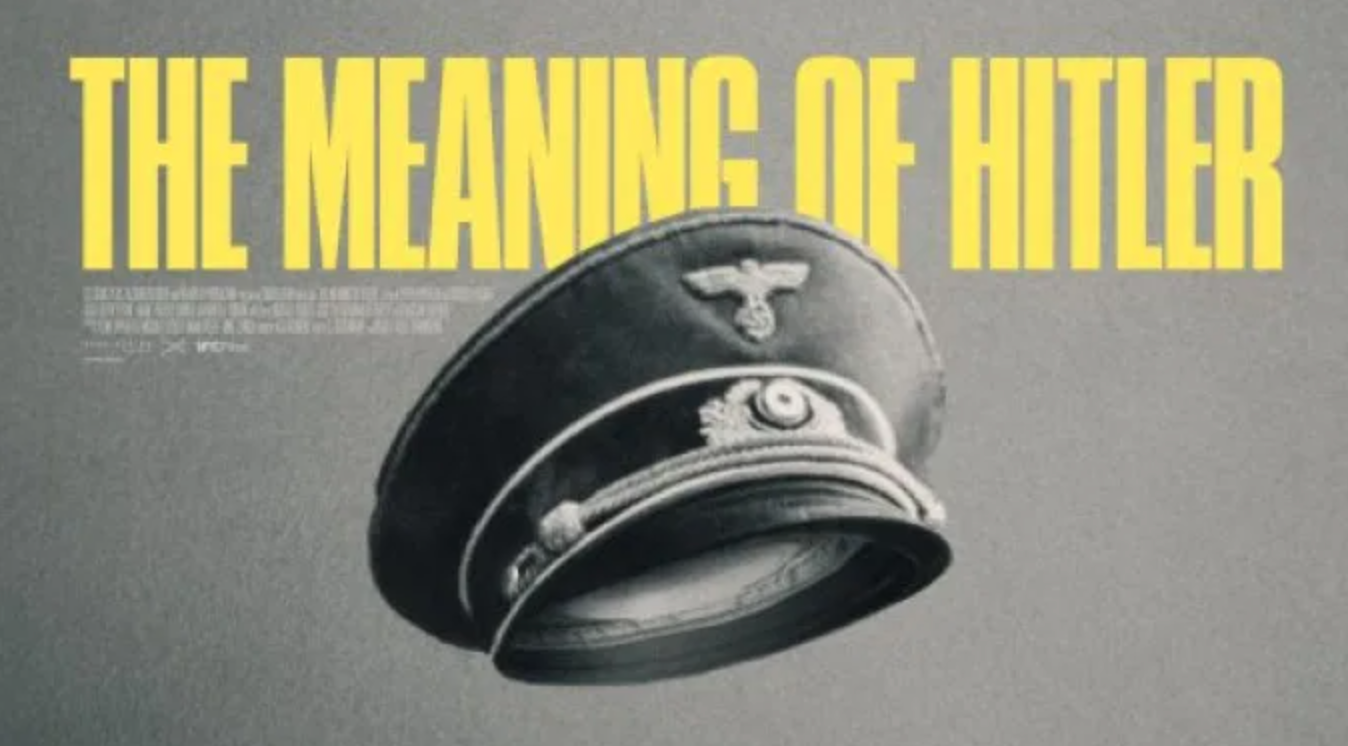
We know practically every tract of land through which the train tracks ran: Auschwitz. Buckenwald. Birkennau. Dachau. Sobibor—to name a few. Based on the book by Sebastian Haffner, The Meaning of Hitler is a seductive documentary – seductive because I clung to every piece of dialogue and every scene for that one glimmer of understanding. Maybe, just maybe, this time, I thought, the directors, Petra Epperlein and Michael Tucker; the screenwriter Sebastian Haffner; or maybe the historians Deborah Lipstadt, Saul Friedländer, and Yehuda Bauer; or the pscychiatrists, sociologist, the archaeologist, and famed Nazi hunters Beate and Serge Klarsfeld, will say the words that will put to rest finally just who was Adolf Hitler and shed some light finally on his meaning to the world, in general, and specifically, to German history.
And I waited.
What is interesting about The Meaning of Hitler is the all-present Mercedes-Benz hood ornament. Designed by Gottlieb Daimler in 1872, each point stands for transportation on land, water, and air. The camera filters the scenic routes through the 3-points-in-a-circle as the filmmakers travel to the next destination. Post-screening of The Meaning of Hitler, the luxury status of a shiny white Mercedes-Benz I saw cruising on O-Street, here in Lincoln, Nebraska, was undercut by the ghost of its history; and the knowledge of the complicity of the Daimler Benz company in the Nazi horror. And then there is the microphone—the newly invented microphone–that allowed Hitler to move about uninhibited onstage as it lifted the messages from his voice, carried them through the air, and landed them on the ears of the assembled masses.
And I waited.
Edited with tight-fisted precision, Epperlein and Tucker remarkably juxtapose mob exhilaration over the Beatles at Shea Stadium and Donald J. Trump speeches, the Charlottesville Tiki torch parade with Hitler’s charismatic personality and his ability to move people to action. The political spectacle dramatized by Leni Riefenstahl in her landmark film Triumph of the Will, produced in 1935, adds an eerie dimension to the documentary
And I waited.
Among other destinations, there are visits to Hitler’s ancestral village in Austria, his apartment complex, and Wolf’s Lair, the Third Reich’s Military headquarters. The most disturbing visual is that of David Irving, a bona fide anti-semitic and a fervent denier of the Holocaust. He believes Hitler’s commanders carried out every atrocity behind the Fuehrer’s back.
And I waited
… only to see how Nazism and Hitler has seeped into pop culture and embraced by a new generation. Be forewarned, these are the most frightening interviews.
Watch for in-depth Film • Television • & More reviews & commentary.
In the meantime, Catch a film … Share the Popcorn … Feed Your Soul!













 The Dreher Report
Prime Notes
by: Jameel Rashad Patterson
Jameel Rashad Patterson comments on the decision Deion Sanders made to accept the offer of Head Coach at the University of Colorado. Sanders’s decision has drawn controversy given he left Jackson State University, a beloved HBCU in Mississippi.
Special to The Dreher Report
I see both sides of it. It would have been cool if he could have ushered in a new era where the Black community had stake in the talent base of Black athletes. Ultimately, we do not know what Deion Sanders went through as coach of Jackson State, how much support he received, and how the HBCU community welcomed him.
I guarantee you this: Somebody at Jackson State and in the HBCU world is happy he is gone.
From my experience, some members of the Black community would rather keep things the way they are because they benefit some kind of way. Even when Nick Saban [head coach at the University of Alabama] came at Prime, there were probably people in the HBCU world who agreed with him. People usually side with power. Even the people bashing Prime for doing what he deems to be best for him and his family probably do the same thing in their own communities and families.
We really stand on the shoulders of our ancestors, our people who stuck together and created networks. We are not the same as our ancestors, however, even though we stand on common historical ground. They owned sports teams, built communities together. Our ancestors started these colleges, and supported the civil rights movement. In some ways, that’s not our culture today. We bend toward individualism.
In essence, Coach Prime talked a good game so that is why he is getting criticism. Oftentimes when we embark on agendas for the Black community we are not prepared for Black people to be adversarial with us. That’s disheartening, and if Prime went through that, I do not blame him for leaving.
Ultimately we want Prime to lead a grassroots effort of building from the ground up. It is not that we do not have the parts, it is a kind of culture we have embraced for the past four decades in which those parts do not operate in unison. It is an individualistic type culture. Some of us still have the communal ways of our ancestors but those ways are not the dominant culture in Black America .
One of those parts is the HBCU. Why don’t we see rich Black athletes putting their money together to create conglomerates? We say we need to start our own league well Ice Cube did it but you do not see Jay Z, Dre, Puff or whoever helping him for purpose creating our own institutions. It’s obvious: the incentives are not here but can be found in the 40s and 30s, those times. I am not mad at Prime moving with the current of the culture. We have to embrace change and embrace new ideas or a culture of individualism will take shape. I say let’s change the culture.
Share this:
Posted by drdreher01 on December 13, 2022
https://thedreherreport.com/2022/12/13/prime-notes/