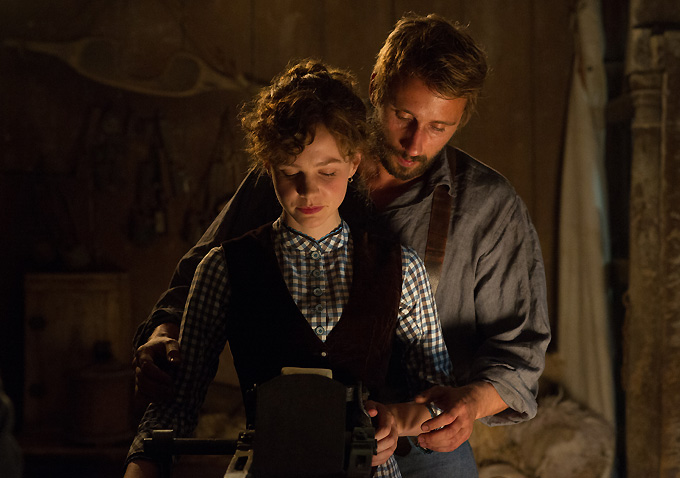
Far From the Madding Crowd @ The Ross

Bathsheba Everdene (Carey Mulligan) and Gabriel Oak (Matthias Schoenaerts)

Bathsheba Everdene (Carey Mulligan) and Gabriel Oak (Matthias Schoenaerts)

Thomas Vinterberg directs Far from the Madding Crowd, his film adaptation of Thomas Hardy’s novel of the same name. Set in 19th century Victorian England, the film centers on the friendship of sheep farmer Gabriel Oak, played by Matthew Shoenaerts, and the headstrong farmer Bathsheba Everdene played by Carey Mulligan. Mr. Oak (as Bathsheba calls him) trusts that his and Bathsheba’s friendship has matured and his economic station is firmly established. When he gathers some courage, he asks her to marry him. She politely declines, offering the excuse that she has no interest in marrying him nor any man. As fate would have it, however, each character’s fortune twists in ways that neither could have anticipated. Mr. Oak’s fortunes turn for the worse. His sheep dog drives all of his herd over the cliff and, thus, he has to give up his farm and seek work with Bathsheba, who, by contrast has inherited a vast acreage of farm land plus a mansion. She attracts three suitors: Sgt. Francis Troy, played by Tom Sturridge; William Boldwood, a monied landowner played by Michael Sheen; and, of course Mr. Oak. His admiration of and devotion to Bathsheba never wavers; and he admirably measures his feelings when asked by Bathsheba for his counsel on matters of the farm and the heart, even though some consultations are strained and do not work in his favor.
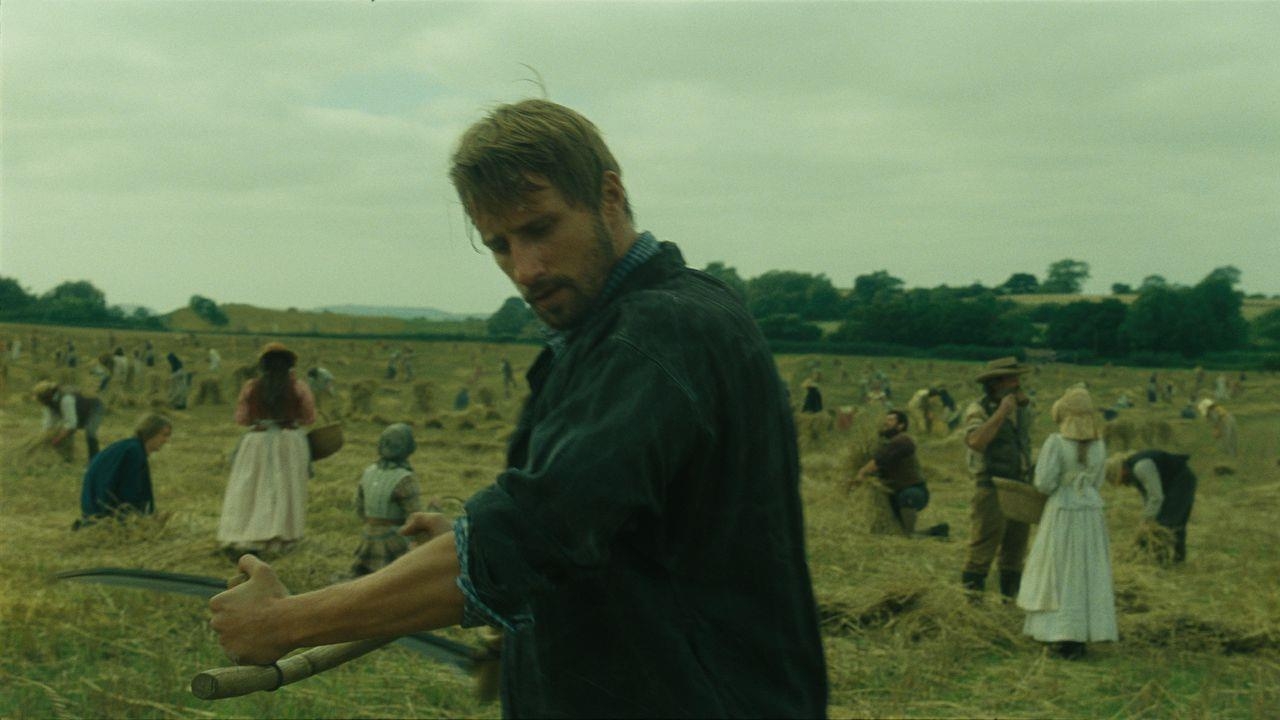
Mr. Oak works the land.

Mr. Oak works the land.

Charlotte Christensen’s cinematography is Oscar worthy. Her panoramic photographs will lull you to sleep as she sweeps across the English countryside. Her depth of field portray the expanse of the land; her character close-ups pull you into the intimacies of moment. You will feel the isolation from the madding crowd and you will sense the urgency of the management of the farm and people through her lens.

The performances by Shoenaerts and Mulligan make for stalwart bookends to Vinterberg’s project. Mulligan shines as she produces a very independent Bathsheba but is sure not to overplay her character’s strong will. Yes, she is financially independent; yes, she is a good manager of people and land. Yet Mulligan has her character recognize people and situations that she cannot control while still maintaining her self-respect AND her money.

Bathsheba surveys her land.

Bathsheba surveys her land.

Throughout ill-fortune and economic gain; nature’s wrath and smile on the land; and, love, marriage, and even murder, Mr. Oak remains as sturdy as his name implies. When he falls into financial ruin, Shoenaerts plays him as a dispirited yet confident sheep herder who, no matter the trial, has a healthy investment in his own worth. When Bathsheba sometimes acts out in arrogance, he dismisses her disrespect; one time he quits the farm rather to be subjected to Bathsheba’s unwarranted whims. No, he is not a man for whom to feel sorry; rather, Mr. Oak is so confident in his farming skills that he believes another place of employment awaits him without question no matter the circumstances. By the same token, Shoenaerts’s Mr. Oak carefully minds his station in the full realization that being gainfully employed brings about comfort in economic stability–not to mention self-satisfaction.

Far from the Madding Crowd is a well-orchestrated film that not only illustrates the intensity of love and desire; in addition, film director Vinterberg and cinematographer Christensen have delivered the beauty of the work ethic. We are given scenes of farmhands tilling the soil and loving it! We see those who work with their hands relish their work, and celebrate a good crop with a good drink and a song. Those were the times …

Far from the Madding Crowd plays through June 25 at The Mary Riepma Ross Media Arts Center.

Watch for in-depth Film • Television • & More reviews & commentary.

In the meantime,
Catch a film!
Share the Popcorn!
Watch TV!
Feed Your Soul!
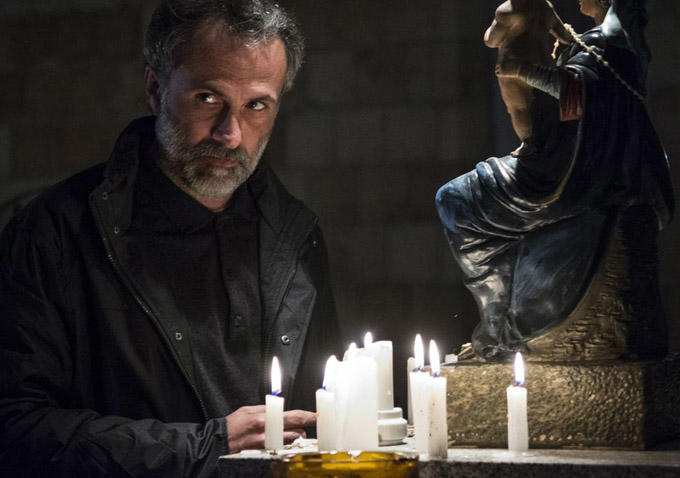
Black Souls @ The Ross

Luciano (Frabrizio Ferracane) seeks solace at the altar

Luciano (Frabrizio Ferracane) seeks solace at the altar

We all have relatives and friends who have chosen paths in life that would make angels fast and pray. We cannot help them nor their situation; some Bible scriptures command us to love them, and we do or at least we try to love them, but from afar. Yet, no matter how much we distance ourselves from them, there is something about the biological hook-up that will cause their life choices to interrupt, if not traumatize our own. Before we know it, we are swept up into a whirlpool of something or other. Life as we have known it never will be the same–ever.

Members from the mafia try to restrain Leo (Guiseppe Fumo)

Members from the mafia try to restrain Leo (Guiseppe Fumo)

Such is the tragic predicament of Luciano in Francesco Munzi’as dark and brooding film Black Souls. I’ll get the obvious out of the way: On its face, Black Souls is a gangster film but without all of the slick glitz we have experienced in Martin Scorsese’s Goodfellas and Francis Ford Coppola’s The Godfather. Munzi, still, carefully interlaces within Black Souls the usual gangster film elements: there is a Godfather Rocco, played with dark worry by Peppino Mazzotta; the good-natured brother Luigi, played by Marco Leonardi, and Leo, Luciano’s hot-headed son ready to come-of-age, played by newcomer Giuseppe Fumo.

The Funeral

The Funeral

Director Munzi makes a filmic turn by setting the story between two worlds: the cosmopolitan city of Milan and the mountainous more remote region of Africo. Luciano, played by Fabrizio Ferracane, is a humble goat farmer in Africo. He has painstakingly distanced himself and his family from life in an underworld whereby his brothers have built a lucrative drug business in Milan–or so he believes. His occupation pales by comparison, and Leo, his 20-year-old son whom he has raised among a herd of goats, rejects his father’s world and turns to the sleek and monied environment of his Uncle Rocco and Uncle Luigi. Thus begins the conflict; thus begins the sorrow; thus begins the torment–all wrapped up into a package delivered to Luciano’s threshold. When that package is unwrapped, there is a descent into madness; what is even worse, no one in the family places a hand on Luciano’s shoulder to help him move through his grief. And that, my friends, is the black in the soul of this film.

Black Souls is a tender story about the powerful force of family. That no matter if you move to heaven or to hell to be away from those who threaten your sense of the world, by some means … in some fashion … what they do or have done will find a way onto your own doorstep.

The Ross logo

Black Souls plays through May 21st at the Ross Media Arts Center in Lincoln.

Welcome to Me also plays thru May 21st at the Ross.

Watch for in-depth Film • Television • & More reviews & commentary.
In the meantime, catch a film, share the Popcorn, and feed your soul!

Matt Shepard is a Friend of Mine @ The Ross

Matthew Shepard

Matthew Shepard

I was in graduate school when I heard of Matthew Shepard. What struck me about his murder was that it occurred in isolation. I could imagine, only imagine, in between a swath of stars that dotted a midnight sky and the wide-open space of the Wyoming frontier, the dogged sounds of a pistol being whipped across Shepard’s skull by the perpetrators Aaron McKinney and Russell Henderson; the sounds of Shepard crying out in that wilderness with no one to hear him but his murderers; and, the echoes and hums of living things only heard in a rough country as they tied him to a fence and left him to die. When I saw his image in the newspaper, I shook my head and murmured, “Tch. He was but a boy … just a boy … who was he? Why?” His death galvanized the LGBTQ community given than he was gay. Later, Matthew Shepard became the symbol for hate crimes committed against those who are different.

Matt Shepard is a Friend of Mine answered those questions. Directed by Michelle Josue, this documentary delves into the story of Matthew Shepard, his life, his parents, and the town of Laramie, Wyoming. Josue and Shepard became friends while both were students at a Swiss boarding school. In her debut, Josue features Shepard’s family and friends who loved him and the teachers who believed in him. She says, “As his story became an international news event, my heartbreak and sense of loss only grew as my friend Matt was replaced by ‘Matthew Shepard,’ an historic figure and icon that will forever be associated with unspeakable violence and hate.” Every testimony, as well as the documentary, serves as post-eulogies for Shepard, and will leave you feeling as if his life has been given its just due outside of the bright lights of the media.

Josue, also, uncovers more than expected; at times, she moves us past our comfort zones. The fence where Shepard was tied up still stands, and its visual is haunting. She brings to the forefront the violent rape by a gang of men Shepard suffered while on a high school trip to Morocco. More poignant, and uncomfortable, is an interview with a Catholic Priest who counselled McKinney and Henderson; he challenges her to think about forgiveness and to consider that McKinney and Henderson are our brothers. Josue begins to sob because she cannot fathom that these men who beat and tortured her friend are worthy of forgiveness. Can you? Would you … forgive? Judy and Dennis Shepard, Matthew’s parents, might will generate some insight into forgiveness in this very personal and intimately raw documentary of Matthew Shepard.

Matthew Shepard is a Friend of Mine plays through April 23 at the Mary Riepma Ross Media Arts Center in Lincoln.

The Ross logo

Watch for in-depth Film • Television • & More reviews & commentary.

In the meantime:
Catch a film
Share the popcorn
Watch TV
Feed your soul!

She’s Beautiful When She’s Angry @ The Ross

Screen Shot 2015-11-05 at 8.22.12 PM

Mary Dore’s documentary She’s Beautiful when She’s Angry is an historical overview of one of the most influential movements in the history of women’s liberation, the founding of the National Organization for Women, better known as NOW. The documentary features the social engineers of that founding, and you will welcome the commentary from them: Susan Brownmiller, Jacqui Michot Ceballos, Rita Mae Brown, Linda Burnham, and Eleanor Holmes Norton are just a few of this stellar line-up of narrators.

These women form a cacophony of voices all rallying around the common cause of women’s liberation. One issue that groups grappled with was how do you integrate race, class, and gender when working within the movement? How do you interlace the difference of experience between women? For example, in an interview with Linda Burnham, the activist explains, “it was very difficult for middle class white women to have any conception about what was going on in communities of color […] and when the voice of one is used as the voice of all, you have a problem.” Eleanor Norton Holmes explained “Black women who have spent their lives working in other women’s kitchens have a different kind of handicap than women who have been oppressed for their sex and other ways.”

Screen Shot 2015-11-05 at 8.24.12 PM

Mary Dore, the director, deftly weaves in stock footage from the 1960s and 1970s of demonstrations, arrests of women activists, and the downright humiliating reactions from their male counterparts. What comes through She’s Beautiful when She’s Angry is the buzz words or the women issues that have been long associated with this movement, and they are sexual harassment, rape, homophobia, domestic violence, safe ad legal abortion, and economic equality. The rallying chants equally are significant, such as “The Personal is Political”; Roxanne Dunbar’s proclamation “I am a revolutionary … I am a feminist … there is no possibility for me to be liberated except that all women be liberated”; and Texas activist Virginia Whitehill’s missive, “You’re not allowed to retire from women’s issues.” The dialogue of the narrators is astounding, and when watching them, you see that the fiery commitment to these women issues burns brightly–still.

Screen Shot 2015-11-05 at 8.25.57 PM

Striking to the documentary are the juxtaposition of women burning bras and taking their voices to the streets with poetry and periodicals, pamphlets, and mission statements with the responses from men. One man, for example, President Richard Nixon, issued a tragic blow to the Comprehensive Child Care Act passed by the Senate in 1970. He countered, “we don’t want to make our women like soviet women. We want women to take care of their own children.” Surprisingly, men countered with their own banner “Husbands and Fathers for Women’s Liberation.”

If you want to see a well-documented history lesson on women and the struggle for equal rights, then Mary Dore’s She’s Beautiful when She’s Angry is the film for you.

The Ross logo

Watch for in-depth Film • Television • & More reviews & commentary.
In the meantime, Catch a film. Share the Popcorn. Feed Your Soul!

Happy Valley @ The Ross

Screen Shot 2016-03-18 at 5.26.18 PM

Happy Valley is a documentary every Nebraskan should see. Directed by Emmy Award-winning filmmaker Amir Bar-Lev, Happy Valley is an exploration of a community where football is a religion. Uh uh, do not try to deny it! We all know the depression that sets in this state when football season is over. You especially will appreciate Amir Bar-Lev’s subjects: Assistant Coach Jerry Sandusky at Pennsylvania State University, and the charges of child molestation for which he was convicted in November 2011.

Amir Bar-Lev’s camera is relentless as it probes the culture of hero worship, secrets, accusations, and tragedy in a city still recovering from an identity crisis. Happy Valley refuses to be a witch hunt of a documentary; let’s face it, the damage is done and now is rooted in the psyches of its residents. Instead, Amir Bar-Lev critiques our penchant to place humans on a pedestal when they bring to us fame and celebrity, especially when it comes from the arena of the athlete, that revered gladiator of sports.

The documentary opens with a long shot of the verdant land filled with tailgaters pitching tents and organizing food in preparation for the game. Coach Joe Paterno begins the dialogue, “You know, it’s a tough life, and to be able to get away and go someplace where you meet friends that you only see once and a while; each stupid food; drink more than you should drink; can get excited about going to a game, and just get it all together and have 100,000 people doing the same dumb things makes you feel that you’re not as dumb as you think you are. College football is something special, and hopefully we will never lose sight of that or screw it up!”

Screen Shot 2016-03-18 at 5.30.37 PM.png

Matthew Sandusky

In November 2011, things screwed up, and Amir Bar-Lev exposes all the elements that went into causing the tragedy that catapulted the state into confusion, shame, and grief. The interview with Sandusky’s adoptive son, Matt, who grew up in a house with no running water, no toilets, and no sinks, among his relatives that numbered 30, will cause your heart to shudder. Remembering his impression of Sandusky when he joined the Assistant coach’s summer camps as a child, Matt says, “to be right next to him, and to understand that he chose you, I felt powerful. I felt like people looked at me and envied me instead of people looking down on me.”

Happy Valley Plays through March 8 at The Ross in Lincoln.

The Ross logo

What We Do In the Shadows @ The Ross

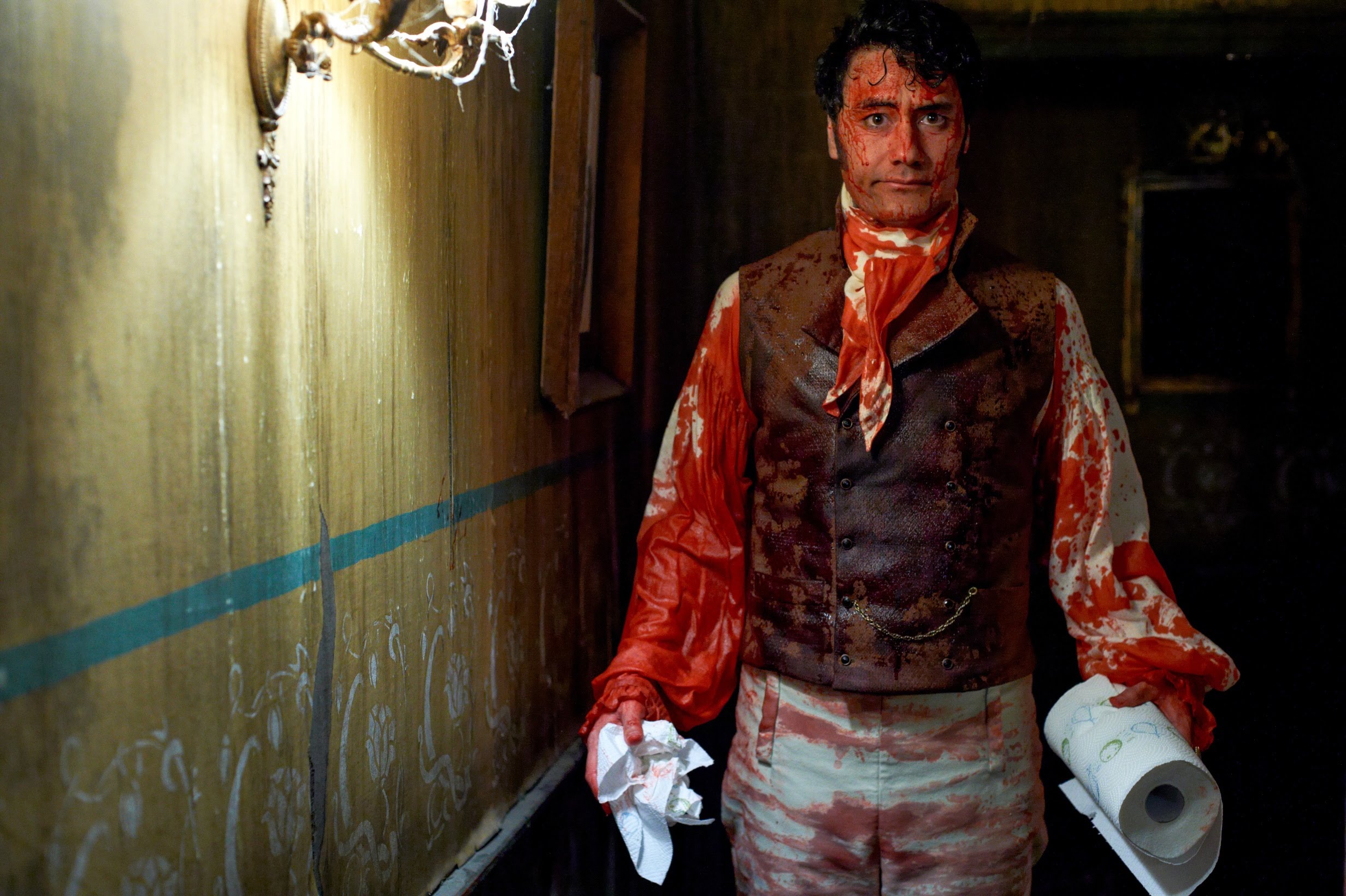
Viago (Taika Waititi)

Viago (Taika Waititi)

Who cannot forget the dark and brooding Count Dracula played by the very handsome Frank Langella in John Badham’s 1979 film Dracula? Or the dashing forever young George Hamilton as Count Vladimir Dracula in Stan Dragoti’s film Love at First Bite also released in 1979? Yes, that’s when Vampires were handsome, sexy, and seductive. Given the right circumstances, you would be hard pressed not to offer your neck to them for a midnight snack. Well, if you come into contact with the vampires in What We Do in the Shadows, an absurd documentary about vampires written and directed by Jemaine Clement and Taika Waititi, you might want to stock up on those turtlenecks and scarves.

Vladislov (Jermaine Clement), Deacon (Jonathan Brugh), and Viago (Jemaine Clement)

Vladislov (Jermaine Clement), Deacon (Jonathan Brugh), and Viago (Jemaine Clement)

Yes, these vampires are outrageous in their antics, and you will love them and all of the unholy ways; I’m not so sure, however, you would want them around when the sun goes down. You never know what they might do in the shadows. Vampires have been running through the night of our popular culture for ages, and Clement and Waititi keeps going our interest in them. Set in New Zealand, the film features a house of four zany vampires. Just to name them would be an injustice so here goes their descriptions. There is Petry, played by Ben Fransham, who is a mute in dire need of a dentist; Deacon, played by Jonathan Brugh refuses to inhabit his age, and he is old; Vladislav, played by co-director Jemaine Clement, is the introspective one who believes in vampire traditions; and, Viago, the leader, played by co-director Taika Waititi adds his own flair to the bunch. These directors explore the night-to-night activities of these dysfunctional creatures from howling and hissing at rival werewolf gangs to house cleaning to coming out as a vampire to friends to discussions about the difference between humans and vampires–you know … the everyday ordinary struggles of life. Along the way, these vampires try to decipher modern day technologies such as skype, cell phones, and computers.

Clement and Waititi have sucked out the seduction and sexy, and even the ugly and repulsive (remember Boris Karloff’s and Gary Oldman’s Draculas?) along with all of our popular notions accorded to vampires to portray regular unadorned people who just happen to be vampires. Threaded within the film is a heartfelt theme: We all have our differences so let us at least try to live peacefully among each other. Just be careful when you come out at night.

What We Do In The Shadows plays through March 12 at the Mary Riepma Ross Media Arts Center in Lincoln.

The Ross logo

Watch for in-depth Film • Television • & More reviews & commentary.

In the meantime,
Catch a film!
Watch an episode!
Share the Popcorn … Feed Your Soul!

Mr Turner @ The Ross

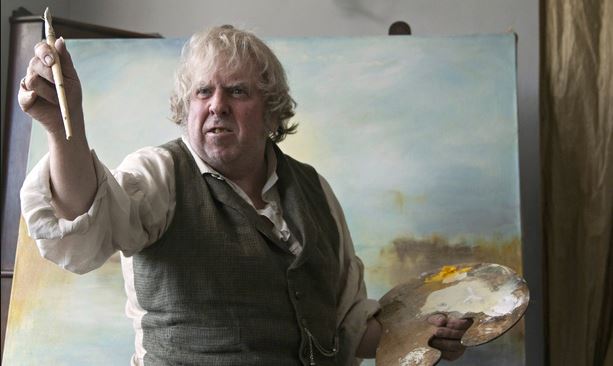
Mr. Turner (Timothy Spall)

Mr. Turner (Timothy Spall)

I highly recommend that you refrain from watching Mike Leigh’s biopic Mr. Turner if you have had a pleasant day; just close it out with a mug of hot chocolate and a snuggle into your grandmother’s afghan or Aunt Gertrude’s quilt. Contemplate the sunset or the close of the horizon as dusk makes its way to welcome the night. Or, if your fuddy-duddy tendencies have reared their ugly heads and a rainbow and a smiley face are the last things you need, then Leigh’s Mr. Turner is just the film for you—all one hundred and fifty minutes of it!

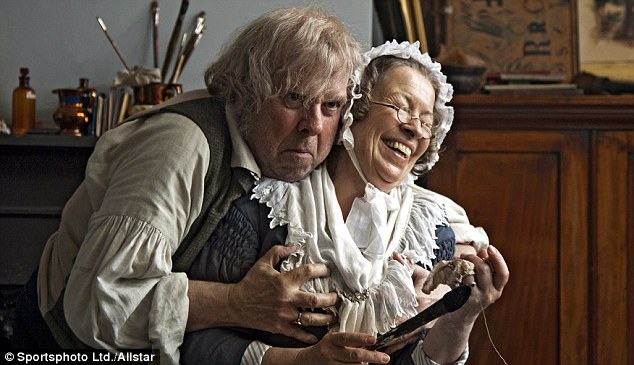
Mr. Turner and Mrs. Booth (Marion Bailey) enjoy a moment of levity.

Mr. Turner and Mrs. Booth (Marion Bailey) enjoy a moment of levity.

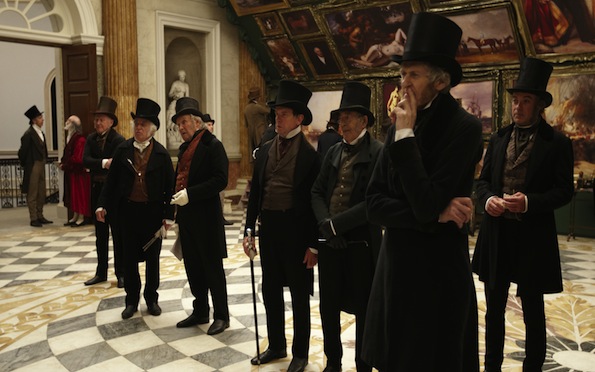
The movie stars Timothy Spall as Mr. Turner, the eccentric British painter—-you know, I’m going to stop right here: eccentric is NOT the description. Spall’s Mr. Turner is a mere aged warthog of a man who grunts and squints as he points a paint brush to a canvas and manages to create a bunch of beige brown sage grey and blue paintings of seascapes and ships at sea that critics deem as art. There. Set in the last twenty five years of his life when he is a celebrated artist in the 1800s, Mr. Turner’s community of artists is equally vacuous, consisting of men–excuse me–artists whose conversations would make a heathen pray for redemption!

Yes. Mike Leigh creates a world without warmth and fuzz, and Mr. Turner along with his cursed housekeeper Hannah Danby played by Dorothy Atkinson and his landlady/lover Mrs. Sophie Booth (played with appeal by Marion Bailey) all move within the dank and cold corridors with ease and comfort.

The Community of Artists

The Community of Artists

Mrs. Booth takes in Mr. Turner as a boarder in her upper room when he visits the seaside town of Margate to get away from London. Later she becomes his companion. Hannah, whom Mr. Turner calls ‘Damsel’, is enamored with her employer who sees her as he would a chair—without notice unless he needs to sit in it; and he sit he does when he desires to sexually exploit her. Both women carry with them a loyalty for Mr. Turner even until death.

fr left Sarah Danby (Ruthy Sheen), William Turner (Paul Jesson), Hannah "Damsal" Danby, (Dorothy Atkinson) , Georgiana (Amy Dawson), and Sarah Foster as Evelina

fr left Sarah Danby (Ruthy Sheen), William Turner (Paul Jesson), Hannah “Damsel” Danby, (Dorothy Atkinson) , Georgiana (Amy Dawson), and Sarah Foster as Evelina

All is not lost, however. Only his estranged mistress Sarah Danby, played exceptionally by Ruth Sheen, stands in for the audience’s own yearnings. She pleads for some demonstration of emotion and sentiment from the painter, especially since she has born him two daughters, Georgiana (Amy Dawson) and Evelina (Sarah Foster). The linguistic exchanges are a welcomed respite. Dick Pope’s cinematography is a feast for the eyes what with sweeping long shots of the sea and its ships; and, Paul Jesson’s performance as Mr. Turner’s father, William, is superb.

William Turner (Paul Jesson)

William Turner (Paul Jesson)

Mr Turner plays through March 5 at the Mary Riepma Ross Media Arts Center in Lincoln.

Watch for in-depth Film • Television • & More reviews & commentary.

In the meantime,
Catch a film
Share the Popcorn
Watch TV
Feed Your Soul!

Two Days, One Night @ The Ross

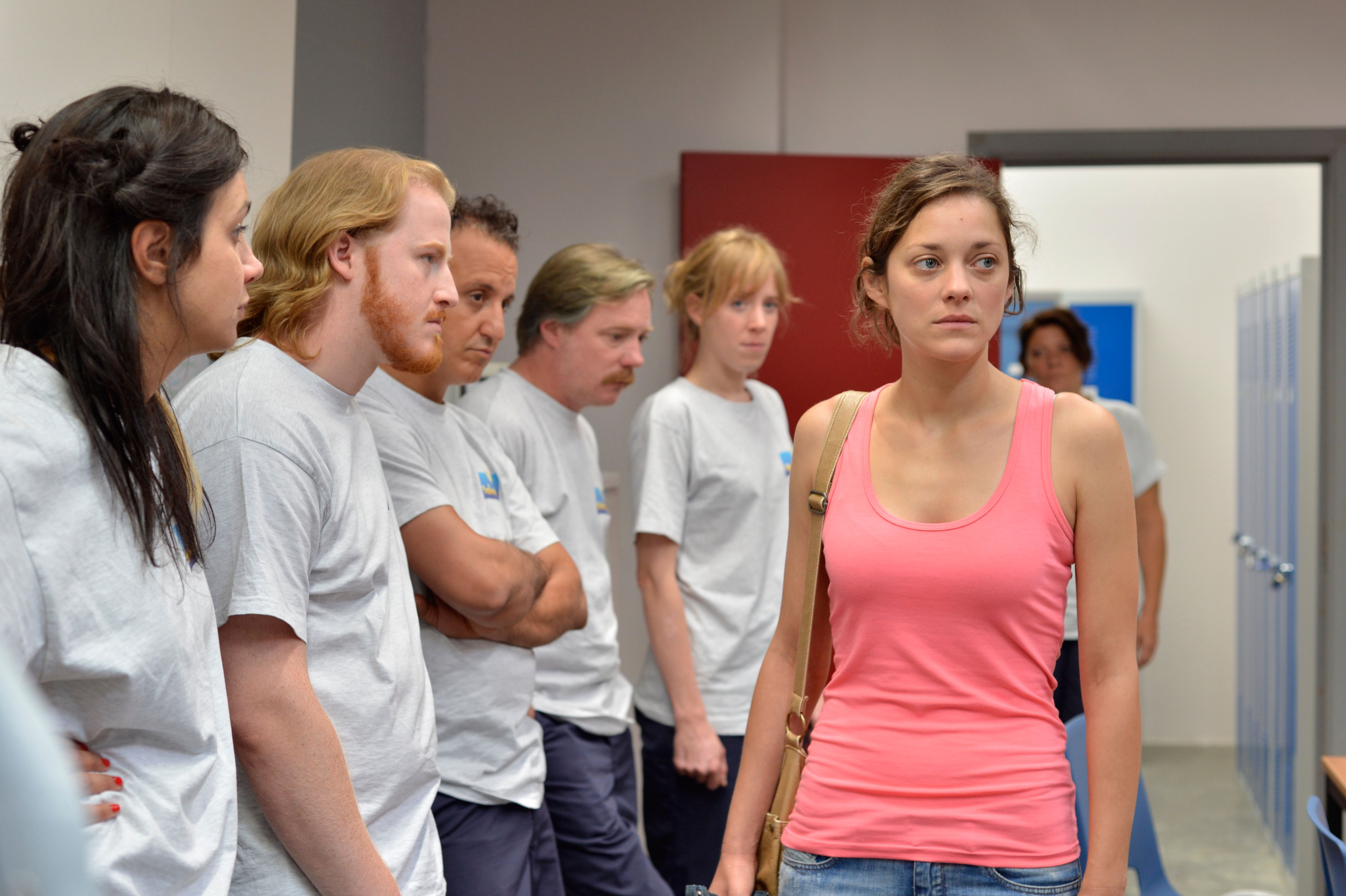
Sandra (Marion Cotillard) walks the line between co-workers

Sandra (Marion Cotillard) walks the line between co-workers

It takes courage to ask for what you want in life, especially when that desire is created out of a dire need to survive. To ask for anything is complicated because that act requires another party to grant to you your request; and, depending on the circumstances, the quest for any desire can put you at their mercy! The exchange can go either way: a cry of jubilance or a descent into humiliation. French brothers and filmmakers Jean-Pierre Dardenne and Luc Dardenne have concluded that to ask is a performance of humility in their French language film Two Days, One Night starring Marion Cotillard and Fabrizio Rongione.

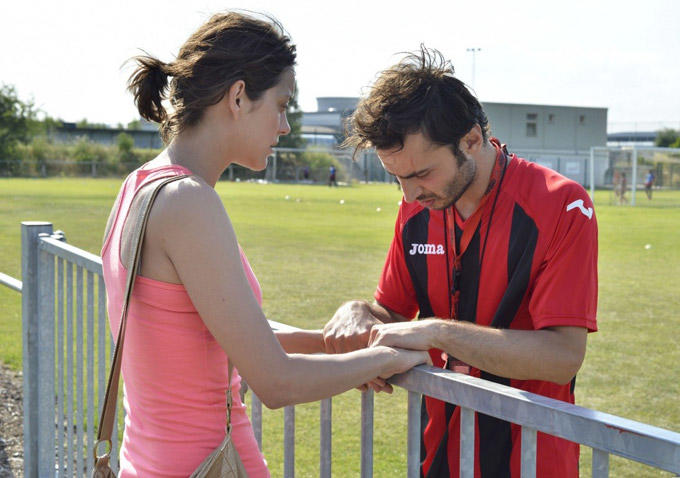
Manu (Fabrizio Rangione) encourages Sandra (Cotilliard) to make a call.

Manu (Fabrizio Rangione) encourages Sandra (Cotilliard) to make a call.

As the story goes, Sandra, a Belgian blue collar worker played Cotillard, has been fired essentially by her co-workers in favor of a company bonus of 1,000 Euros. The manager has found that his team of employees can get the work done without Sandra. He offers them a choice: take a company bonus and fire Sandra or vote for Sandra and forego the bonus. Sandra is told of the vote on Friday. Her friend Juliette, played by Catherine Salee, persuades the boss, Dumont, played by Batiste Sornin to schedule another vote that Monday. He agrees, and Sandra’s husband Manu, played with charming patience by Rongione, convinces Sandra to visit each co-worker over the weekend or two days and one night, and ask them to recast their vote in favor of her keeping the job.

A co-worker expresses remorse for voting against Sandra

A co-worker expresses remorse for voting against Sandra

What follows is a disquieting journey as audiences are forced to experience Sandra’s every plea wrapped in humility and emotion. Cotillard is brilliant as Sandra, as she displays every minute detail of her character’s emotion. She cannot appear desperate; nor can she beg but she must demonstrate to each co-worker that her job is just as important to her as those 1,000 euros are to them. Yet, the filmmakers carefully coax us into an understanding of her co-workers’s reasons for their vote against her. Those euros come just in time to take care of those family necessities that otherwise would go to seed.

Sandra and the one night visit in search of one vote

Sandra and the one night visit in search of one vote

Each visit … each knock on the door … each ring of the door-bell brings her front and center to the culprits; their exchanges are delicate especially since Sandra’s request lays out her personal financial situation: her husband’s salary is not enough to take care of the family. Sandra’s firm resolve to take this most excruciating journey to stand face-to-face with the culprits, however, is a portrayal of a particular kind of heroine, and you will love her. There is no jubilant cry nor a descent into humiliation; rather, there is a sigh of relief from a woman who, at the end of her journey, brings home to her family a personal self whose sleep will come easy.

Two Days, One Night plays through February 26 at the Ross Media Arts Center in Lincoln.

The Ross logo

Watch for in-depth Film • Television • & More reviews & commentary.

In the meantime,
Catch a film …
Share the Popcorn …
Feed Your Soul!

Foxcatcher @ The Ross

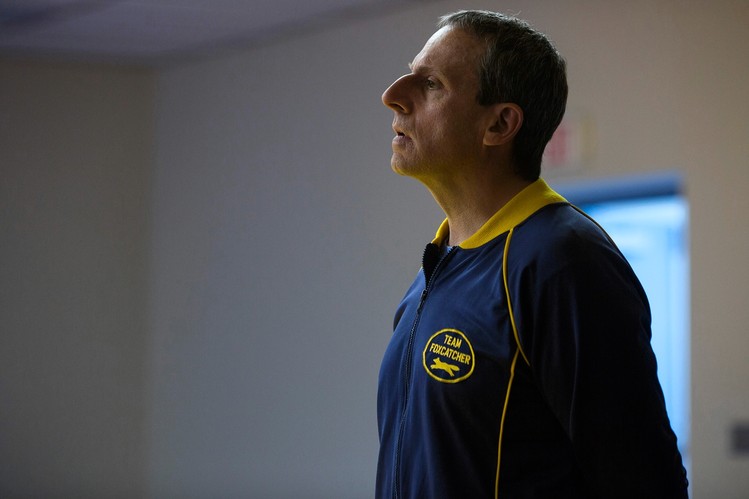
John du Pont (Steve Carell)

John du Pont (Steve Carell)

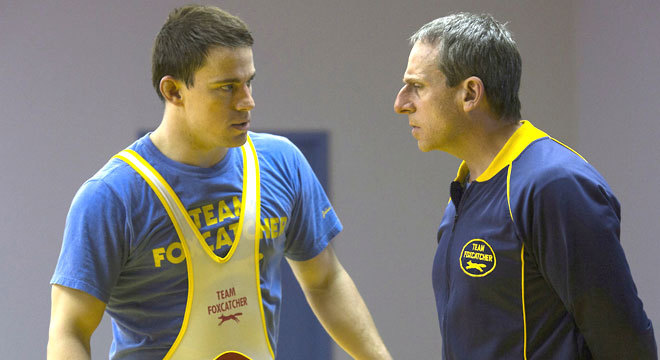
Bennett Miller’s newest film Foxcatcher is a sturm and drang of a production. Set in a time of limbo for Olympic hopefuls who are training for the 1988 Seoul Olympics, Foxcatcher tells the story of Mark and David Schultz, two brother wrestlers who won Gold Medals competing in the 1984 Olympics in Los Angeles. Mark, played by Channing Tatum, lives in a ramshackle of an apartment. The only family he has is his brother David, played by Mark Ruffalo. The film opens with Mark giving a speech to a very uninterested elementary school audience on the American Dream and the discipline and focus necessary to attain it—all for a hefty $20.00. Mark’s hope for another try at that Gold Medal, however, pushes away the effects of his depressing environs. He is alone. He lives alone. His brother David, by contrast, is happily married to Nancy, played by Sienna Miller, and they have two rambunctious fun-loving children. The death of their parents and the sport of wrestling bonded the two brothers. David raised Mark and trained him to wrestle. When the sinister millionaire (and he is sinister) John du Pont (Steve Carell) enters the picture, Miller’s film direction painstakingly constructs a deadly triangle that blindsides all parties involved.

The Brothers Mark Schultz (Channing Tatum) and David Schultz (Mark Ruffalo)

The Brothers Mark Schultz (Channing Tatum) and David Schultz (Mark Ruffalo)

The sturm and drang of Foxcatcher comes from the vision of the after glory of an athletic god who finds no solace in anything other than the Olympic coliseum. That Mark is reduced to accepting speaking engagements at $20 a pop is heartbreaking, and Miller mercilessly opens with this visual. His contrasts in du Pont, Mark, and David men are finely-tuned that when they constellate, you feel the ominous cloud hovering above them.

Once you wade through the grunts and grumbles of men in leotards wrestling on the mat, a story of the shortcomings of wealth emerges. We know the saying: money cannot buy you love. Well, screenwriters E. Max Frye and Dan Futterman have crafted a narrative that places front and center John du Pont’s yearning for the brotherly love he witnesses between Mark and David. For all of his wealth and power; for all of the 1,000 acre du Pont estate in New Town Square Pennsylvania; and, for all of the fatherly demonstrations of love he accords to the ever needy wrestler Mark, John du Pont, heir to the du Pont family fortune, cannot break the unfaltering faith, loyalty, and love between Mark and David. Nor, can he have it. This is Foxcatcher’s arc, and Steve Carell’s portrayal of du Pont’s craving cuts like a knife.

Mark and du Point

Mark and du Point

Jeanne McCarthy’s casting of the wrestlers in Foxcatcher is sharp. Each actor simulates how the sport of wrestling has sculpted their bodies. Together, the wrestlers look like a bunch of eager lemurs as they listen to du Pont’s vapid speeches on wrestling. When they stand, hands droop as those of Dr. Frankenstein’s monster and they bend as if ready to take on an opponent. Such is the effect the sport of wrestling has on the wrestler’s body. You will appreciate the lumbering gait Ruffalo, Tatum, and Carell have mastered.

Foxcatcher plays through January 29 at the Mary Riepma Ross Media Arts Center in Lincoln.

The Ross logo

Watch for in-depth Film • Television • & More reviews & commentary.

In the meantime,
Catch a film!
Share the Popcorn.
Watch TV!
Feed Your Soul!
A Girl Walks Home Alone At Night @ The Ross

The Girl (Sheila Vand)

The Girl (Sheila Vand)

A Girl Walks Alone at Night is the first Iranian Vampire Western ever made. Directed by Iranian filmmaker Ana Lilly Amirpour, this film explores the power of isolation in a small town, and the kinds of elements isolation will breed. Set in a fictional Iranian oil town called Bad City, The Girl, played by Sheila Vand, walks alone at night dressed in the traditional black chador seeking out the bad seeds of the city to devour, namely men who are not kind to women. For cinephiles, the aesthetics of A Girl Walks Home Alone at Night will remind you of Breathless, directed by French New Wave filmmaker Jean Luc Godard in 1960 as well as Francois Truffaut’s 1959 film 400 Blows—oh, and let me mention Touch of Evil, a classic by Orsen Welles produced in 1958.

A Girl Walks Home Alone at Night is shot in black and white, and Lyle Vincent’s cinematography cloaks the city in a static darkness to produce the feel of a sluggish town with nowhere to go and nothing to offer its youth. The sound is spare, so we are forced to feel the action rather than to take the usual cues a film’s soundtrack gives to its audience. This film will hold your interest. Why? Because girls are not supposed to walk alone at night; there are dangers lurking in every corner to prey on them. Armirpour, however, has turned the tables: Here is a girl vampire who fears nothing and no one but everyone around her is in danger.

A Girl Walks Home Alone At Night plays through January 15 at the Ross Media Arts Center in Lincoln.

The Ross logo

Watch for in-depth Film • Television • & More reviews & commentary.
In the meantime,
Catch a film …
Share the Popcorn …
Feed Your Soul!