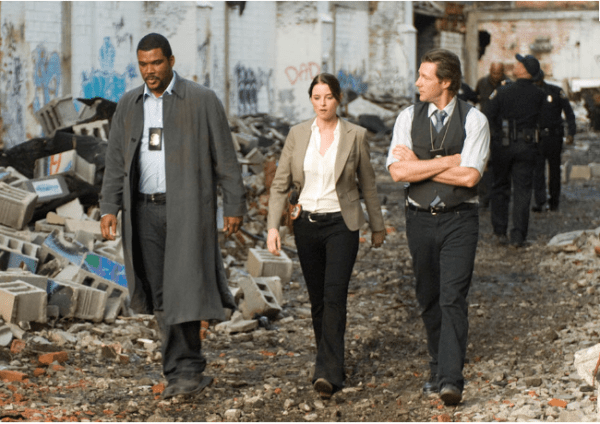
Alex Cross (Tyler Perry), Monica Ashe (Rachel Nichols), and Tommy Kane (Edward Burns)
Tyler Perry takes a chance in the middle of a career that he has established carefully as a writer, producer, director, and actor. Refreshing is this cinematic move. Refreshing, too, is Perry’s faith in his followers that they will support his decision to perform outside of the Madea box. Perry’s calculated risk affords him top billing, and a project advanced by a well-oiled advertising campaign; however, the movie rewarded him with a dismal box office disappointment. Not surprising because this newest venture directed by Rob Cohen (The Fast and The Furious; Dragon: The Bruce Lee Story) has too many individual parts that fail to coalesce into a unified filmic ensemble.
Alex Cross is the creation of author, James Patterson, whose entourage of murder mysteries and crime thrillers features an African American homicide detective who is a psychologist with the skill of deduction that mimics Sir Author Conan Doyle’s Sherlock Holmes. Film goers were introduced to Cross in Kiss the Girls (1997) and Along Came a Spider (2001) starring Morgan Freeman. In this installment set in Detroit, Michigan, Cross finds himself tackling a sadistic assassin and serial killer named Picasso (Matthew Fox), so-called because of the cubist drawings he leaves with his victims. Cross believes he can draw Picasso out by psycho-analyzing him; but his sole reliance on textbook psychology leads him to underestimate the extreme lengths Picasso will go to divert the detective from his deadly mission. Picasso snags Tommy Kane (Edward Burns), Cross’s longtime partner, in his lethal coil. Motivated by intense grief and loss, Kane and Cross launch a no-holds-barred man-hunt for Picasso.
Fox delivers Picasso with such an exaggerated passion that it pushes him into caricature; The Joker and The Riddler could be his big brothers. Burns works hard to establish his character’s loyalty to Cross and to make believable to the audience his commitment to his girlfriend Monica (Rachel Nichols).
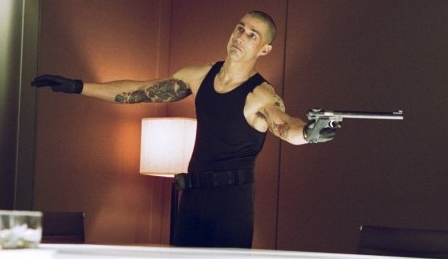
Picasso (Matthew Fox)
Unfortunately, no one really cares. The most awkward performance, however, is by John C. McGinley who plays the forgettable Captain Richard Brookwell. Who is he again? As for costumes, someone should have advised costume designer Abigail Murray against her design of Cross’s long coat; it looks like two sleeping bags sewn together; and, who made the decision on those dreadful shotguns?
Puzzling, too, is the undeveloped character and confusing storyline of the likeable Pop Pop Jones (Simenona Martinez), a young African American female teenager in jail for murdering two people whom Cross visits. As they sit down to play chess, she says to him, “you can’t save everybody Dr. Cross,” and he replies, “I’m not trying to save everybody, just you.” The film does not fully explain Pop Pop’s function in the story.
Alex Cross is a good enough story, but painful to watch are talented actors working with a script that compromises their efforts. Marc Moss and Kerry Williamson wrote the screenplay that gives generous back story to Cross. During an October 12 interview with Huffington Post Entertainment, Williamson remarks, “What I really wanted to do was an origin story, and introduce [Cross] to a new audience. I knew that it would invite comparisons to Morgan Freeman, and I kind of wanted to pull away from that.” Williamson does more than ‘pull away’; the screenwriter creates a vehicle that firewalls a smidgen of thought of Freeman thereby generating a push/pull viewing experience. Perry portrays very well the homicide detective Williamson draws in the screenplay: the “caring, principled [and] loving family man” whose strong belief in himself and his skill are bolstered by the love of a resilient extended family. Herein resides the strength of Alex Cross and a demonstration of Perry’s promising talent as an actor outside of Madea‘s workshop.

Nana Mama (Cicely Tyson)
Perry’s impressive display of grief when blindsided by tragedy clearly marks not only the gravity of the moment; also, his display sets up the question, “how will the detective present his anger to his family?” Respectfully, the movie pauses to give the audience a private moment with the Cross family and, in this moment, we are party to Cross’s parenting skills as well as to his deference for his mother, Nana Mama (Cicely Tyson). The close-up brings to light the gentle acknowledgment of his daughter Janelle’s (Yara Shahidi) sorrow; Janelle’s acceptance of his tender gestures to console her reveals a daughter’s trust in her father. Cross’s tenderness, though, is transmuted to firm resolve as Nana Mama cautions him against taking revenge. She says with a piercing seriousness that is all Tyson, “Don’t you try placating me! […] Look at cha, self-appointed judge, jury and executioner!” Cross replies with sincere respect wrapped in a blanket of restraint, “Mama, either you step aside or you go back up those stairs, but you’re in my way.” We even are treated to the rituals of the Black church.

Maria (Carmen Ejogo) and Alex (Tyler Perry) enjoy an intimate moment over dinner.
Cinematographer Ricardo Della Rosa contrasts these intense moments with lighthearted interaction between family members. Cross grabs Nana Mama and hugs her as she prepares a meal. Under a smile she feigns annoyance that Cross has interrupted her in the kitchen. Another scene highlights a comfortable banter between Cross and his wife Maria, commendably played by Carmen Ejogo. Cohen’s direction of these playful relationships easily showcases a likeable Black family in everyday situations and thereby builds audience investment in the Cross household.
The domestic levity in the Cross family, however, is insufficient to bind the movie into a unified whole. Even the crimes themselves—as heinous as they are–fall short of holding the pieces together. Hopefully, Tyler Perry will find another action thriller in which to star; he’s good. Perhaps he should write his own.
Watch for in-depth Film • Television • & More reviews & commentary.
In the meantime, Catch a film … Share the Popcorn … Feed Your Soul!


 The Dreher Report
A Note of Gratitude
Gabrielle Douglas demonstrates superior skill on the balance beam
There is no need to replay the insane preoccupation with the hair of 16-year-old Gabrielle “Gabby” Christina Victoria Douglas. There is no need to comment that this emphasis on her hair rather than on her self-mastery and consummate skill that spun gold is senseless. There is no need to point to the absurdity of the media circus surrounding her father, Timothy Douglas, and the financial hardships faced by her mother Natalie Hawkins, no matter the authors of this information. These news articles are having full play right now as this column is being written, and let’s just leave it at that.
Instead, let’s cast our attention on two families from disparate backgrounds who dared to believe in this one Olympic hopeful and who were present to see the fruits of their labors because they dared to exercise their faith: The Hawkins family: Natalie (mother) and Gabby’s siblings, Arielle, Joyelle, and Jonathan; and the Parton Family: Travis and Missy (parents) and children, Hailey, Leah, Lexi, and Elissa.
A Note of Gratitude
Dear Families Parton and Hawkins:
In Bible literature, the book of Hebrews 11:1 gives the reader a definition of Faith: Faith is the substance of things hoped for, the evidence of things not seen. When I read Gabrielle’s story, I imagined an informal interview whereby each of you would walk me through how you managed the enthusiasm a teenager had for not only her talent; but, also a robust confidence in her ability to carry it through to an Olympic scale. It is one thing for a child to have the will to reach heights; it’s another to have people who stand in the gap, uplift her, and steady her on shoulders so that she may reach a little higher.
I curry the hope that such an interview will occur. Until then, however, I want to extend to each of you this Note of Gratitude:
Ms. Hawkins, the word “sacrifice” is not enough to cloak the trepidation you felt when you handed over your 14-year-old African American daughter to a white family in the Midwest to train for the Olympics with Liang Chow. I cannot imagine the interior discomfort that settled in your heart when you realized that through all of your caretaking, in order for your daughter to make it to the next level she had to leave the home you made for her. I am sure that you tried to find some consolation in conversations with the Partons, holding on to every assurance that your daughter would be taken care of. I am sure that you tried to see through to the success that your daughter so enthusiastically wanted to achieve but had yet to happen. Away from home, things could go horribly wrong in a nimiety of ways. Sometimes, though, we are sent intercessors to help us along in our faith, and what you could not see, your daughter Arielle envisioned it for you. There are two other children in the home—Joyelle and Jonathan—for whom you are responsible, and mothers always have to be cognizant of a potential fall-out from the perception that one child is being favored over the other. After much soul-searching and encouragement from Arielle, you took the chance. When you reluctantly let Gabrielle go to the Parton home, nevertheless, you set in motion faith—that thing hope for–and from that day forward, Gabrielle’s works would not die. We are grateful.
Missy and Travis Parton, you opened your home to a 14-year-old African American girl while raising four daughters of your own to live with you for 2 years. You took a chance. You could not foresee how this newest addition to the Parton home would pan out. How would your daughters react to the new girl? Somehow and from somewhere, you pulled from within yourselves the faith in something you could not see. You facilitated for Gabrielle a most difficult transition. You continued her rigorous schedule of practices; kept up her spirits; and enabled her to sustain her discipline and focus that her mother had worked hard to cultivate. You rested in the hope of the formation of a congenial relationship between members of your home and that of Ms. Hawkins. Soon, you named Gabrielle “daughter.” We are grateful.
Families Parton and Hawkins, we offer up to you our heartiest gratitude.
Thank you for exercising your faith and hope.
Thank you for taking care of our girl.
(Note: This commentary was published in the August 16, 2012 edition of The Washington Informer at http://washingtoninformer.com/index.php/lifestyle/item/11639-a-note-of-gratitude).
Share this:
Posted by drdreher01 on October 5, 2012
https://thedreherreport.com/2012/10/05/a-note-of-gratitude/