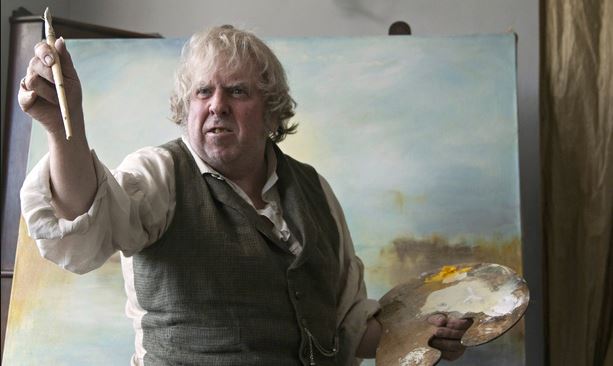
Mr Turner @ The Ross

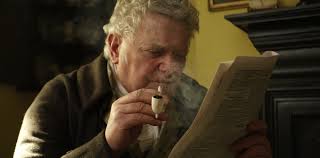
Mr. Turner (Timothy Spall)

Mr. Turner (Timothy Spall)

I highly recommend that you refrain from watching Mike Leigh’s biopic Mr. Turner if you have had a pleasant day; just close it out with a mug of hot chocolate and a snuggle into your grandmother’s afghan or Aunt Gertrude’s quilt. Contemplate the sunset or the close of the horizon as dusk makes its way to welcome the night. Or, if your fuddy-duddy tendencies have reared their ugly heads and a rainbow and a smiley face are the last things you need, then Leigh’s Mr. Turner is just the film for you—all one hundred and fifty minutes of it!

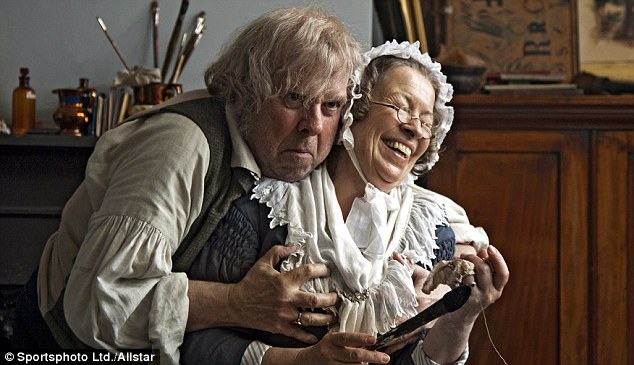
Mr. Turner and Mrs. Booth (Marion Bailey) enjoy a moment of levity.

Mr. Turner and Mrs. Booth (Marion Bailey) enjoy a moment of levity.

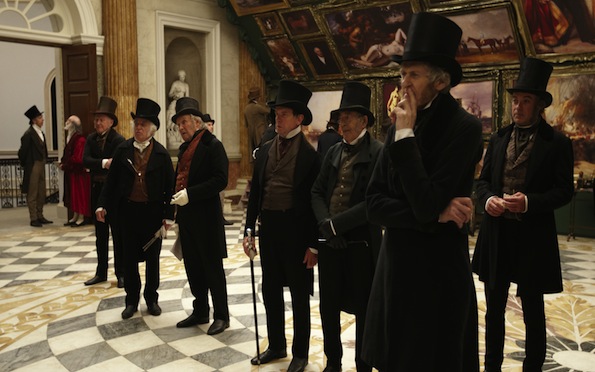
The movie stars Timothy Spall as Mr. Turner, the eccentric British painter—-you know, I’m going to stop right here: eccentric is NOT the description. Spall’s Mr. Turner is a mere aged warthog of a man who grunts and squints as he points a paint brush to a canvas and manages to create a bunch of beige brown sage grey and blue paintings of seascapes and ships at sea that critics deem as art. There. Set in the last twenty five years of his life when he is a celebrated artist in the 1800s, Mr. Turner’s community of artists is equally vacuous, consisting of men–excuse me–artists whose conversations would make a heathen pray for redemption!

Yes. Mike Leigh creates a world without warmth and fuzz, and Mr. Turner along with his cursed housekeeper Hannah Danby played by Dorothy Atkinson and his landlady/lover Mrs. Sophie Booth (played with appeal by Marion Bailey) all move within the dank and cold corridors with ease and comfort.

The Community of Artists

The Community of Artists

Mrs. Booth takes in Mr. Turner as a boarder in her upper room when he visits the seaside town of Margate to get away from London. Later she becomes his companion. Hannah, whom Mr. Turner calls ‘Damsel’, is enamored with her employer who sees her as he would a chair—without notice unless he needs to sit in it; and he sit he does when he desires to sexually exploit her. Both women carry with them a loyalty for Mr. Turner even until death.

fr left Sarah Danby (Ruthy Sheen), William Turner (Paul Jesson), Hannah "Damsal" Danby, (Dorothy Atkinson) , Georgiana (Amy Dawson), and Sarah Foster as Evelina

fr left Sarah Danby (Ruthy Sheen), William Turner (Paul Jesson), Hannah “Damsel” Danby, (Dorothy Atkinson) , Georgiana (Amy Dawson), and Sarah Foster as Evelina

All is not lost, however. Only his estranged mistress Sarah Danby, played exceptionally by Ruth Sheen, stands in for the audience’s own yearnings. She pleads for some demonstration of emotion and sentiment from the painter, especially since she has born him two daughters, Georgiana (Amy Dawson) and Evelina (Sarah Foster). The linguistic exchanges are a welcomed respite. Dick Pope’s cinematography is a feast for the eyes what with sweeping long shots of the sea and its ships; and, Paul Jesson’s performance as Mr. Turner’s father, William, is superb.

William Turner (Paul Jesson)

William Turner (Paul Jesson)

Mr Turner plays through March 5 at the Mary Riepma Ross Media Arts Center in Lincoln.

Watch for in-depth Film • Television • & More reviews & commentary.

In the meantime,
Catch a film
Share the Popcorn
Watch TV
Feed Your Soul!

Two Days, One Night @ The Ross

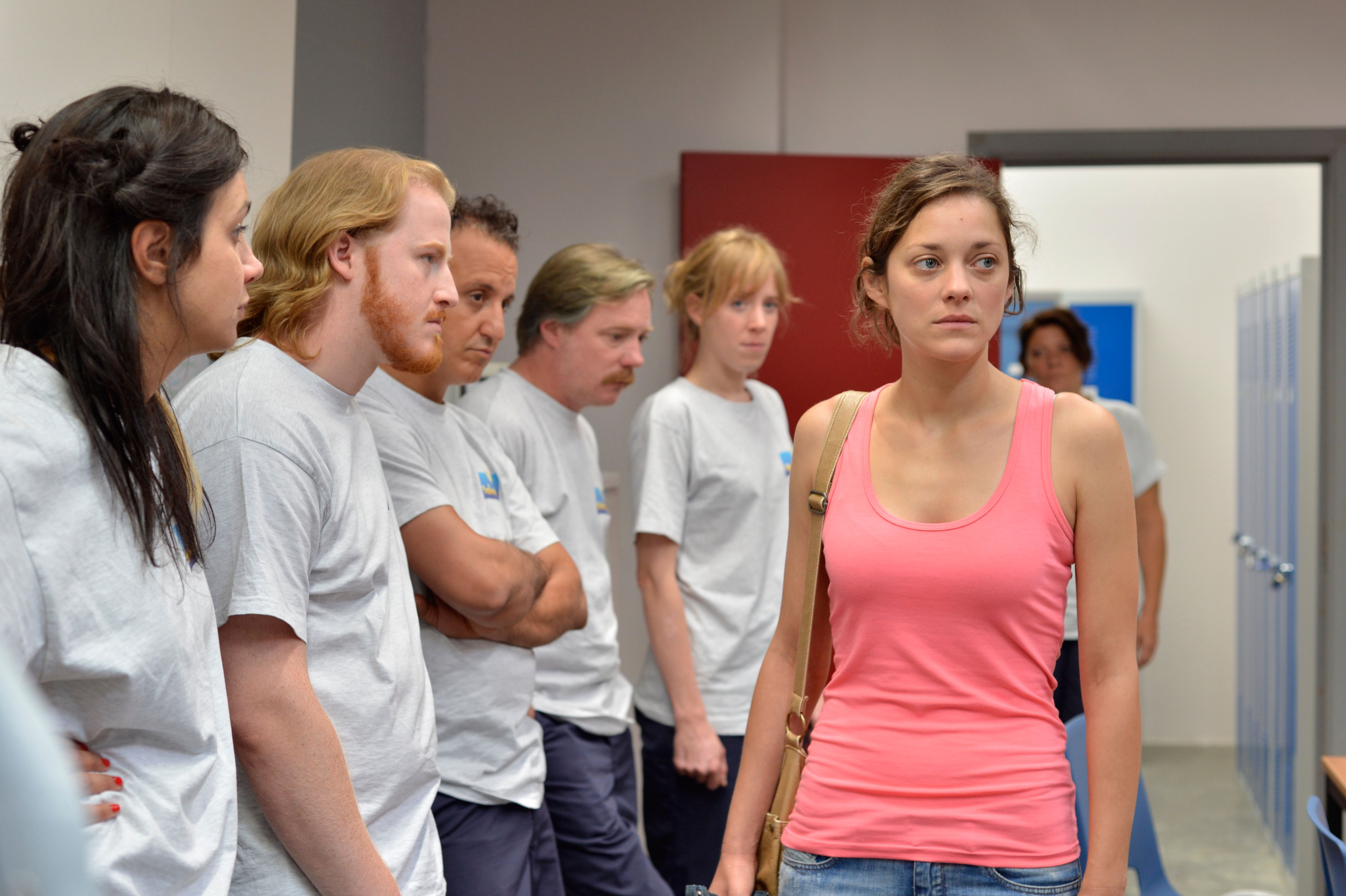
Sandra (Marion Cotillard) walks the line between co-workers

Sandra (Marion Cotillard) walks the line between co-workers

It takes courage to ask for what you want in life, especially when that desire is created out of a dire need to survive. To ask for anything is complicated because that act requires another party to grant to you your request; and, depending on the circumstances, the quest for any desire can put you at their mercy! The exchange can go either way: a cry of jubilance or a descent into humiliation. French brothers and filmmakers Jean-Pierre Dardenne and Luc Dardenne have concluded that to ask is a performance of humility in their French language film Two Days, One Night starring Marion Cotillard and Fabrizio Rongione.

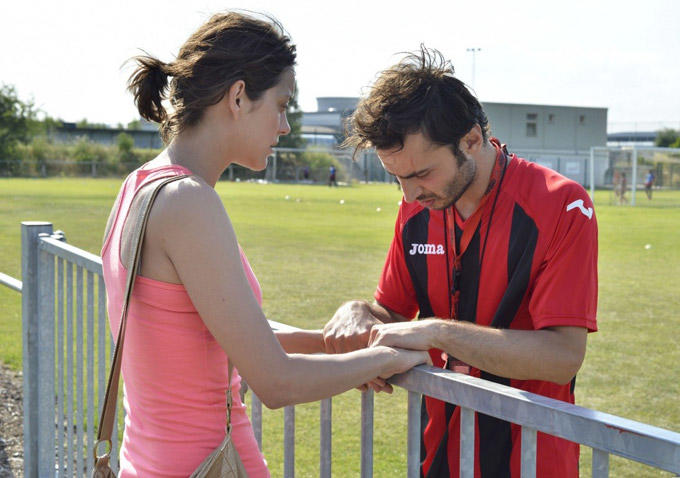
Manu (Fabrizio Rangione) encourages Sandra (Cotilliard) to make a call.

Manu (Fabrizio Rangione) encourages Sandra (Cotilliard) to make a call.

As the story goes, Sandra, a Belgian blue collar worker played Cotillard, has been fired essentially by her co-workers in favor of a company bonus of 1,000 Euros. The manager has found that his team of employees can get the work done without Sandra. He offers them a choice: take a company bonus and fire Sandra or vote for Sandra and forego the bonus. Sandra is told of the vote on Friday. Her friend Juliette, played by Catherine Salee, persuades the boss, Dumont, played by Batiste Sornin to schedule another vote that Monday. He agrees, and Sandra’s husband Manu, played with charming patience by Rongione, convinces Sandra to visit each co-worker over the weekend or two days and one night, and ask them to recast their vote in favor of her keeping the job.

A co-worker expresses remorse for voting against Sandra

A co-worker expresses remorse for voting against Sandra

What follows is a disquieting journey as audiences are forced to experience Sandra’s every plea wrapped in humility and emotion. Cotillard is brilliant as Sandra, as she displays every minute detail of her character’s emotion. She cannot appear desperate; nor can she beg but she must demonstrate to each co-worker that her job is just as important to her as those 1,000 euros are to them. Yet, the filmmakers carefully coax us into an understanding of her co-workers’s reasons for their vote against her. Those euros come just in time to take care of those family necessities that otherwise would go to seed.

Sandra and the one night visit in search of one vote

Sandra and the one night visit in search of one vote

Each visit … each knock on the door … each ring of the door-bell brings her front and center to the culprits; their exchanges are delicate especially since Sandra’s request lays out her personal financial situation: her husband’s salary is not enough to take care of the family. Sandra’s firm resolve to take this most excruciating journey to stand face-to-face with the culprits, however, is a portrayal of a particular kind of heroine, and you will love her. There is no jubilant cry nor a descent into humiliation; rather, there is a sigh of relief from a woman who, at the end of her journey, brings home to her family a personal self whose sleep will come easy.

Two Days, One Night plays through February 26 at the Ross Media Arts Center in Lincoln.

The Ross logo

Watch for in-depth Film • Television • & More reviews & commentary.

In the meantime,
Catch a film …
Share the Popcorn …
Feed Your Soul!

Foxcatcher @ The Ross

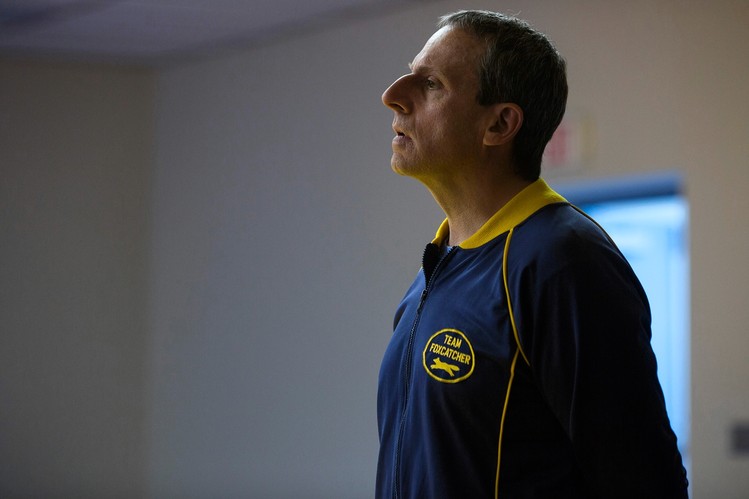
John du Pont (Steve Carell)

John du Pont (Steve Carell)

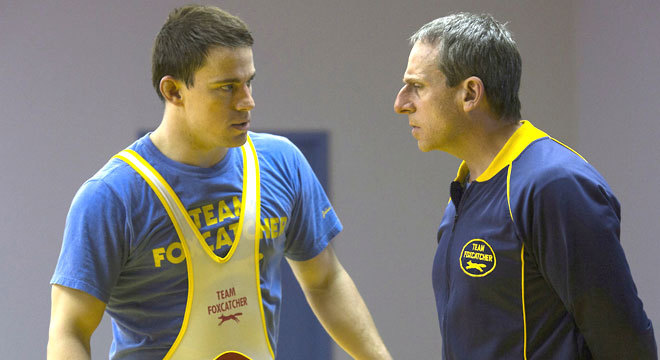
Bennett Miller’s newest film Foxcatcher is a sturm and drang of a production. Set in a time of limbo for Olympic hopefuls who are training for the 1988 Seoul Olympics, Foxcatcher tells the story of Mark and David Schultz, two brother wrestlers who won Gold Medals competing in the 1984 Olympics in Los Angeles. Mark, played by Channing Tatum, lives in a ramshackle of an apartment. The only family he has is his brother David, played by Mark Ruffalo. The film opens with Mark giving a speech to a very uninterested elementary school audience on the American Dream and the discipline and focus necessary to attain it—all for a hefty $20.00. Mark’s hope for another try at that Gold Medal, however, pushes away the effects of his depressing environs. He is alone. He lives alone. His brother David, by contrast, is happily married to Nancy, played by Sienna Miller, and they have two rambunctious fun-loving children. The death of their parents and the sport of wrestling bonded the two brothers. David raised Mark and trained him to wrestle. When the sinister millionaire (and he is sinister) John du Pont (Steve Carell) enters the picture, Miller’s film direction painstakingly constructs a deadly triangle that blindsides all parties involved.

The Brothers Mark Schultz (Channing Tatum) and David Schultz (Mark Ruffalo)

The Brothers Mark Schultz (Channing Tatum) and David Schultz (Mark Ruffalo)

The sturm and drang of Foxcatcher comes from the vision of the after glory of an athletic god who finds no solace in anything other than the Olympic coliseum. That Mark is reduced to accepting speaking engagements at $20 a pop is heartbreaking, and Miller mercilessly opens with this visual. His contrasts in du Pont, Mark, and David men are finely-tuned that when they constellate, you feel the ominous cloud hovering above them.

Once you wade through the grunts and grumbles of men in leotards wrestling on the mat, a story of the shortcomings of wealth emerges. We know the saying: money cannot buy you love. Well, screenwriters E. Max Frye and Dan Futterman have crafted a narrative that places front and center John du Pont’s yearning for the brotherly love he witnesses between Mark and David. For all of his wealth and power; for all of the 1,000 acre du Pont estate in New Town Square Pennsylvania; and, for all of the fatherly demonstrations of love he accords to the ever needy wrestler Mark, John du Pont, heir to the du Pont family fortune, cannot break the unfaltering faith, loyalty, and love between Mark and David. Nor, can he have it. This is Foxcatcher’s arc, and Steve Carell’s portrayal of du Pont’s craving cuts like a knife.

Mark and du Point

Mark and du Point

Jeanne McCarthy’s casting of the wrestlers in Foxcatcher is sharp. Each actor simulates how the sport of wrestling has sculpted their bodies. Together, the wrestlers look like a bunch of eager lemurs as they listen to du Pont’s vapid speeches on wrestling. When they stand, hands droop as those of Dr. Frankenstein’s monster and they bend as if ready to take on an opponent. Such is the effect the sport of wrestling has on the wrestler’s body. You will appreciate the lumbering gait Ruffalo, Tatum, and Carell have mastered.

Foxcatcher plays through January 29 at the Mary Riepma Ross Media Arts Center in Lincoln.

The Ross logo

Watch for in-depth Film • Television • & More reviews & commentary.

In the meantime,
Catch a film!
Share the Popcorn.
Watch TV!
Feed Your Soul!

Get On Your Knees ~ Nicki Minaj ft. Ariana Grande

Nicki Minaj and Ariana Grande

Nicki Minaj and Ariana Grande

Get On Your Knees has thrown under the bus the art of courtship in favor of primal and animalistic sex performance. As I listened to this track, gushy Zales and Kay’s Jewelers commercials came to mind featuring all of those couples who are so in love that only a diamond ring and/or a heart-shaped pendant can express what they really are feeling about romantic love (what’s that?). Yes, over the years as I have listened to some of the music playing on the airwaves, I have tried hard not to admit this but now I must: Courtship–the “middle wo/man” to getting “it”–and all of its accoutrements (roses, poems, jewelry) has been told s/he no longer is needed. Interested partners just should beg for “it!” … sigh … Romance is dead, and Cupid has been thrown to the wolves!

Watch for in-depth Film • Television • & More reviews & commentary from The Dreher Report.

A Girl Walks Home Alone At Night @ The Ross

The Girl (Sheila Vand)

The Girl (Sheila Vand)

A Girl Walks Alone at Night is the first Iranian Vampire Western ever made. Directed by Iranian filmmaker Ana Lilly Amirpour, this film explores the power of isolation in a small town, and the kinds of elements isolation will breed. Set in a fictional Iranian oil town called Bad City, The Girl, played by Sheila Vand, walks alone at night dressed in the traditional black chador seeking out the bad seeds of the city to devour, namely men who are not kind to women. For cinephiles, the aesthetics of A Girl Walks Home Alone at Night will remind you of Breathless, directed by French New Wave filmmaker Jean Luc Godard in 1960 as well as Francois Truffaut’s 1959 film 400 Blows—oh, and let me mention Touch of Evil, a classic by Orsen Welles produced in 1958.

A Girl Walks Home Alone at Night is shot in black and white, and Lyle Vincent’s cinematography cloaks the city in a static darkness to produce the feel of a sluggish town with nowhere to go and nothing to offer its youth. The sound is spare, so we are forced to feel the action rather than to take the usual cues a film’s soundtrack gives to its audience. This film will hold your interest. Why? Because girls are not supposed to walk alone at night; there are dangers lurking in every corner to prey on them. Armirpour, however, has turned the tables: Here is a girl vampire who fears nothing and no one but everyone around her is in danger.

A Girl Walks Home Alone At Night plays through January 15 at the Ross Media Arts Center in Lincoln.

The Ross logo

Watch for in-depth Film • Television • & More reviews & commentary.
In the meantime,
Catch a film …
Share the Popcorn …
Feed Your Soul!

The Homesman @ The Ross

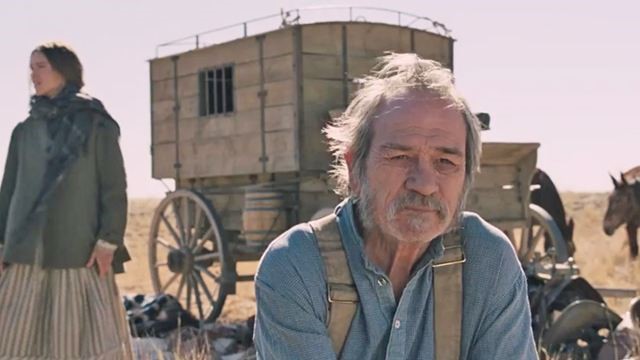
Mary Bee Cuddy (Hilary Swank) and George Briggs, The Homesman (Tommy Lee Jones)

Mary Bee Cuddy (Hilary Swank) and George Briggs, The Homesman (Tommy Lee Jones)

We all have heard of people who lived on the prairie during the nineteenth century committing suicide because the land and its lethal isolation had etched itself onto their psyches. Settlers pitched their tents in an environment where there was nothing between them but land and sky–somewhere out there. Men, women, and children built with their bare hands four walls out of sod, hoisted grass or hay for a roof, and called it a homestead … somewhere out there.

These elements on the plains … we all know them: the obnoxious prairie winds and the bitter winters in a nineteenth century world — all could drive a man to drink or catapult a woman onto crazy’s doorstep. And onto crazy’s doorstep is just where three women living on the plains land: Arabella Sours played by Grace Gummer; Theoline Belknap played by Miranda Otto, and Gro Svendsen played by Sonja Richter–three women who found themselves in another state of mind in the middle of nowhere in The Homesman, Tommy Lee Jones’s 2d directorial project. A western, New Mexico fills in for the great plains of Nebraska and Iowa of the 1850s. Hilary Swank co-stars as Mary Bee Cuddy, a self-determined unmarried woman of 31 who single-handedly has worked her acres of land to a profit. Jones stars as George Briggs, a curmudgeon of a drifter whom Mary Bee saves from the hangman’s noose. Briggs, the Homesman, and Mary Bee agree to transport Arabella, Gro, and Theoline across the great plains from Nebraska to be taken in by Altha Carter, the minister’s wife in Iowa, played by Meryl Streep. The plains no longer could tolerate them.

Mary Bee Cuddy (Hilary Swank)

Mary Bee Cuddy (Hilary Swank)

Cinematographer Rodrigo Prieto photographs the stark beauty of the prairie landscape but he admirably portrays its dangers as well. There is nowhere to hide from any threat of attack but George Briggs assures the audience of his resourcefulness in varying scenes. He makes us trust him. Swank’s portrayal of Mary Bee brings a prairie woman with good intentions but her piety can find no home on the flat desolate prairie horizon.

The Homesman dances with the many faces of insanity, and this detail is what will endear the film to you.

The Ross logo

The Homesman plays through January 22 at the Ross Media Arts Center in Lincoln.

Watch for in-depth Film • Television • & More reviews & commentary.

In the meantime,

Catch a film …
Share the Popcorn …
Feed Your Soul!

‘Into the Woods’ ~ The Skinny

Jack (Daniel Huttlestone) and Milky White

Jack (Daniel Huttlestone) and Milky White

The singing? Crystal clear! The acting? Committed! The cinematography? Fantastic! From the Broadway stage to the silver screen, screenwriter James Lapine and director Rob Marshall have produced admirably Stephen Sondheim’s heartfelt musical, and we carry with us a host of platitudes when we leave the theater. The music seamlessly is interwoven within the dialogue, and you will not declare through gritted teeth, “just one more !@#$%&* song, and I am out of here!”

Into the Woods is an adventure into the business of wish-making and the tedious processes it takes to make wishes come true. The story also delves into the tensions between children and parents; the search for the charms that will grant motherhood; spells mothers cast on their daughters; and, the hell you pay for touching and taking things that do not belong to you.

Baker's Wife (Emily Blount) and Baker (James Corden)

Baker’s Wife (Emily Blount) and Baker (James Corden)

Tiffany Little Canfield & Co. have assembled a laudable cast for the production, and the actors portray each character with honesty, compassion, and courage. Johnny Depp plays the prurient Wolf that brings to mind a pedophile most nefarious; his rendition of “Hello Little Girl” would cause a rattlesnake to recoil! By contrast, James Corden’s Baker is precious, and the actor interprets the Baker well as a protective husband but reluctant father. Emily Blount as the Baker’s wife, Lilla Crawford as Little Red Riding Hood, and Chris Pine as Prince Charming, among others, ably transport us into the world that critiques the usual suspects who inhabit the land of make believe. A small but significant note: Canfield & Co. sprinkles the palace crowds with people of color.

The darling of the film is, however, Daniel Huttlestone as Jack, and his performance is the reason his photo opens this review. His confidence is catching, yet, he refrains from playing a precocious know-it-all adolescent. Instead, Huttlestone’s Jack trusts in his own world and, with a bit of dash, explores its wonders (and steals from it too) because “you’re free, to do whatever pleases you … exploring things you’d never dare ’cause you don’t care …”

The Wolf (Johnny Depp)

The Wolf (Johnny Depp)

Overplayed and overdone is–here it comes–Meryl Streep as The Witch (did I just hear a shriek?) Simply put, she is miscast! What is all of that whirling dervish mess she acts out in the middle of the wood? Her delivery of “Last Midnight” is hollow–no … maddening, as are her obnoxious over-the-top appearances! For me, she fails to reach the depths of the Witch’s emotions.

While I am at it, I have an issue with Lapine, Marshall, and Mr. Sondheim: The Witch, the eldest of the group, finally gets her wish only to be dismissed? Into the Woods suggests, then, that happy endings are reserved only for young adults and not for the communal elders. Yet, as I call to mind fairy tale endings, their suggestion is par for the course.

Little Red Riding Hood (Lilla Crawford)

Little Red Riding Hood (Lilla Crawford)

Before closing, here are some more things to ponder: Little Red Riding Hood sings Wolf made her “feel excited and scared”; and, exactly what were those secrets she learned of “down a dark slimy path” that Wolf slid her through? As for Jack, he sings the Woman Giant “draws [him] close to her Giant breast, and [he knows] things now that [he] never knew before”, and this friendship causes Man Giant to “come[] along the hall to swallow [him] for lunch … when the fun is done”?

I’m just thinking on these very lyrical moments that rang out with passion into the woods!

And that’s the Skinny!

Watch for in-depth Film • Television • & More reviews & commentary right here on The Dreher Report.

In the meantime, Catch a film … Share the Popcorn … Feed Your Soul!

Narcel Reedus ~ An Interview

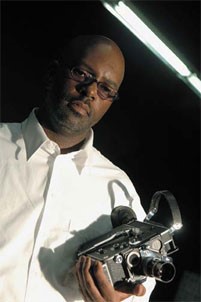
Reedus

“Everybody has their thing. And everything and everybody has a story. Digging deep to find and tell that story is my thing.”

~ Narcel Reedus

… and film is the medium writer-director Narcel Reedus reaches for to tell his stories. In his feature film project One Day in June, Reedus directs his attention to Father’s Day, that one day in June when fathers are recognized as special. Be they biological, step-dad, or guardian, that third Sunday in June is designated as the time when those for whom he has cared are to offer gifts of appreciation. Just check the Hallmark card aisle. Praises range from the serious to the comical—all singing glory to that one man whom we deemed did his job right for yet another year.

Reedus is developing this project and plans to bring to the screen the conundrum of the fatherless child juggling the emotional and psychological remains of anger, shame, and guilt over the father who chose, for whatever reason, to let go of his family. As its bookend is the trek taken by one man named Russ, a musician, who finds the courage to search for the children he left behind.

Poster

Yes, Reedus reaches deep to bring to our minds those strands of life that more often than not are taken for granted or simply overlooked. His digging for the depth, however, is informed by his observations of the socio-cultural dynamics within the African American community. I spoke with the filmmaker, who talked about his love for film and how this medium is a powerful tool for storytelling. Along the way, we discussed the poignant matters of manhood and fatherhood, and their cultural import in today’s society.

TDR: Why did you choose film as your tool for storytelling?

REEDUS: My first introduction to film–certainly in my past as a child–planted the seed and facilitated my development as a storyteller later in life. I remember seeing The Learning Tree in Chicago when I was 5 or 6 years old. For sure, that experience shaped me. I watched a lot of the older black & white films that came on WGN … they held my attention.

TDR: In what ways did film inspire you to tell stories?

REEDUS: My mother and I watched films together, and what I realize now but did not then is that my mother and I were building unconsciously a foundation for the art of storytelling.

TDR: You mentioned your mother and watching films with her. I remember how my mother and I bonded over watching soap operas, affectionately known as “my stories”. Talk more about your mother and how she influenced you.

REEDUS: All in retrospect—I was the youngest of 6, a mother’s boy. My mom and father were older when they had me so I did not get the discipline my brothers and sisters got. I do remember really enjoying that experience of having my little snack and watching a movie on channel 9 on this little black and white TV with my mom. That experience certainly instilled in me an underlying beat–a foundation for filmmaking, storytelling … those sorts of things.

I anticipate communities getting together to talk about growing up without a father. I want One Day in June to be that tool or healing mechanism that enables children, mothers, and families to understand why is it difficult for fathers to step up and to be present.

TDR: The story of focus here is your feature, One Day in June that has to do with Father’s day. How was that concept developed?

REEDUS: Angela Washington and a former student of mine Ms. Pruitt were thinking of a title from a script Ms. Pruitt wrote. It needed more work, and I pushed her towards a bigger concept. We were bouncing around ideas for a movie. I thought June is the month for father’s day—that one day where we recognize fathers. Father’s Day doesn’t get the merit that mom’s day gets; but that collaboration laid the foundation for me to consider the importance in the title as it connects to Father’s Day and to the overall idea of what is a father in our society.

TDR: Your target audiences are African American males and female adults 18-35. Why not children who right now are experiencing the “remains” after a father leaves?

REEDUS: I think that in terms of me developing this story, I came up with people, with characters that I wanted to make it rich and dynamic. If this man is going to find his children, I had to place him in a time where he could do that. So how old is he? When did he start? We made him mid-50s and a horn player who performed with the popular Funk bands of the 1970s. That means that he was a teenager who traveled with band members who would trade off horn players from one concert tour to another.

TDR: I remember the funk bands, and how some of my classmates had formed their own groups…

REEDUS: In my neighborhood and around town posters for Con Funk Shun coming to town would go up; none of them printed the year, just the day and date. They reused those posters from city to city because they were on the road and he traveled a lot. They met women and had kids and thus became biological fathers.
Con Funk Shun

Con Funk Shun

TDR: … and this is where your character Russ, who is a musician, enters. What are the other threads running through this feature film about children and fatherhood?

REEDUS: Sometimes we have men who choose to not to be in their child’s life and, of course, we have men who, because of circumstances beyond their control, cannot be in the home. In the film, we had to have iconic characters to communicate these situations. For example, there is this unspoken mythology that strippers grew up without a father. Mercedes, an exotic dancer, has a father, Jamal, who is in prison. So, I asked the question through this familial set-up “What does it look like to be an exotic dancer and to have a father in prison?” Little Man is Mercedes’s son growing up without his father. By virtue of not having a father he is asked to step up and to become the man of the house … to take on this responsibility.

TDR: How do women / mothers figure into your project?

REEDUS: More recently we had a Transmedia Storytelling fundraising event. Our target audience with this film is really going to be single parent mothers—those black women who grew up without their fathers. They are the force that is going to be most interested in this. Some men certainly will gravitate towards it; others are going to be turned off by it.

TDR: To what do you attribute the resistance?

REEDUS: There is some hurt and defensiveness from men, and there is this question, “why don’t you talk about those men who ARE present in the home?” that they will ask. ….

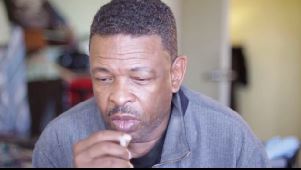
Russ Campbell, the father (Chip Hammond)

Russ Campbell, the father (Chip Hammond)

TDR: In what ways to you see One Day In June instigating dialogue about Black fatherhood?

REEDUS: It’s going to be a movement. I anticipate communities getting together to talk about growing up without a father. I want One Day in June to be that tool or healing mechanism that enables children, mothers, and families to understand why is it difficult for fathers to step up and to be present. Once we show this on the screen where we see a man decide “I’m going to seek ways to find my children” it will create a national dialogue.

Something definitely happened to the Black male that trended from the New Negro out of black empowerment into this divide of corporate America. These trends, I believe, left some black men without a badge of honor and without a sense of being.

TDR: Why do you feel it is so difficult to ‘step up’ into that role as father?

REEDUS: I really believe that promiscuity is the new masculinity. Some men are having as many kids that their seed can produce. One Day in June can be a message to them: It is not too late to step up! I strongly feel that we need to move beyond finger pointing and the deadbeat dad syndrome. This film will answer the question, “ok how do I step up? How do I face what I have done?”

Mercedez (Ida Weldesus), granddaughter

Mercedez (Ida Weldesus), granddaughter

TDR: The “promiscuity is the new masculinity.” When do you think this happened?

REEDUS: I think the shift happened when the tangible effects of the Civil Rights movement netted visible changes in the black community in terms of housing and education. There was this attitude of taking every material advantage that economics could bring. There certainly was a swift and sharp divide. Reagonomics played the part … economics … Rap culture and its music.

TDR: In what ways to do you believe Rap culture and its music contributed to these attitudes?

Reedus: Something definitely happened to the Black male that trended from the New Negro out of black empowerment into this divide of corporate America. These trends, I believe, left some black men without a badge of honor and without a sense of being. So, they were left with a sub-culture that became glorified in Rap music. During this time “I am Bad. I have a lot of women. I have a lot of money and respect and gold chains, and I overcompensate for the lack of education, a job, or a career!” became the mantras of the day. The culture emphasized this “me” maleness, and embraced the athletic body: look how bad I am; how violent I can be; I’m a player… I’m a pimp! Blaxploitation … all of these elements moved into the 1980s and nested in Rap culture. They even are present in this present day.

Lisa (Erin Monet), youngest daughter

Lisa (Erin Monet), youngest daughter

TDR: How do women figure into this trend?

Reedus: The glorification of the idea of multiple women and masculine virility all combined together attributed to this epidemic of fatherless children … multiple children with multiple women … “These are my claims to fame, and this is the movement that I have made in my community! I don’t need the upper middle class badges of education and corporate agility to get the house, land, cars, and access to people places and things.”

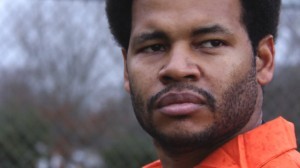
Jamal (Dennis Scottbey), oldest son

Jamal (Dennis Scottbey), oldest son

TDR: One day in June obviously deals with angst, regret, and memory; how our actions through memory will hold us accountable, so we have to move to satisfy their desire to be reconciled. All of these happen that ‘one day’ in June. Talk about that moment when Russ is in a room, sitting on a bed alone with a TV dinner tray.

Reedus: “In the quietness of everything there is time to reflect on addressing my fatherless child” is the spirit of that scene. When we first opened up the movie, Russ is in his apartment with a little Hispanic boy with smudges on his face; he lives next door. There was a fire, and Russ rescued that little boy and stayed with him for the night. Later Child Protective Services picked up the boy; but that fire burned something in Russ, and sets in motion this desire to search for his own children: Chris, Lisa, Jamal, and Keisha.

TDR: So, the fire serves as a metaphor …

Reedus: Russ felt he had to stop ignoring his shame and go into the fire– the burning building of memory. The house that is burning is his shame—a shame he could not face before then. After that fire, Russ realizes he will not die; it will not kill him. He also realizes that this particular journey will be very difficult but in spite of the difficulty he has to walk that road. He has to. There is no turning back from it. There are very few times in our lives do we have those moments. We can count them on one hand.

Keisha (Vedra Grant), oldest daughter

Keisha (Vedra Grant), oldest daughter

NPR: What do you feel is the value of taking those journeys?

Reedus: There was an honor in saying “this is what I am going to do: be it going to school, get my freedom, marry, fatherhood.” It was divine because we truly believe that we had the perseverance to ride through the storm. There is something about the decision and the process that makes us who we are. Generally, we make deliberate choices about marriage or education or living arrangements. We used to be very thoughtful in making decisions about our children. We did not go back on them, either. … something to the effect of: I have decided that I am going to marry you. I am not going to change my mind. We are going to have children, and we are going to be together NO MATTER WHAT!

I am postulating now how often do we make those decisions that we do not go back on? We are living in society where we can go from Keisha, Valerie, Shenia, and back home to momma—even grandmomma–then move back in with Keisha. It is so transient! There are folks who are afraid of commitment; and, even more tragic there are men who feel living in the ‘big house’ ain’t a bad deal. I have to believe, however, that there are others out there who are going to die trying to live up to the core of who they are.

TDR: If Russ had been famous or had a solid paying gig in the city surrounded by friends, do you think Russ would have had this prompt from memory to move?

Reedus: If he were in New York in a part of the musician’s union and had a gig, I think there still would have been a fire next door; whatever he was doing there would have been a fire …

Chris (Charles Easley), youngest son

Chris (Charles Easley), youngest son

TDR: I am concerned about the character depiction of Chris – the Gay character. Why burden him with any kind of sickness? Why not a healthy gay male?

Reedus: Chris is someone who is trying to come to terms with who he is and how he is trying to live his life. He is speculative, and living off of his sexuality, his good looks, and his gayness. He is processing a bad break-up. The first place that Russ goes to is to Chris. Father and son take do take some time together which results in Chris going to rehab as he tries to get his life together.

TDR: Why not have Russ contact the mothers to get to the children?

Reedus: We did not want Russ to have to try to get through the kids through the mothers because contact would have undone completely what he is trying to do. The children are grown. The mother does not play a part in there. We do have some backstory that we are going to do on Russ … how did he get to be a horn player, his education …

TDR: Does this story of fatherhood come out of some of your experiences as a son?

Reedus: I come to One Day in June purely as an artist able to write for someone who is not me. I don’t have any children so I am not a father, nor did I not grow up without my father. I had a very solid relationship with him, so I don’t fall into those notions of what would motivate me to tell this story. If I call myself a storyteller I can tell anything. My motivation for this is not necessarily personal in terms of my life but it is personal in terms of me being a griot and understanding that this is just one of the stories in my community that needs to be told.

Film Screenings of One Day in June to be announced soon!

Watch for more in-depth Film • Television • & More Reviews & Commentary!

In the meantime …
Catch a film …
Share the Popcorn …
Feed Your Soul!
Citizenfour @ The Ross

Edward Snowden, Citizenfour

Edward Snowden, Citizenfour

My dad cautioned me to always watch what I say; my mom warned me, “anything you don’t want told, don’t tell it, and never ever put anything in writing! That piece of paper could be used against you.” Dad never owned a cell phone; mom had one but never used it – not once. The landline–a green Trimline model with a rotary dial–still hangs in the kitchen. You’ll get a busy signal if you call when anyone is on the phone; there is no call waiting. Dad used to say, “If I’m on the phone, I can’t talk to anybody else!” There is no voice message system. Mom would say, “If you call and I don’t answer I’m not at home! Call back!” Neither parent worked on a computer.

After screening Citizenfour, the newest documentary by Laura Poitras, it took every fiber of my being to keep me from tossing out both my computer and smartphone and begin a retreat to the bygone technological era my parents enjoyed! The film charts the discovery of post-911 surveillance by the NSA and other entities of intelligence. ‘Citizenfour’ sends covert e-mails to Poitras and, later, Poitras along with Glenn Greenwald, an attorney and columnist from The Guardian, fly to Hong Kong to meet with Citizenfour at the Mira Hotel who turns out to be Edward Snowden, the whistleblower.

With camera in hand, Poitras unfolds the story in the intimacy of his hotel room, as Snowden, from his hotel bed dressed in a white t-shirt and jeans, narrates how he came to his discoveries. We’re in that hotel room for a long time, and the camera creates a claustrophobic feeling to such an extent, that after it was over, I couldn’t wait to get outside and breathe in the fresh cold Nebraska air! Snowden’s revelation of the web of networks that are involved to accommodate the cross-currents of information is mindboggling. The general premise is this: We are being watched. Period. Privacy is fast beginning non-existent as our conversations, text, voice, and e-mail messages are being monitored. If we know that our every movement is being monitored, then we would be hard-pressed to say what we really feel! We’ll have to start communicating in codes. Snowden believes, “We are building the biggest weapon for oppression in the history of mankind.”

So take heed! Watch what you say! Anything you don’t want told, don’t tell it!

CitizenFour plays through December 18 at the Ross Media Arts Center in Lincoln.

The Ross logo

Watch for in-depth Film • Television • & More reviews & commentary.

In the meantime, Catch a film … Share the Popcorn … Feed Your Soul!
Whiplash @ The Ross

Andrew (Miles Teller) in practice

Andrew (Miles Teller) in practice

Some of you reading this review right now have a regret over not learning that instrument–be it the trumpet, flute, guitar, or the piano. I regret not learning the piano, and I blame myself for not having applied myself through practice nor, I resolve, having the talent nor skill to learn it. If we were to dig deep into our memories, I’ll bet most of us would find our abandonment of our music lessons settled on one teacher who whacked our knuckles with a ruler or called us stupid for missing a note on a scale. These approaches to learning crushed our spirits; after all, we practiced and practiced until our fingers cramped from the discipline.

Jim Neimann (Paul Reiser) comforts son Andrew

Jim Neimann (Paul Reiser) comforts son Andrew

If you resonate with this anecdote, then Whiplash, directed by Damien Chazelle, is a film you will appreciate. Whiplash stars Miles Teller, who plays Andrew Neimann, a talented drummer who aspires to become a great artist like legendary jazz drummer Buddy Rich. He is accepted into Schaffer, a most prestigious east coast conservatory of music. There, Neimann gives himself over to his drums and to every minute required to develop his skill as a drummer. He wants to become a member of the school’s esteemed Jazz band and, with discipline and dedication, he believes he can make it. He does, and falls under the tutelage of the sadistic conductor, Terence Fletcher, played with estimable skill by J. K. Simmons. Once Neimann is selected as a core drummer for the band, Fletcher inflicts cruel and unusual punishment on his nineteen-year-old progeny. It’s not that Fletcher hates Neimann. No. It’s that Fletcher wants Neimann to be all that he can be; to realize the artistic genius that is lying dormant inside of him; and, to pull from his feet through the pelvic through the rib cage and branch off into the hands that hold the sticks that beat the drums in Fletcher’s jazz band. But … Neimann must endure Fletcher’s verbal and physical abuse to get into those places.

Fletcher (JK Simmons) the 'Angel' of Jazz

Fletcher (JK Simmons) the ‘Angel’ of Jazz

Miles Teller is genius as Andrew Neimann. He takes the audience into the vein of a psycho yearning to not only belong, but to master both his instrument and his emotions in the presence of a vicious taskmaster. The anticipation of that final jazz concert, however, keeps the adrenalin flowing, and we push with Neimann through his personal challenges to make it to the stage. Paul Reiser plays Neimann’s devoted father, Jim, who keeps the confidence for his son as he faces humiliation. Damien Chazelle’s Whiplash is a riveting film that will leave you emotionally spent but feeling victorious!

We may have put away our instruments, but Andrew Neimann’s victory will direct us to the dark recesses of our closet and pull out the flute or trumpet or clarinet; or, to raise the piano’s cover and play those keys!

Whiplash plays through December 4 at the Mary Riepma Ross Media Arts Center in Lincoln.

The Ross logo

Watch for in-depth Film • Television • & More reviews & commentary.

In the meantime,
Catch a film …
Share the Popcorn …
Feed Your Soul!